
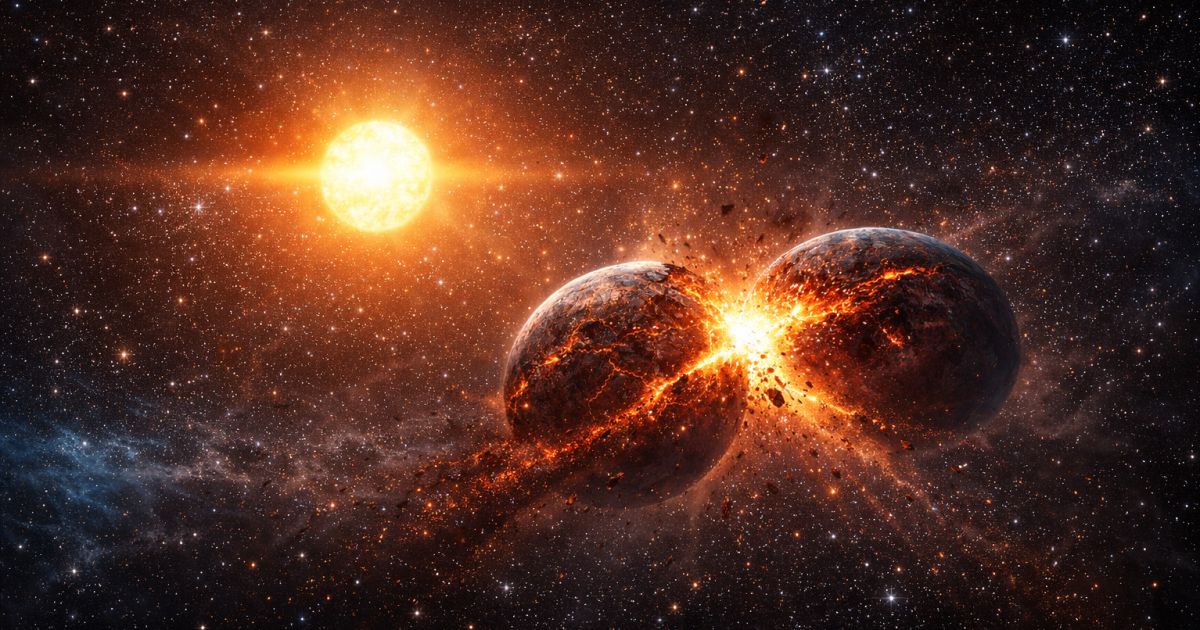
SEATTLE/USA. Astronomers at the University of Washington have detected evidence suggesting a potential planetary collision approximately 11,000 light-years away. The observation centers on the star Gaia20ehk and was published on Wednesday, March 11, 2026. Researchers believe the event may offer parallels to the early formation of Earth and its moon.
The team, while reviewing archival telescope data, identified a star exhibiting unusual behavior. Typically, stars like our sun maintain a relatively consistent brightness over extended periods. However, Gaia20ehk began showing brief dips in brightness as early as 2016, with the signal becoming significantly more erratic around 2021, according to a report on the University of Washington’s website.
The team, led by Anastasios Tzanidakis, determined the cause likely wasn’t within the star itself. Instead, large amounts of dust and rock may have passed in front of the star, partially obscuring its light. This pattern is considered a potential indicator of a violent collision within the distant system.
Dust and Heat Provide Key Clues
Crucially, the analysis also considered infrared light, or thermal radiation. As the star’s visible light dimmed, this heat radiation increased noticeably. This suggests the material in the surrounding area was significantly heated. This discovery highlights the potential of analyzing light signatures to understand events happening light-years away.
Astronomers theorize that two planets may have initially grazed each other multiple times, eventually leading to a major impact. While this scenario isn’t yet confirmed, the data aligns well with it, according to the team.
Finding Echoes of Our Solar System’s Past
The distance of the dust cloud from its star is particularly noteworthy. Researchers say it orbits Gaia20ehk at approximately one astronomical unit – roughly the distance between Earth and the Sun. This makes the finding especially compelling for research into planet formation.
Directly observing such events is rare, requiring favorable orbital alignments and precise brightness measurements of a star over years. This new discovery could aid scientists better understand how often planetary collisions occur and the conditions under which habitable worlds can form.
The analysis was published on March 11 in the journal Astrophysical Journal Letters. The finding also suggests that future large-scale sky surveys could uncover many more such collisions.
