
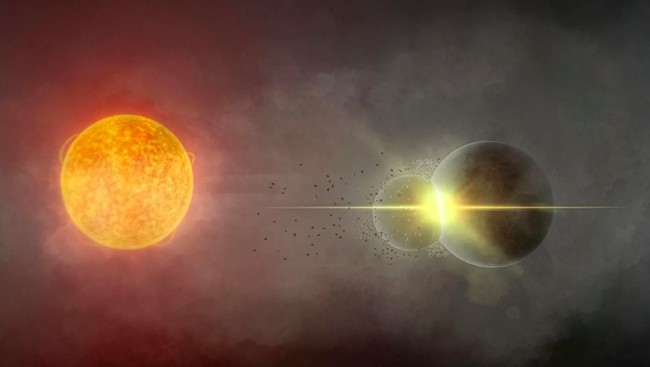
Jakarta, CNBC Indonesia – A recent study has revealed evidence of a distant planetary collision that triggered several unusual phenomena, including the potential formation of Earth’s satellite, the Moon.
The clues originated from a main-sequence star called Gaia20ehk, which closely resembles our Sun but began exhibiting fluctuating brightness.
“Starting in 2016, there were three instances of dimming light. Around 2021, its brightness surged dramatically,” said lead author and University of Washington astronomer Anastasios Tzanidakis, according to Futurism on Monday, March 16, 2026.
Researchers believe this phenomenon was caused by a large stream of rock and dust passing in front of the star, obscuring a portion of its light.
The team concluded that the light obstruction was caused by debris from a planetary collision. Observations from other telescopes supported this theory, indicating the material was extremely hot.
According to the researchers, the event likely involved two planets orbiting each other and gradually drawing closer. The planetary collision didn’t occur in a single, catastrophic impact, but rather through a series of smaller collisions.
Planetary collisions are not uncommon. A 2023 study found that a collision between two ice giants in a young star system created a hot, torus-shaped cloud of debris.
Long ago, approximately four and a half billion years ago, Earth itself experienced a collision with another planet named Theia, which was roughly the size of Mars. The impact was devastating.
However, Theia wasn’t completely destroyed. The remnants coalesced in orbit around Earth and eventually formed the Moon.
Astronomers have also observed that the dust cloud around Gaia20ehk orbits at a similar distance from its star as Earth does from the Sun. This suggests the cloud could cool and potentially form a rocky satellite.
This discovery offers valuable insight into the processes that shape planetary systems and the potential origins of moons. Understanding these events can help scientists better understand the formation and evolution of our own solar system and others beyond it.
