
The Extreme World of Mercury: Exploring the Solar System’s Smallest Planet
Positioned as the closest celestial body to the center of our solar system, Mercury represents one of the most hostile environments known to science. Characterized by massive temperature swings and a punishing radiation environment, the planet serves as a stark example of the extreme conditions that define the inner reaches of space.
According to data from NASA, Mercury is the smallest planet in our solar system, measuring only slightly larger than Earth’s Moon. With a radius of approximately 2,440 kilometers (1,516 miles), it is roughly one-third the width of Earth. Its diminutive size is further highlighted by the fact that it is smaller than Ganymede, one of Jupiter’s natural satellites.
A Study in Thermal Extremes
One of the most defining characteristics of Mercury is its lack of a substantial atmosphere. The planet possesses only a thin exosphere composed of helium, hydrogen, sodium, potassium and oxygen. Because this layer is too thin to trap or distribute heat, the planet experiences some of the most drastic temperature fluctuations in the solar system.

During the day, surface temperatures can soar to 430°C (800°F). Although, once the sun sets, temperatures plummet to as low as -180°C (-290°F). Despite its proximity to the Sun, Mercury does not hold the title of the hottest planet; that distinction belongs to Venus, which maintains higher temperatures due to its dense, heat-trapping atmosphere.
From a biological perspective, these conditions—combined with intense solar radiation—render the planet’s environment entirely unconducive to life as we know it. The extreme thermal volatility and radiation levels would likely be too severe for any known organism to adapt to, underscoring the critical importance of atmospheric protection for planetary habitability.
Geological Composition and Orbital Dynamics
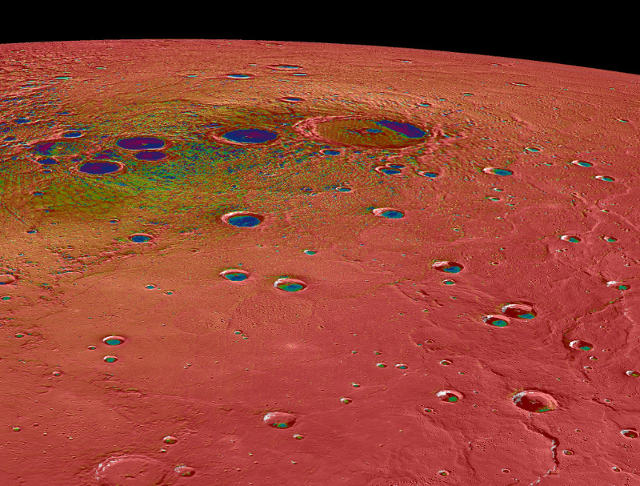
Visually, Mercury closely resembles Earth’s Moon, featuring a surface heavily scarred by craters. These formations are the result of billions of years of asteroid and meteorite impacts, which occur frequently because there is no thick atmosphere to burn up incoming space debris. Among its most notable geological features is the Caloris Planitia, the planet’s largest crater.
The planet’s internal structure is equally notable, dominated by a massive metallic core. This dense composition contributes to a surface gravity that is slightly higher than that of Mars.
Mercury’s proximity to the Sun—averaging about 58 million kilometers (36 million miles)—results in a highly accelerated orbital period. The planet zips around the Sun every 88 Earth days, making it the fastest planet in the solar system. However, this rapid revolution is contrasted by a exceptionally slow rotation on its own axis.
The visual experience on the surface would be overwhelming compared to Earth; the Sun would appear more than three times larger and shine up to seven times brighter, further contributing to the planet’s extreme energy environment.
