
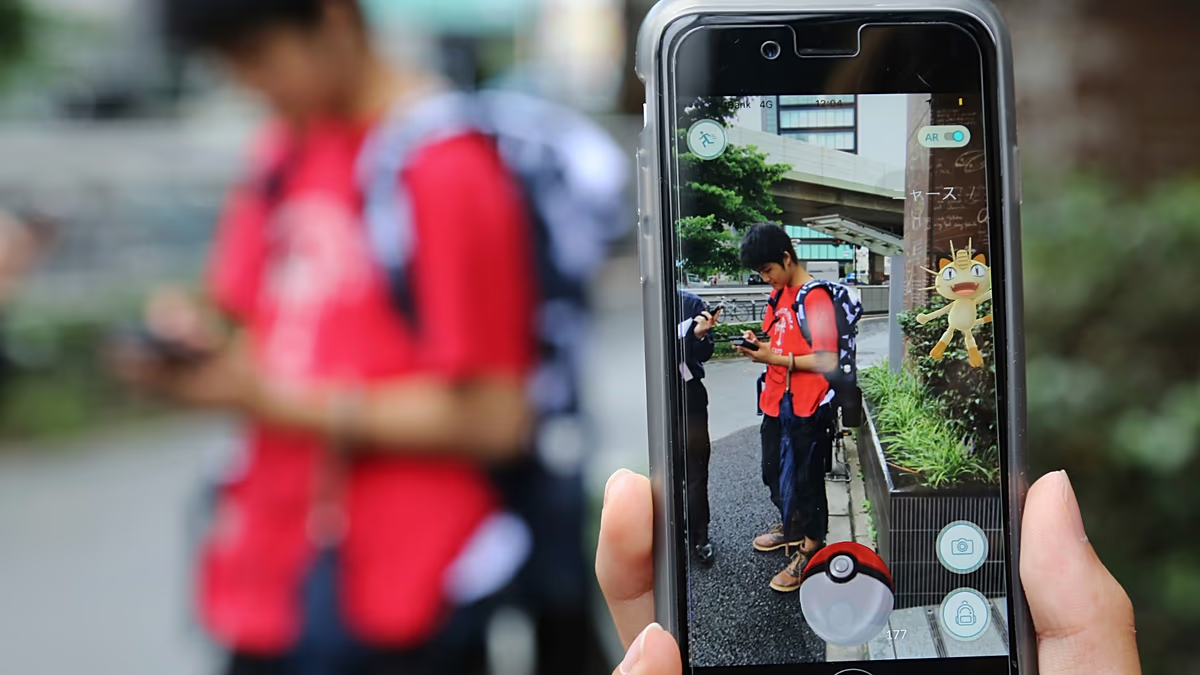
Pokémon Travel developer Niantic is leveraging player-submitted images to build detailed 3D maps of the real world, sparking discussion about data privacy and the future of spatial computing. The company’s work, initially focused on enhancing the augmented reality experience within the popular mobile game, is now expanding into applications for autonomous delivery robots.
Since its 2016 launch, Pokémon GO quickly became a global phenomenon, transforming cities like Brussels, Paris and Rome into augmented reality playgrounds where players could hunt for virtual creatures like Pikachu, Dragonite, and Eevee. The game remains popular, boasting over 100 million players in 2024, according to Scopely, Niantic’s parent company.
Recent reports from MIT Technology Review highlighted how Niantic Spatial, spun out from Niantic in 2025 after the sale of its gaming division to Scopely, utilizes images collected during gameplay to train its systems. These systems are designed to create detailed 3D maps of real-world environments. The technology is a key component of the growing field of spatial AI, which aims to give machines a better understanding of their physical surroundings.
Social media posts circulating on X suggested Niantic was using images captured by players during their weekend walks to develop visual navigation systems for delivery robots. Although, Niantic clarified that the data was not collected without player awareness.
Opt-in AR Mapping
Niantic introduced dedicated AR mapping features in 2020, allowing players to scan real-world locations and objects while using their smartphone cameras. This process captures visual data used to enhance the augmented reality experience. Crucially, this feature isn’t available to all players initially; it unlocks at level 20. This means images aren’t automatically captured in the background as players move around searching for Pokémon.
According to a statement provided to The Cube in 2022, Niantic states that players must opt-in to anonymously submit scans and videos of public places to improve Niantic’s Spatial Visual Positioning System (VPS). The company maintains that participation is entirely optional, requiring users to intentionally select and review specific landmarks, such as statues or notable objects.
Testing by The Cube confirmed that when a smartphone camera is pointed at a sculpture in Brussels’ Parc du Cinquantenaire, a message appears informing users that they are contributing to the development of augmented reality mapping technology and that their data will be shared with a third-party service. The message also states that the collected data will be used to create 3D models of real-world locations and to support the development of the technology and related services.
Niantic’s terms of service, specifically the “Rights You Grant Us – AR Content” section, outline this process. The company states that by choosing to utilize the AR scanning feature, users grant Niantic a non-exclusive license to use the collected images to improve its services.
Building a 3D Digital World
MIT Technology Review reported that Niantic Spatial has actively used images from Pokémon GO players to develop its latest products. The company told The Cube it has trained over 50 million neural networks based on approximately 30 billion images.
Niantic has developed a Visual Positioning System (VPS) that it claims “provides accurate, vision-based localization and mapping at scale anywhere in the world, including places where GPS is unavailable or unreliable.” This technology has enabled the company to create a highly detailed 3D model of the real world. The development of these detailed maps is a significant step towards creating more immersive and interactive AR experiences.
However, Niantic Spatial doesn’t rely solely on data from Pokémon GO’s augmented reality features. The company also states on its website that it incorporates spatial data from other sources, including robots, drones, and satellites.
From Pokémon GO to Real-World Applications
On March 1, Niantic announced a partnership with Coco Robotics, an urban robot delivery platform, to broadly deploy its spatial AI technology, and VPS.
Coco Robotics operates robots capable of delivering groceries, electronics, and hot meals in cities like Los Angeles, Chicago, Jersey City, Miami, and Helsinki. The company has collaborated with the online delivery platform DashMart since 2018.
Coco Robotics has unveiled a new generation of more robust delivery robots designed to withstand the challenges of city streets. These robots historically relied on GPS, which often provides limited accuracy in dense urban environments.
This is where Niantic Spatial’s technology comes into play. The collaboration aims to integrate Niantic’s spatial mapping and VPS into autonomous delivery robots, enabling them to navigate complex urban landscapes more efficiently. By leveraging detailed 3D maps and vision-based localization, the robots can move with greater precision through city streets while delivering goods directly to customers.
