
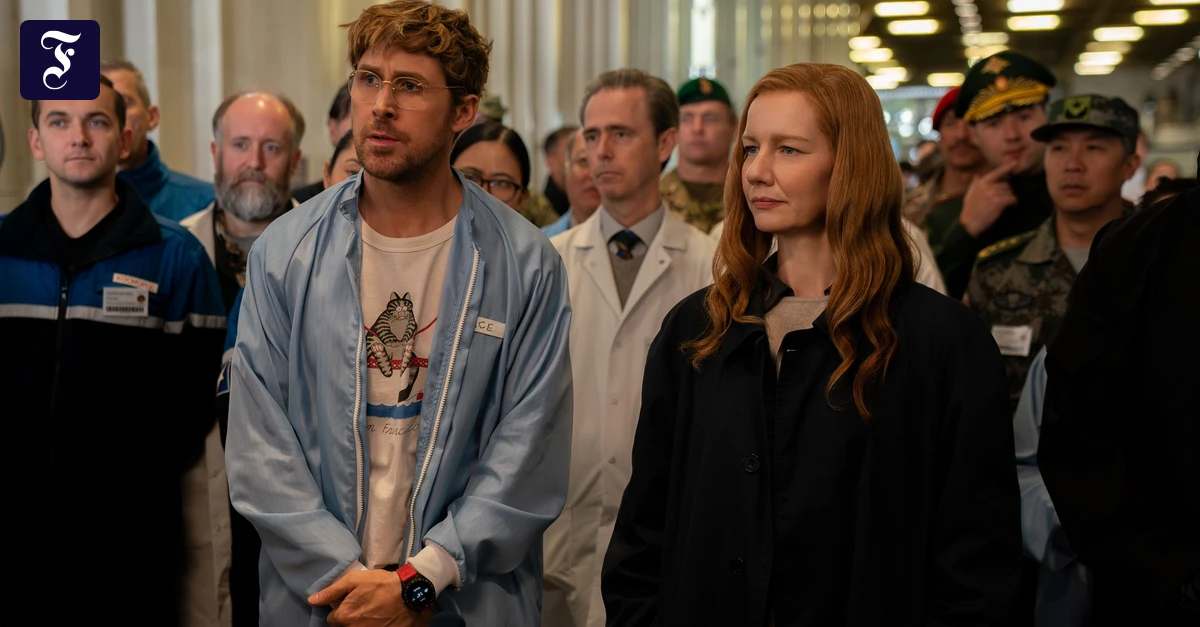
The chilling sense of false freedom grips Dr. Ryland Grace as a glimpse out the window reveals his location: near the star Tau Ceti, involuntarily liberated from the constraints of Earth (no rain in space) and human society (no rules, no orders). He immediately begins searching for other people. A machine asks him what two plus two equals. He doesn’t care. Machines aren’t human; he’s lost his world and his memory.
What humans call “loneliness” is the most false freedom of all. Its opposite isn’t simply community (a naturally occurring group) or society (a social order that can be trained, even to the point of a state), but solidarity – intentional being-for-one-another, even across species boundaries. That’s what the clever, slightly lengthy, but ultimately beautiful and occasionally hilarious science fiction film “The Astronaut – Project Hail Mary,” directed by Phil Lord and Christopher Miller, is about, based on a novel by Andy Weir (who also wrote “The Martian,” filmed by Ridley Scott in 2015). Ryan Gosling stars as the astronaut Grace, and Sandra Hüller plays Eva Stratt, the head of the project that sent him into space.
Grace names him “Rocky”
The central concern of the film is an infrared arc between the Sun and Venus, composed of tiny exotic organisms called “Astrophage” (star-eaters) that are consuming our sun, disrupting Earth’s energy balance and threatening massive food shortages. Mass extinction looms if no one does anything. The night sky reveals that many stars are suffering similarly, but one isn’t: Tau Ceti. So, humanity sends a research mission there to find out what’s warding off the plague. The ship initially carries three people in long-term artificial comas, but only one awakens – Ryland Grace. Upon arriving, he encounters a non-human ship and its sole survivor, also there to save their star, 40 Eridani.
The colleague appears to be constructed from stone; Grace appropriately names him “Rocky.” The trills, clicks, crackles, and hums in which Rocky communicates gradually evolve into a language Grace can understand, through mutual and computer-assisted linguistic approximation. The process is excellently didactic in the book and highly entertaining in the film; at one point, we hear the little guy speaking with the voice of Meryl Streep, because “she can do anything” (Grace).
Learning Solidarity Together
The film frequently presents text on screen; what was an extreme cinematic risk in Henry-Alex Rubin’s “Disconnect” in 2012 is now commonplace enough to function for storytelling. Language and writing are often gracefully interwoven with all sorts of music, from the smooth soundtrack to melancholic singing characters to the famous five tones from Steven Spielberg’s “Close Encounters of the Third Kind” (1977), which sound at a point that manages the fragile feat of blending media-historical cleverness with deeply human comedy. The script by Drew Goddard continually enlivens the cold cosmic setting with emotional warmth, sometimes with a little too much sweetness, but always plausibly touching in the serious passages.
At one point, Grace, who is learning what solidarity means with Rocky, seems on the verge of breaking under the pressure; in that moment, he is truly the second-best weeping space traveler of all time, right after Matthew McConaughey in Christopher Nolan’s “Interstellar” (2014).
Humanism? Weir’s novel explicitly states that the rescue ship doesn’t use AI – that is, no artificial neural network – when providing for humans. (You don’t need that to save the world. Maybe you need it to destroy it. Ask Palantir.)

Goddard added a few jokes to the original text, shortening and simplifying some of the scientific processes (but those that remain are lovingly explained with school-level detail; Grace is a teacher, not an astronaut). Even more cleverly used science is in the direction, especially in the montages between the present plot and flashbacks that gradually reconstruct Grace’s memory: he spins in centrifugal gravity (present), he spins in an office chair (memory) – a smart play with inertial systems, a beautiful relativistic backdrop.
Someone to be brave for
It’s a shame that some scenes from the novel, in which Rocky expresses his wildest speculative ideas, are missing; the freaks who form the hard core of the audience for such films would have happily sacrificed a few (albeit coolly choreographed) stunt scenes for them. But that’s give and take – just like solidarity, which also requires courage under extreme conditions.
“The gene for courage” is missing, Gosling says to a Chinese astronaut in the film (the story takes its collaborative idea so seriously that China and Russia also help). The Chinese astronaut replies that it isn’t a gene; all you need is someone to be brave for. Solidarity stands in complicated relationships with community and society. It doesn’t always have to be negotiated (although Jürgen Habermas would have preferred it); it’s even compatible with authority (if it serves efficiency and is revocable and criticizable).
Which brings us to Sandra Hüller as Eva Stratt, who represents that authority in the film. In the book, Stratt is strictly amoral, but in the film, Hüller’s famous smile softens the severity – simultaneously annoyed and full of empathy. When she finally shows her human side at a mini-party (the film’s high point), she signals that that’s enough for now. Because she refuses to act according to the worst fashion leadership principle: endlessly chatting with the masses but hesitating when making decisions. How funny she is in this bitter material! Once, she has to keep pace with Grace, who is in a hurry, and manages to elevate her brisk movement to something like mild mockery of his recklessness. And you consider: Wow, Sandra Hüller was the missing element at Monty Python, we didn’t even know something was missing. How can anyone be so good? It’s breathtaking.
The unfortunately dumb and morally tarnished world society that we irradiated monkeys on Earth have created with the help of trading institutions and a little internet truly doesn’t deserve this great actress’s glittering heart intelligence. But she gives it to us anyway. Thank you, boss.
