
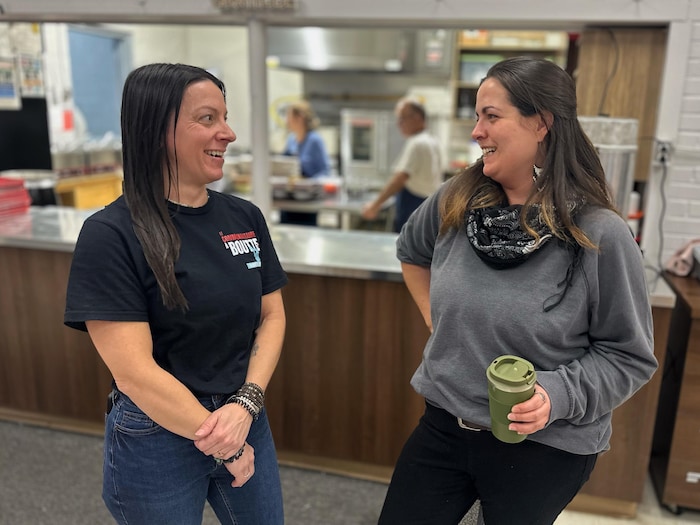
Guillaume, a former construction team leader, is emerging from three years of homelessness, a period that included living in a forest encampment. His story highlights the growing challenges of affordable housing and economic precarity in Quebec.
“I had to learn to live by hunting, trapping and fishing,” Guillaume recounted, speaking from the relaxed atmosphere of Restaurant Populaire de Victoriaville, a community organization providing meals to those facing significant hardship.
His descent into homelessness began after losing a stable, well-paying job he had held for several years. “I lost my job, I lost my housing, I fell into substance use, then I lost my girlfriend, and that was the beginning of the end. I wasn’t able to get back on my feet,” he said.
I lost my job, I lost my housing, I fell into substance use, then I lost my girlfriend, and that was the beginning of the end. I wasn’t able to get back on my feet.
A major obstacle to regaining stability was finding affordable housing, as rental prices have surged since the pandemic. Since 2018, rents in Victoriaville have increased by 70%, and in Drummondville by 80%.
Currently receiving approximately $800 USD per month in social assistance, Guillaume finds securing an apartment nearly impossible, as average rental costs for a room are around $700 USD monthly. He is currently sharing an apartment with two others, with a combined monthly rent of $1400 USD.
Evelyne Heeremans et Maude Tremblay discutent dans le Restaurant Populaire de Victoriaville
Photo : Radio-Canada / Vincent Rességuier
Community Organizations Overwhelmed
Guillaume’s situation has improved thanks to a network of support from community organizations and public services. The increasing demand for these services underscores the widening gap between social support and the rising cost of living.
“Psychosocial services are overwhelmed, the CIUSSS is overwhelmed, it’s overwhelmed here too, but thankfully we are here,” said Maude Tremblay, a psychosocial worker at Restaurant Populaire.
The organization provides free breakfast to 15 to 25 people daily and distributes an average of 80 affordable lunch plates. The number of regular patrons has nearly doubled in the last three years.
Tremblay notes a growing number of working individuals are finding themselves in precarious situations. “When they can’t pay their rent, the landlord evicts them,” she explained.
“If you lose your housing that you were paying maybe $600 USD for, it will be impossible to find another one at that price,” stated Evelyne Heeremans, director of the Association des locataires du Centre-du-Québec.
According to her observations, the face of homelessness has changed significantly since the pandemic, “it’s not just people who use substances anymore.” Seniors now comprise a substantial portion of the homeless population, and previously hidden homelessness is now increasingly visible.
In Drummondville, the housing vacancy rate stands at 1.8%. The situation has improved for renters, as it was at 0.5% in 2023. But, this improvement should be viewed cautiously, as the rate remained stable between 2024 and 2025, while most major Quebec cities saw a significant increase.

Eliane Valérie Viau, directrice et courtière en immobilier chez RE/MAX Élite
Photo : Radio-Canada / Vincent Rességuier
Limited Inventory, Strong Demand
The market remains tight for everyone, even those with greater financial resources.
According to real estate agent Eliane Valérie Viau, rental properties are leased within days, regardless of price. The same is true for property sales, which close in an average of 46 days.
On parle beaucoup d’effervescence et de folie immobilière, c’est du jamais-vu.
The pace of construction is not keeping up with demand, and sale prices are soaring, according to Viau, based on transaction data from her agency.
Over the past five years, the median price of single-family homes has risen by 90%. Depending on the location, the price of income properties has increased by 114% to 124%.
Paradoxically, the Centre-du-Québec remains an affordable region compared to major urban centers and is attracting remote workers. Drummondville is located one hour from Montreal, a location Viau describes as “interesting” for those commuting to the office once or twice a week.
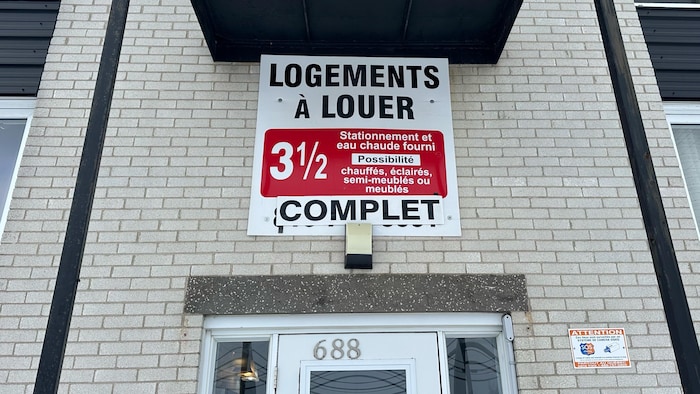
Les locations se font rares dans le Centre-du-Québec. À Drummondville, le taux d’inoccupation des logements s’élève à 1,8 %.
Photo : Radio-Canada / Vincent Rességuier
The Single-Family Home in Decline
The dream of owning a single-family home is becoming increasingly inaccessible. It was the norm just a short time ago, but that is no longer the case.
According to Viau, buyers are having to adjust their plans due to affordability issues, and “models are tending to diversify.”
Her clients are increasingly turning to duplexes or income properties, with families, friends, or couples pooling resources to purchase a property.
This trend is expected to continue. According to data from the Canada Mortgage and Housing Corporation (CMHC), 2018 marked a turning point for the Drummondville sector. It was the last year that the number of single-family home starts (345) exceeded the number of rental apartments (270).
In 2025, single-family home starts totaled 370, compared to 935 for rental apartments.
Last year, Drummondville reached a peak with 1389 new constructions, “a record for the region,” noted Francis Cortellino, an economist at CMHC. Before the pandemic, there were typically between 500 and 800 starts per year.
