
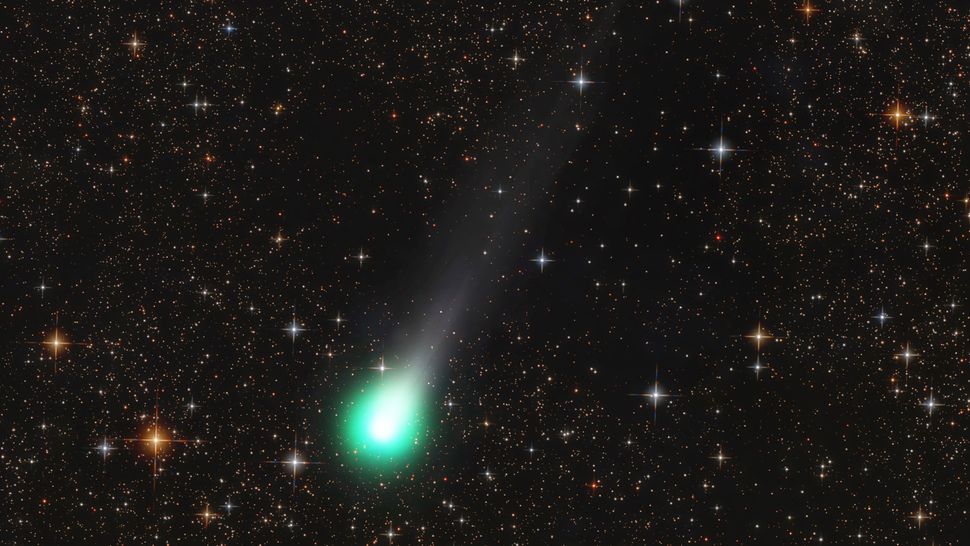
Astronomers are tracking a rare celestial visitor, Comet C/2025 R3 (PanSTARRS), as it makes a once-in-a-lifetime journey through the inner solar system. This hyperbolic Oort cloud comet, which has an inbound orbital period of approximately 170,000 years, is currently approaching its closest point to the Sun.
Perihelion Passage and Visibility
The comet is scheduled to reach perihelion on April 19, 2026, passing within 0.499 AU (approximately 75 million km) of the Sun. While it is currently unknown if the comet will survive this intense passage, experts suggest that around perihelion, it may reach a naked-eye visibility of approximately apparent magnitude +3.
The object has already been brightening as it nears the Sun; by March 20, 2026, it became visible to observers using 10×50 binoculars. For those tracking its progress, the comet’s Earth MOID (Minimum Orbit Intersection Distance) is 0.487 AU.
Discovery and Characteristics
C/2025 R3 was first identified by the Pan-STARRS survey on September 8, 2025, through images captured by the 1.8-meter Ritchey-Chretien telescope at Haleakala, Hawaii. At the time of discovery, the comet had an apparent magnitude of about 20, appearing as a diffuse head roughly 2.5 arcseconds across with no visible tail.

Subsequent follow-up imaging by the Canada-France-Hawaii Telescope revealed a broader tail extending 10 arcseconds. By September 11, 2025, the comet was located 3.60 AU (539 million km) from the Sun.
Orbital Data
Detailed orbital characteristics provided by researchers include:
- Eccentricity: 0.99984 (inbound) and 1.00025 (outbound), confirming its hyperbolic trajectory.
- Inclination: 124.73°
- Aphelion: Approximately 6,300 AU (inbound).
- Semi-major axis: Approximately 3,100 AU (inbound).
The observation of such ancient objects provides critical data for scientists studying the composition of the outer solar system. Tracking these rare events allows researchers to better understand the dynamics of the Oort cloud and the history of our cosmic neighborhood.
