
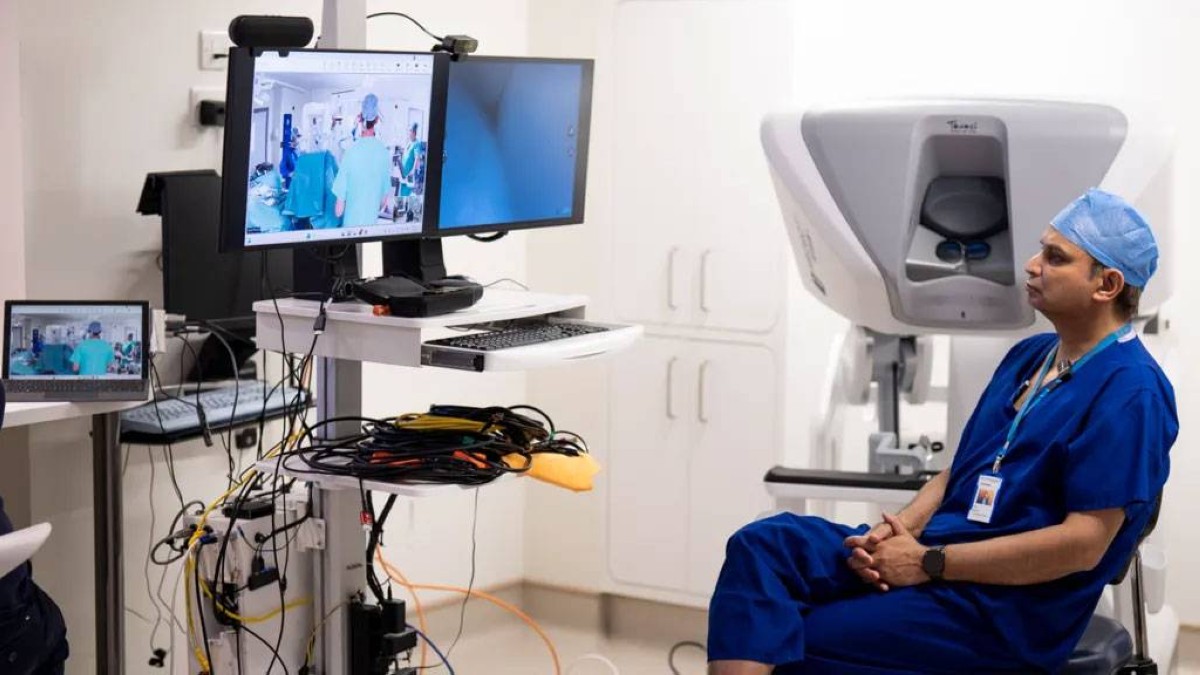
In a landmark achievement for remote surgery, a London-based surgeon successfully removed a prostate from a patient in Gibraltar on March 4, 2026, utilizing a robot controlled remotely. This breakthrough demonstrates the growing potential of robotic surgery to overcome geographical barriers and expand access to specialized care.
The procedure was performed by Professor Prokar Dasgupta, head of the robotic surgery center at a London clinic, on 62-year-old Paul Buxton, who was diagnosed with prostate cancer at St Bernard’s Hospital in Gibraltar. This marks the first time a patient in the United Kingdom has benefited from a fully remote robotic surgery.
The surgery relied on the TMA system robot, operated entirely from a console in London. Despite the patient being approximately 2,400 kilometers (1,500 miles) away, Dasgupta was able to direct the robot with high precision, with a minimal delay of just 48 milliseconds between the surgeon’s movements in London and the robot’s response in Gibraltar, thanks to a secure, high-speed network established by Presidio, according to interestingengineering.
The robot was positioned within the robotic surgery suite at St Bernard’s Hospital, equipped with multiple instruments and a high-definition 3D camera. The device successfully carried out all steps of the operation under Dasgupta’s remote supervision, serving as a practical example of how modern technology can transcend geographical limitations. Advances in robotic surgery are increasingly offering new options for patients and surgeons alike.
Buxton was diagnosed with prostate cancer in January and offered the opportunity to participate in the remote surgery trial as part of a collaboration between the London clinic and the Gibraltar Health Authority. While traveling to London for the procedure was an option, he opted for the remote approach.
“A lot of people told me, ‘You’re not going to do that, are you?’” Buxton said. “But I felt like I was giving back here.”
For Dasgupta, the operation confirms the ability of advanced communications and robotic systems to treat patients over long distances, adding, “I explained to Mr. Buxton that the technology is now ready to do this remotely. Why waste time and effort traveling?”
This achievement opens new avenues for patients in areas with limited access to specialized surgeons, allowing them to receive treatment locally while experts perform operations remotely. Expanding access to specialized care is a critical goal for healthcare systems worldwide.
The medical team plans to perform a second remote procedure on March 14, 2026, during the European Association of Urology congress in London, where the operation will be broadcast live to thousands of surgeons globally, to further promote and disseminate the experience of remote surgery.
This historic event underscores that the future of medicine holds remarkable possibilities, as remote robotic surgery can render geographical boundaries irrelevant and ensure advanced care reaches any patient, anywhere.
