

A shift back to office-based work is gaining momentum across both the public and private sectors following the widespread adoption of remote work in 2020, driven by the pandemic. The move raises questions about whether this approach is the most effective strategy for businesses and employees alike.
Diane-Gabrielle Tremblay, a professor of human resources at Université TÉLUQ, believes many private sector companies will follow suit. This trend comes as governments increasingly mandate a return to the office for public sector employees.
According to Tremblay, the public sector’s push for in-office work is shifting the balance of power in the labor market, potentially disadvantaging private sector employees. The ability for workers to negotiate remote work arrangements – previously bolstered by the threat of seeking opportunities with more flexible public sector employers – has diminished, she explains.
Since the beginning of 2026, Ontario government employees have been directed to work from the office five days a week, whereas Quebec civil servants are required to be present for three days. In July, the federal public service will implement a four-day in-office requirement, increasing to five days for managers in May.
The headquarters of the Department of National Defence in Ottawa (Archival Photo)
Photo : La Presse canadienne / Adrian Wyld
Several major Canadian employers already required a full or partial return to the office in 2025, including Rogers, Amazon, RBC, BMO, Scotiabank and TD Bank.
More recently, Ubisoft announced it would modify its office presence policy to require five days a week in the office, to foster creativity, cohesion and collective performance
, according to Antoine Leduc-Labelle, the company’s head of public relations.
And Internationally?
A study by Stanford University found that remote work is also declining internationally. Across 22 countries studied, the average number of remote workdays decreased from 1.6 days in 2022 to 1.33 days in 2023, and further to 1.27 days in 2024-2025.
The Productivity Argument
Tremblay questions this widespread trend toward increased in-office days. She notes that governments and companies frequently justify the return to the office by claiming remote work is associated with decreased productivity.
However, the expert points to a lack of concrete evidence supporting this claim. Especially in the public administration or service sectors, exceptionally few studies have been conducted on productivity in remote work
, Tremblay stated.
By definition, productivity is easier to measure in the manufacturing sector when you produce an object, whereas in the service sector, and particularly in public administration, where you work with ideas, develop a program, develop content, it is very demanding to measure.
She also highlights that the limited studies on productivity conducted before and after the pandemic focused more on the perception
of an employee’s performance rather than objective measurements.
Tremblay cited a 2021 Statistics Canada study which found that 58% of new remote workers reported accomplishing about the same amount of work per hour, while 32% felt they were getting more done. Only 10% believed they were less productive at home than in the office.

Diane-Gabrielle Tremblay is a professor of human resources at the School of Management Sciences at Université TÉLUQ.
Photo: Université TÉLUQ Website
Are Office Spaces Equipped for the Return of Civil Servants?
Tremblay argues that many workspaces are ill-equipped to accommodate the return of civil servants to the office. Organizations, particularly public administrations, have taken advantage of the pandemic and post-pandemic to promote a hybrid model. They say “you work at home a few days and other days in the office,” but they are taking advantage of it to reduce office space. And so, in many places, [they have] developed open-plan areas
, she explained.
A study led by Tremblay, in partnership with the Robert-Sauvé Institute for Health and Safety at Work, showed that for many people, audio and visual distractions
in open-plan offices hinder their productivity.
This leads the expert to believe that the hybrid model is optimal, as it allows employees to perform tasks requiring concentration
at home, while focusing on collaboration tasks
in the office.
When some organizations say “we want more communication, more exchanges,” especially if we are in a somewhat creative sector where we are looking for new ideas or developing new products, new services, new policies in the public service, [being present in the office] can be justified
, the expert believes.
We really need to sense in terms of activity, and unfortunately, these returns to the office are often thought of simply in terms of days.
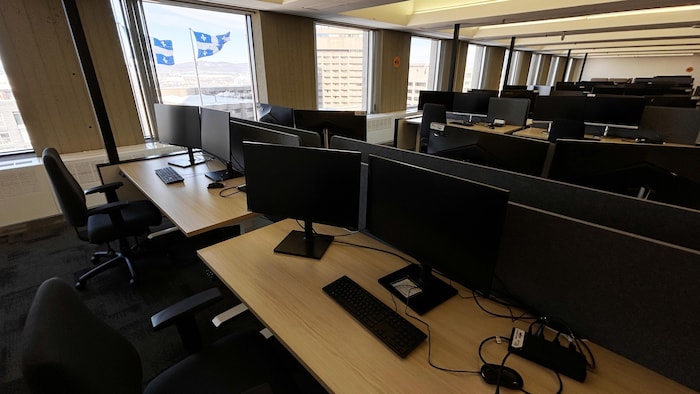
Unassigned workstations in premises of the Marie-Guyart building in Quebec City (Archival Photo)
Photo : Radio-Canada / Bruno Giguère
The issue of remote work remains divisive. As Ottawa seeks to reduce spending in the public service and eliminate 40,000 positions over the next three years, public sector unions view the new federal directive as a way to push civil servants toward the exit, with some preferring to seek opportunities with private employers that guarantee remote work.
The Public Service Alliance of Canada (PSAC) has filed an unfair labor practice complaint with the Federal Public Sector Labour Relations Commission. The union accuses the federal government of circumventing negotiations regarding working conditions, including remote work.
The Montreal Metropolitan Chamber of Commerce (MMCC), however, advocates for a reduction in remote work, particularly to ensure the vitality of the downtown core. Montreal is lagging behind in terms of returning to the office: nearly 20% of downtown offices are vacant, resulting in losses estimated at around $14.1 million per week for businesses, restaurants and culture
, according to a study by the MMCC.
Remote Work as a Competitive Advantage?
Despite these differing views, Tremblay believes the hybrid model remains the most advantageous for workers, whether for greater productivity, work-life balance, or time savings from commuting.
Public relations agency Tact, for example, is pushing back against the trend of returning to the office and, like Tremblay, believes that flexibility is key to greater productivity.
At our firm, remote work arrived with the pandemic, like many companies in Quebec
, explains Pascale Gagnon, Vice President at Tact. Before, we had a 100% in-office policy. When the pandemic hit, we were forced to adapt to it. We realized that the model worked really well for our teams.
The company now offers its employees a 100% flexible model, meaning no minimum number of days in the office is required. Gagnon assures that the offices are never empty and a balance between in-person and remote work occurs naturally.
I think flexibility is really what sets us apart right now on the market, compared to other company models that are bringing people back to the office. It’s a good lever for recruitment
, Gagnon adds.
For the time being, Tact has no plans to change its remote work policy, despite the reversals observed elsewhere.
