
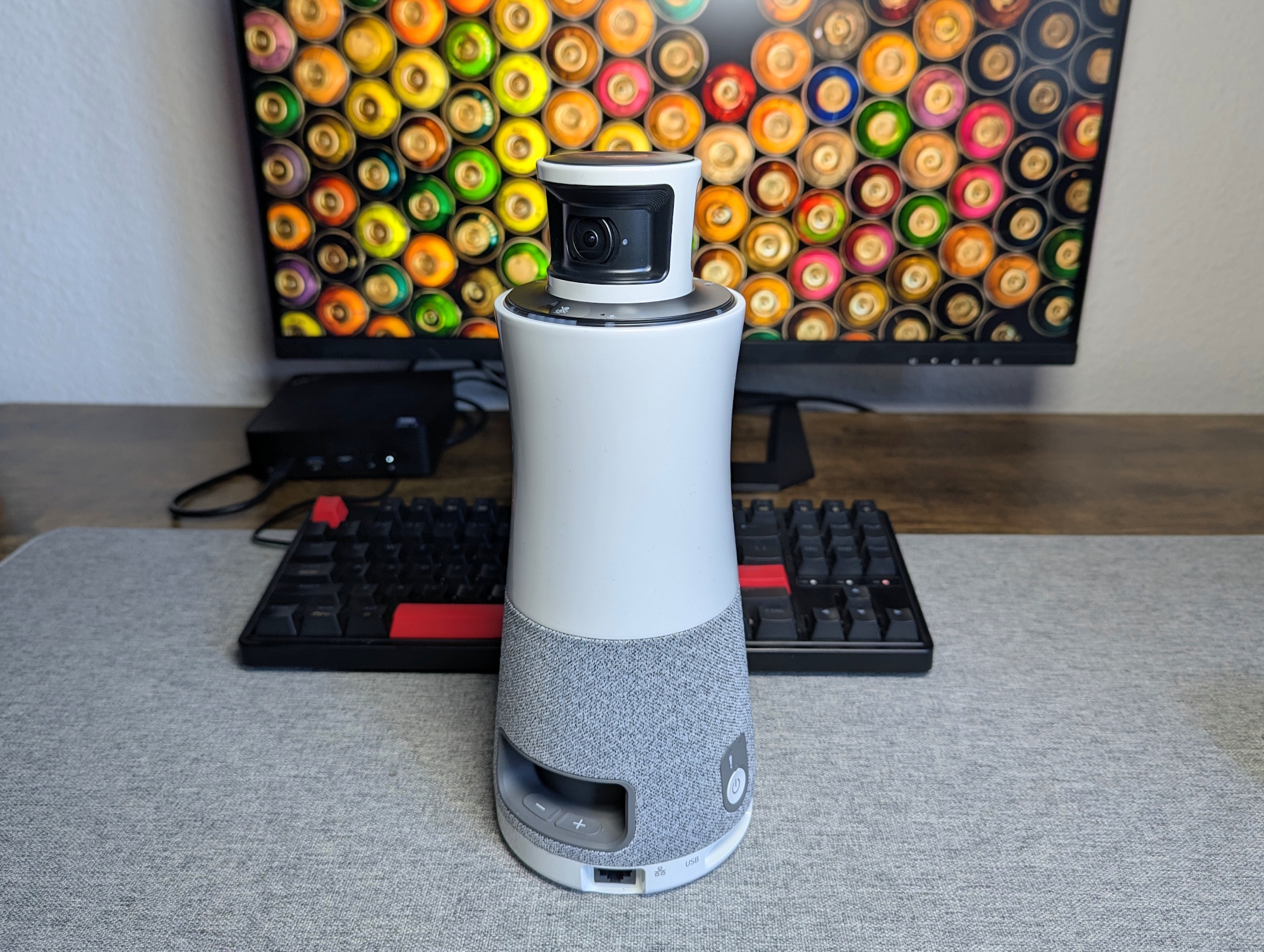
Speaker detection performs well, provided multiple people aren’t speaking simultaneously. Even when seated a considerable distance away, the system identifies the active speaker and zooms in. Though, this functionality is most effective in uncluttered rooms.
In a kitchen environment, the device failed to recognize the speaker from 1.5 meters away. Despite only one speaker – and therefore a clear audio source – the camera apparently struggled with the numerous objects present in the room (shelves, a refrigerator, kitchen appliances, etc.). This issue did not occur in a tidy conference room.
All zoom operations are purely digital. If someone sits at the far end of the room, the image becomes highly small and somewhat blurry. The system is best suited for small conference rooms where everyone is seated around the same table. Performance can turn into more challenging in seminar-style scenarios with participants further away. Ricoh specifies a video range of 3.6 meters.
Latency is also noticeable and proved relatively high in several measurement scenarios. The speaker always appears slightly out of sync with their lips despite the delay.
Here’s a rewritten version of the provided text, formatted as a technology news article for headlinez.news:
A new speaker-tracking system demonstrates strong performance in controlled environments, but struggles with both distance and clutter, according to recent testing. The technology, which automatically identifies and focuses on the active speaker during meetings and presentations, relies heavily on a clear line of sight and a relatively organized space.
Testing revealed that the system’s speaker detection capabilities diminish as distance increases. In a kitchen setting, the device failed to recognize a speaker positioned 1.5 meters (approximately 5 feet) away. While the audio source was singular, the presence of numerous objects – including shelves, appliances, and furniture – appeared to hinder the camera’s ability to accurately identify the speaker. This highlights the importance of environmental factors in the effectiveness of automated video conferencing tools.
The system utilizes digital zoom, meaning that significant magnification results in a loss of image clarity. Performance is optimized for smaller conference rooms where participants are seated closely together. Ricoh states the system’s effective video range is 3.6 meters (roughly 12 feet). Beyond this range, image quality degrades noticeably.
Researchers also noted a perceptible level of latency during testing. While the speaker’s audio and video remain generally synchronized, a slight delay was consistently observed. This lag, though not disruptive, is a factor to consider for applications requiring precise real-time communication.
