
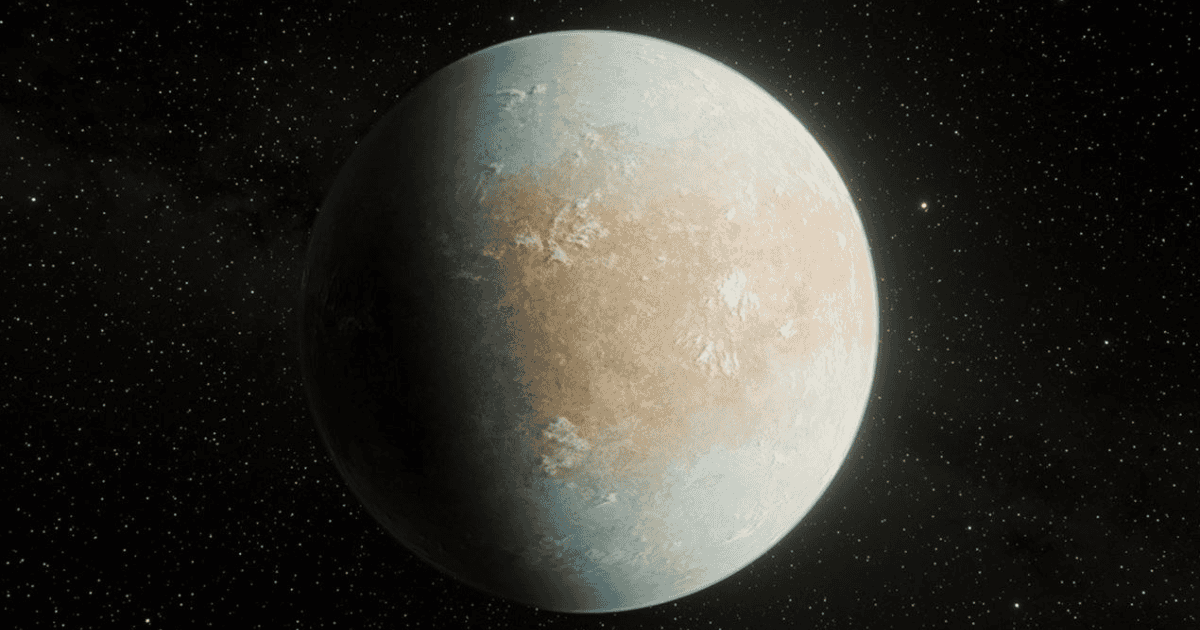
A new study challenges the long-held belief that life requires a sun to flourish, suggesting that moons orbiting “rogue” planets – those floating freely in space without a host star – could remain warm enough to sustain liquid water for billions of years. This finding expands the potential search for habitable environments beyond traditional star systems.
“The cradle of life does not necessarily require a sun,” stated David Dahlbüdding, lead author of the study and a researcher at Ludwig Maximilian University of Munich, Germany. Using computer models, researchers found that temperatures on a Earth-sized moon orbiting a Jupiter-like rogue planet could support liquid water on its surface for up to 4.3 billion years – a period comparable to the existence of our own planet.
The study focuses on exomoons, natural satellites of exoplanets, specifically those accompanying rogue planets. Even as the existence of exomoons hasn’t been definitively confirmed, increasing circumstantial evidence suggests a discovery is imminent. Rogue planets are worlds that were ejected from the orbit of their host star due to chaotic gravitational encounters in young planetary systems. Previous research indicates these planets are likely to retain their moons after being ejected.
As a moon orbits its planet in an elliptical path, the planet’s immense gravity repeatedly compresses and deforms the moon’s interior. This phenomenon, known as tidal heating, generates internal heat through friction. In our own solar system, this process is responsible for the intense volcanic activity on Jupiter’s moon Io and helps maintain subsurface oceans in icy moons like Europa and Enceladus in a liquid state.
According to the new study, this tidal heating could be powerful enough to prevent oceans of liquid water from freezing, even in the frigid emptiness of interstellar space. The key to retaining this heat on the surface, researchers explain, lies in the moon’s atmosphere. Previous studies suggested that carbon dioxide could provide enough greenhouse effect to retain these moons habitable for up to 1.6 billion years. Though, in the extreme cold of interstellar space, carbon dioxide tends to condense, leading to atmospheric collapse and heat loss.
This is where a hydrogen atmosphere comes into play. The study argues that, under conditions of high pressure and density, hydrogen behaves differently. The team’s simulations show that when hydrogen molecules collide, they can briefly absorb heat that would otherwise radiate into space. This allows a dense hydrogen atmosphere to act as an “insulating blanket,” trapping heat much more effectively.
The findings, published in February in the journal Monthly Notices of the Royal Astronomical Society, conclude that, under these conditions, some exomoons could remain warm enough to harbor liquid water – and therefore potentially be habitable for life as we understand it – for up to 4.3 billion years. These discoveries “significantly broaden the spectrum of possible environments that could harbor life,” suggesting that “life could arise and persist even in the darkest regions of the galaxy.”
