
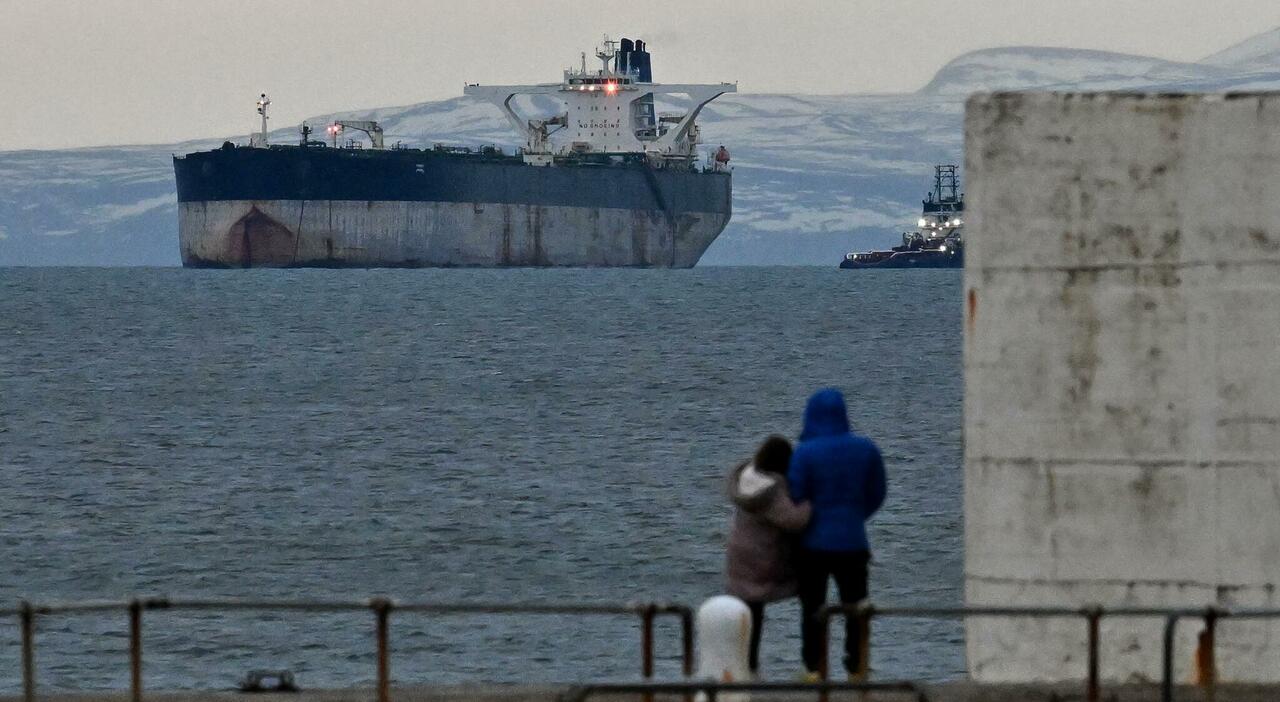
Despite its reliance on sanctioned “shadow” tankers, Russia’s crude oil exports are currently 6% higher than they were before the invasion of Ukraine, according to a report released four years after the conflict began. The Centre for Research on Energy and Clean Air (CREA) found that China, India, and Turkey now absorb 93% of Russia’s crude oil exports – totaling 201 million tons.
The continued flow of Russian oil to key global markets, even as Western nations attempt to restrict its revenue, highlights the challenges of enforcing sanctions and the shifting dynamics of the global energy landscape. Although export volumes have increased, Moscow’s earnings from fossil fuel exports have fallen by 19% year-on-year and are now 27% lower than pre-invasion levels. Total revenue from fossil fuel exports in the fourth year of the invasion reached 193 billion euros, with European Union imports accounting for 14.5 billion euros – a substantial 36% decrease annually.
The decline in revenue, despite increased export volumes, is attributed to price caps imposed by sanctions and the significant discounts Russia is forced to offer importers. A key component of circumventing these controls has been the employ of a growing fleet of tankers operating under false flags. “The sanctions imposed by the EU on refined oil products made from Russian crude, combined with sanctions from the Office of Foreign Assets Control (OFAC) on the two major Russian oil companies Rosneft and Lukoil, almost immediately led to a collapse in Russian crude sales, particularly to India, to levels not seen since the full-scale invasion of Ukraine,” the report states.
Even within the EU, some nations continue to rely on Russian energy supplies, with Slovakia and Hungary still importing Russian natural gas.
Russia has been able to bypass controls through the use of “shadow” fleets. These vessels operating under false flags increased from 12 at the beginning of 2025 to a peak of 109 in October. By January 2026, the number had decreased to 81, with only three vessels using false flags in January, compared to 32 in July 2025.
The recent decrease in the number of tankers using false flags is due to several factors, including operations by the French Navy and the U.S. Coast Guard. However, this decline has coincided with a sharp increase in ships registered directly under the Russian flag. At the beginning of 2025, 106 ships in the “shadow” fleet flew the Russian flag, a number that remained relatively stable throughout the first half of the year, reaching 111 in June before increasing to 120 in October. By January 2026, 153 “shadow” vessels were flying the Russian flag directly.
While tankers using false flags operate completely outside of maritime governance norms, ships flying the Russian flag are registered with a legitimate, albeit sanctioned, state. This shift towards the Russian flag represents an open acknowledgement of the connection to Russia, rather than a fraudulent concealment.
© RIPRODUZIONE RISERVATA
