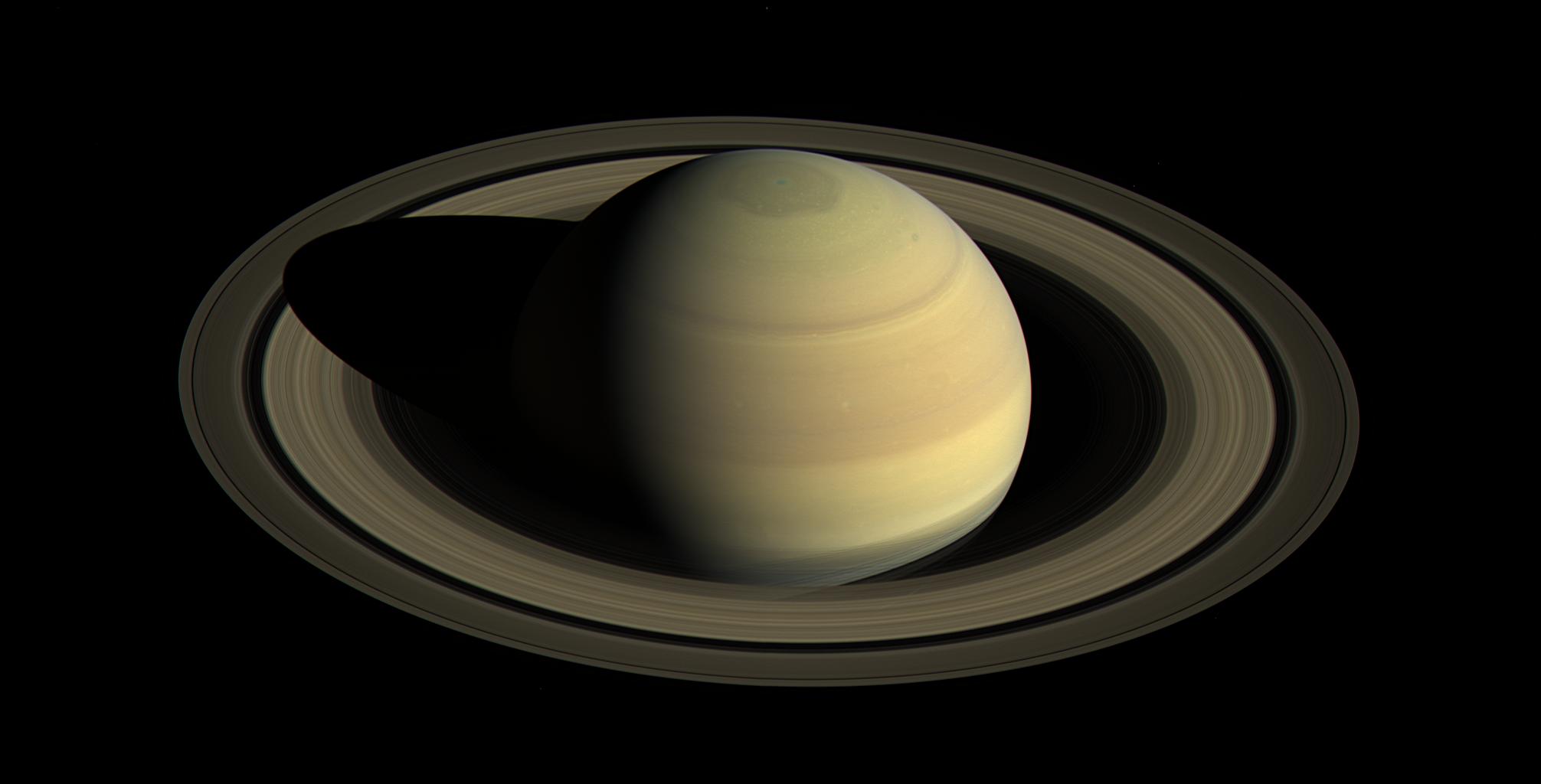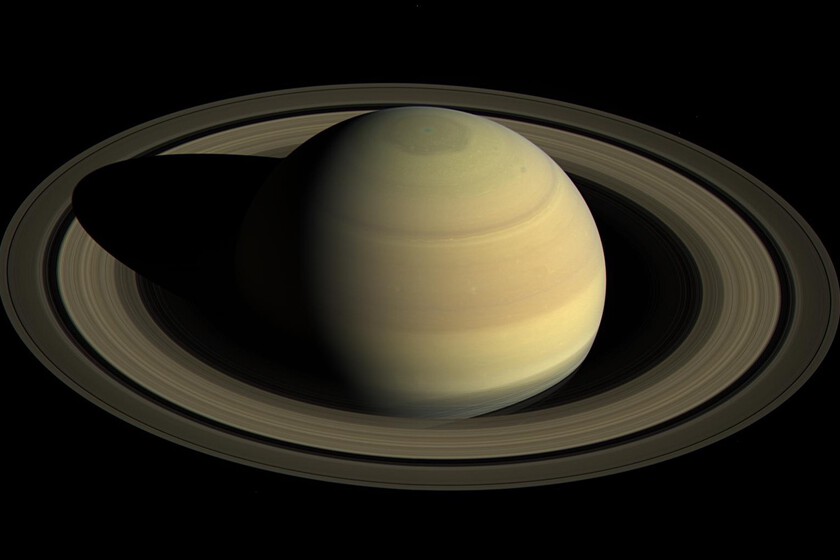
Saturn, a planet long known for its stunning rings – likely formed by a collision of its moons – harbors another, more subtle enigma: a massive, hexagonal cloud pattern at its north pole. This geometric shape, measuring approximately 30,000 kilometers in diameter, is large enough to contain two Earths, and has captivated scientists for decades. The discovery highlights the complex and often unexpected atmospheric phenomena occurring on other planets.
First observed in 1981 by the Voyager 2 spacecraft, the hexagon’s persistence has baffled researchers. While nature is capable of producing geometric forms, a stable hexagon of this scale is unusual. Now, a new hypothesis published in Proceedings of the National Academy of Sciences offers a compelling explanation rooted in the planet’s internal dynamics.
Researchers from the Department of Earth and Planetary Sciences at Harvard suggest the hexagon isn’t a surface feature, but rather a manifestation of deep, rotating convection within Saturn’s atmosphere. Turbulence in the planet’s lower layers generates vortices that push and warp a high-speed air current circling the north pole, ultimately shaping it into a hexagonal form. Essentially, the hexagon isn’t the storm itself, but a visible trace of what’s happening beneath the surface.
This finding is significant because it resolves a decades-vintage mystery. Previous theories failed to adequately explain the hexagon’s stability and formation. This new model, however, generates the hexagonal shape from fundamental physics without requiring additional assumptions. It also provides insight into the extent of Saturn’s winds, suggesting they extend all the way to the planet’s core.
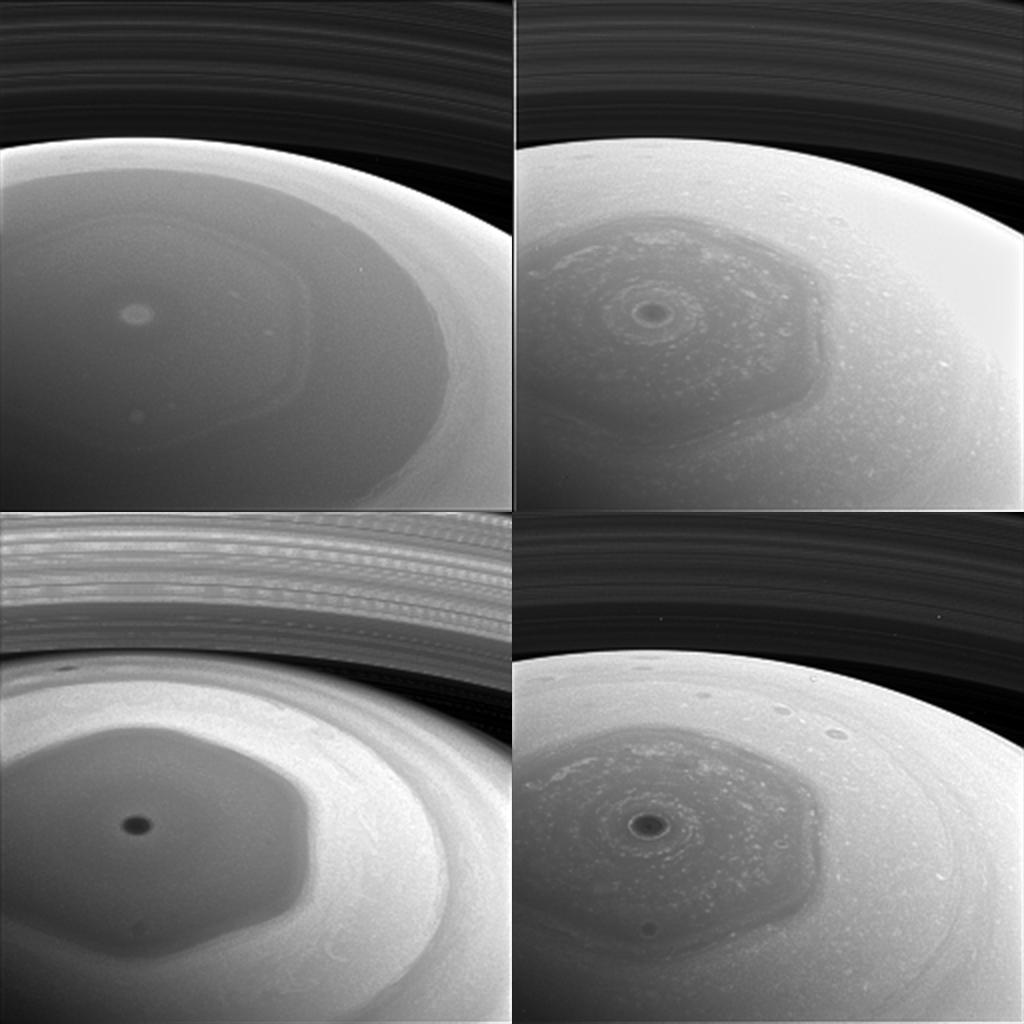 Hexágono de Saturno con imágenes de la sonda Cassini. NASA/JPL-Caltech/Space Science Institute
 Prior to this 2020 theory, two main schools of thought existed. One, the forced Rossby wave, proposed the hexagon was an atmospheric wave maintained by an anticyclone observed south of the pole in Voyager 2 data. However, that anticyclone was absent when the Cassini spacecraft arrived at Saturn in 2004. The other, the superficial jet theory, suggested the hexagon was a surface wind that became unstable and formed a polygonal shape. This theory required an initial wind current and contradicted gravitational data from Cassini’s Grand Finale, which indicated Saturn’s winds maintain their intensity down to pressures of 100,000 bars.
Both of these earlier models could reproduce the hexagon *if* given an initial wind, but neither could generate it from scratch.
How it was done. The research team employed a complex simulation, essentially creating a slice of Saturn, rotating it, and heating it from below, then allowing the laws of physics to take over. The simulation began without any pre-existing winds or hexagonal patterns. The code used for the simulation, as well as the data, are publicly available for verification.
Caveats remain. While the Harvard team’s hypothesis is currently the most robust explanation, the research paper itself acknowledges some limitations. The polygon in the simulation rotates faster than the actual hexagon, a discrepancy the researchers attribute to computational power.
the simulation only tests specific conditions over a relatively short period; it remains unproven whether the results would hold under different parameters or over longer timescales.
In Xataka | We’ve just discovered a genuine cosmic anomaly: an “invisible” galaxy formed almost entirely of dark matter
In Xataka | A new “solar system” has just been discovered. There’s just one problem: it shouldn’t exist
Portada | NASA/JPL-Caltech/Space Science Institute