
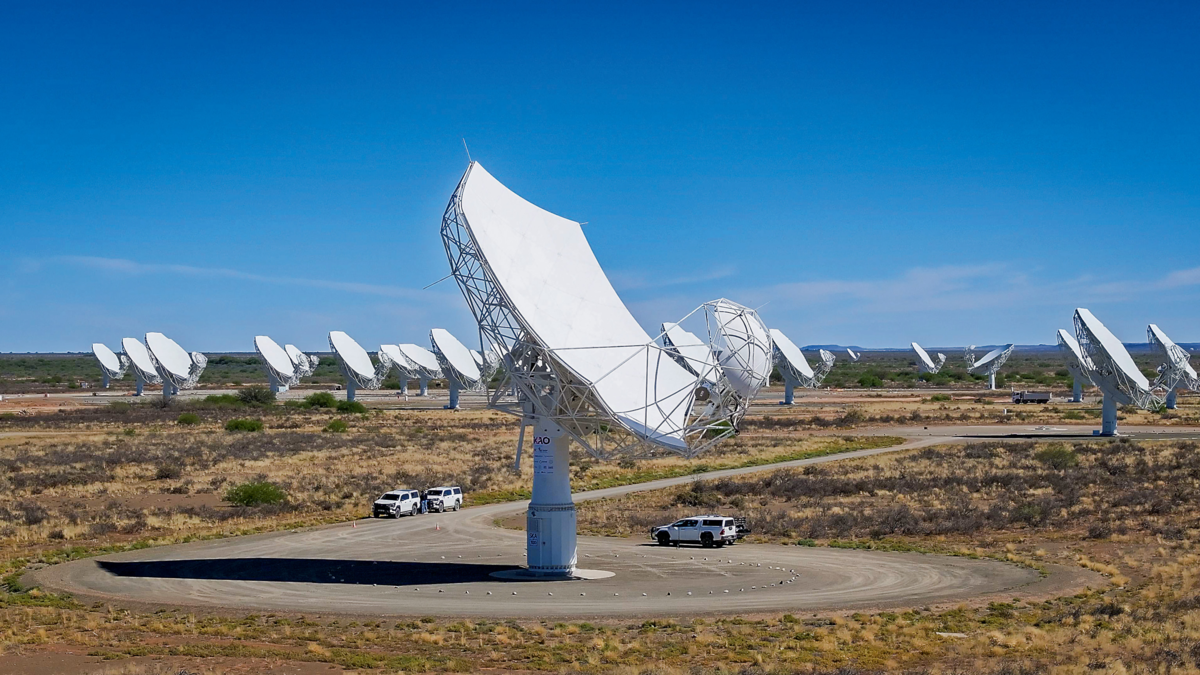
Spanning the arid landscape of South Africa’s Karoo desert, a network of 64 interlinked receptors is taking shape – the first antennas of the Square Kilometre Array (SKA), poised to become the world’s largest radiotelescope by the finish of the decade.
These new dishes join the existing 64 of the MeerKAT observatory, a precursor technology that will be integrated into the mid-frequency component of the SKA. The project, a collaboration between 16 countries, is simultaneously under construction in South Africa and Australia, with the two sites working in tandem.
The primary mission of the SKA is to detect faint signals from the universe’s earliest stages, a period known as the “Dark Ages” when only hydrogen atoms existed. Scientists are particularly interested in understanding the moment when hydrogen transitioned into the first suns and galaxies – an event dubbed the “Cosmic Dawn,” occurring just a million years after the Big Bang. “We grasp that dark matter acts as a kind of anchor, guiding hydrogen gas to clump together, but we don’t know how it does it,” explains cosmologist Aaron Parsons of the University of California, Berkeley. “Mapping that gas with a radiotelescope is crucial because this nebula is invisible to optical telescopes.”
Experts determined decades ago that a telescope capable of such a task would require a collective collecting area of one square kilometer – equivalent to one million square meters. Building a single dish of that size is impractical, but dividing the area into numerous components, strategically positioned, can achieve the desired result. The instrument must also be able to capture and process radio waves across a broad spectrum of frequencies, from low to medium, between 50 MHz and 15.4 GHz.
the SKA won’t resemble the typical image of a radiotelescope. The South African component will feature 196 dishes, each 15 meters in diameter, connected by miles of underground fiber optic cabling. Some will be clustered together, while others will be separated by kilometers of desert. Meanwhile, the Australian counterpart will consist of 131,072 antennas resembling two-meter-tall Christmas trees, arranged in circular formations, creating “forests” of high-tech equipment. Construction in both South Africa and Australia began in 2022, following a competitive bid process between the two nations to host the telescopes.
Bastions of Silence
The chosen locations are ideal for radio astronomy due to their minimal electronic interference. The Australian SKA site is located on the traditional lands of the Wajarri Yamaji people, in the red plains of Murchison in Western Australia. The South African site resides on the ancestral lands of the San people, within the Karoo, where the sandy terrain holds fossils and a unique quiver tree species.
In 2020, the South African government established the MeerKAT National Park, encompassing 135,000 hectares, to protect the sensitive astronomical instruments. This designation also supports conservation efforts to restore the fragile ecosystem and reverse centuries of damage from over-farming, livestock grazing, and the introduction of non-native plants. The park has ambitious plans to reintroduce black rhinos and herds of various antelope species that once roamed the area.
Currently, the most visible features are the shell-shaped antennas of the SKA and MeerKAT. Visiting the site requires a special invitation from the South African Radio Astronomy Observatory (SARAO), a private plane flight from Johannesburg, and a two-and-a-half-hour journey culminating in a landing on a remote airstrip where a vehicle awaits. Upon arrival, visitors must surrender their cell phones, recorders, cameras, microphones, and any electronic devices that could potentially interfere with radio frequencies. This restriction applies even at a distance from the antennas, and workers are prohibited from using cell phones or staying overnight, requiring them to commute from the town of Carnarvon, 80 km away.
The challenge extends beyond terrestrial interference. “Mitigating interference is one of our biggest hurdles,” says Adrian Tiplady, SARAO’s deputy director of strategy, gesturing towards the sky. “Thousands of low Earth orbit satellites,” such as those operated by SpaceX’s Starlink, “are constantly ‘bombarding’ the sky.” These satellites emit radio signals that can introduce background noise, potentially obscuring the telescope’s ability to detect the delicate signals from the early universe.
SKA antennas in Australia, which will cover a range of low frequencies. There will be a total of 131,072. Foto:Foto: Max Alexander. SKAO.
In response, the South African government has enacted legislation to protect the area and is actively seeking global regulations to ensure a quieter sky. “If optical astronomy needs dark skies, radio astronomy needs very quiet ones.”
The path to the central computing and data hub winds between the impressive 22-meter-high antennas. A closer look reveals the sophisticated engineering beneath the surface. To ensure absolute stability, the antennas are anchored to concrete foundations extending 12 meters deep. In the Karoo, where temperatures range from -5°C in winter nights to over 42°C in summer heat, materials expand and contract. The engineering must account for this, maintaining the structural rigidity needed to point at a specific coordinate in the deep sky with needle-like precision.
The receiver technology is also a masterpiece of cryogenic physics. To detect signals that have traveled for over 13 billion years, it’s necessary to silence the telescope’s internal electronic noise. This is achieved by cooling the receivers to 18 Kelvin (approximately -255°C) using liquid helium. This deep freeze effectively “quiets” the equipment, allowing it to capture signals so faint they are almost imperceptible.
One observer questioned the potential danger of being near these signals. “If you added up all the cosmic radio energy received by all the radio telescopes on Earth since the dawn of science, you’d only have enough energy to power a light bulb for half a second,” explains Tiplady.
MeerKAT pioneered the crucial technique of digitizing signals directly at the antenna. Traditional radiotelescopes transmit analog signals through long cables, losing power and picking up interference along the way. By converting the “whisper” of the universe into digital data at the source, the new observatory preserves the message’s purity as it travels through kilometers of fiber optic cables to the processing center – at a rate of 200 gigabits per second.
Within the Faraday Cage
The result is a level of clarity that has already produced stunning images of the center of the Milky Way, revealing ten times more radio filaments than previously mapped. This is just one proof of concept from the young observatory. In January, South Africa’s SKA team successfully synchronized two of its most remote antennas to observe the sky simultaneously. “Getting each dish to observe the sky individually is an achievement, but getting them to work as if they were a single telescope, in concert, is a huge technical challenge, and we’ve accomplished it,” announced Philip Diamond, the observatory’s director general.
But the antennas are only part of the equation. The data processing center operates like a Faraday cage, blocking all external electric fields to receive cosmic messages without distortion. When fully operational, the SKA will generate approximately 700 petabytes of scientific data annually – enough to fill the storage of 1.5 million typical laptops each year.
The data rate is so immense that just three seconds of information from the pioneering telescopes represents 10 percent of the annual data speed of the entire internet network.
This necessitates the development of new artificial intelligence tools for automated data processing. These innovations extend beyond astronomy, with potential applications in diverse fields like medical imaging and climate modeling.
Over time, the scientific community has recognized that a radiotelescope of this scale will not only answer fundamental questions about our cosmic origins and destiny but also enable a wealth of other discoveries in areas such as the formation of Earth-like planets, the detection of gravitational distortions in spacetime, the origin of cosmic magnetic fields, and the understanding of the formation and growth of black holes. In fact, a book detailing the breadth of science the SKA telescopes will eventually address contains 135 chapters written by 1,213 contributors from 31 nations.
That will truly be an intellectual dawn of cosmic proportions.
Ángela Posada-Swafford (Science Journalist)
For EL TIEMPO
Carnarvon, South Africa
READ ALSO
