
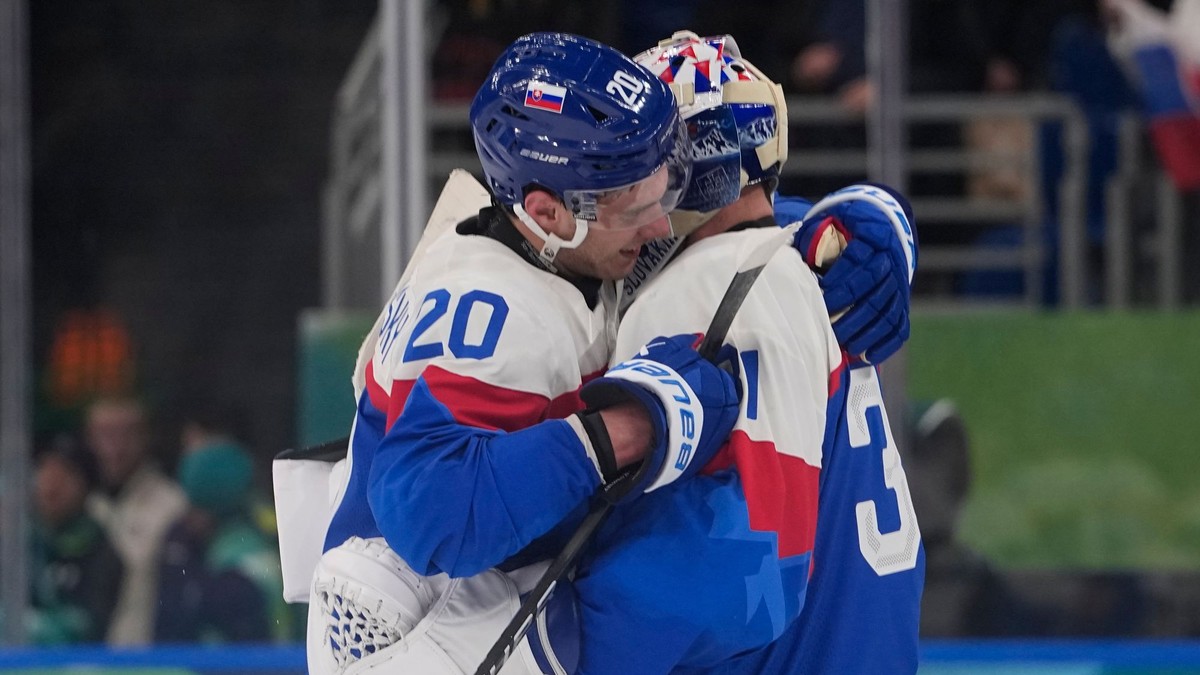
Slovakia, Latvia, and Denmark all secured their spots at the 2026 Winter Olympics in Milan last August through a series of qualifying tournaments.
Of those three teams, only Slovakia advanced to the quarterfinal round. They ultimately finished fourth after a 6-1 loss to Finland in the bronze medal game.
Despite winning a bronze medal at the previous Winter Olympics in Beijing, the Slovakian team was required to compete in a qualifying tournament for the 2026 Games.
The Slovakian national team also had to play qualifying matches in 2021.
What must Slovakia do to avoid another challenging qualification process in 2029, and what factors determine their eligibility?
Slovakia Currently Ranked 9th
Nine men’s hockey teams qualify directly for the Olympic tournament: the host nation and the top eight teams according to the International Ice Hockey Federation (IIHF) world rankings.
Three additional teams will earn their place through qualification, similar to Slovakia’s recent experience.
The IIHF world ranking, which is used to determine the initial eight teams, is calculated three years prior to the Olympics.
The current IIHF rankings, established after the May 2025 championship in Sweden and Denmark, place Slovakia ninth.
If the rankings were finalized today, Slovakia would once again have to compete in a qualifying tournament.
The Olympic cycle spans four years, and the IIHF ranking is based on performance over that period. The ranking totals points from the five most recent tournaments: four World Championships and one Olympic tournament.
Points are awarded based on a simple system: the World Champion or Olympic gold medalist receives 1600 points, with a standard difference of 20 points between each position.
You’ll see exceptions for significant jumps in ranking—between 1st and 2nd, 2nd and 3rd, 4th and 5th, and 8th and 9th—where the difference is 40 points. These bonuses are designed to reward teams for reaching the quarterfinal, semifinal, and final rounds, as well as winning the title.
The ranking system is designed to reflect current team form more accurately than past performance.
Results are gradually devalued over the four-year cycle: the current tournament counts for 100 percent, the previous year for 75 percent, two years prior for 50 percent, and three years prior for 25 percent. After four years, the result is completely removed from the overall score.
Projected IIHF Ranking After the 2026 Games
Whereas the IIHF states that the ranking is updated after each World Championship and Olympic tournament, as of Tuesday, March 3, 2026, more than a week after the conclusion of the games in Milan, the new edition of the ranking is not yet available.
Based on the IIHF’s calculation principles, we have compiled the latest version of the IIHF ranking for the top 10 teams.
We subtracted points for the 2022 Beijing Olympics (weighted at 25 percent) from the current standings and added points based on teams’ overall placement at the 2026 Olympics in Milan (weighted at 100 percent).
Slovakia would receive 1500 points for their fourth-place finish, bringing their total to 4715 points, which would move them to eighth place.
This projected ranking would see Slovakia move ahead of Denmark, who finished ninth at the Milan Olympics.
They would trail seventh-place Germany by 95 points and fifth-place Finland by 185.
The United States currently leads the ranking with 5220 points, followed by Canada (5135) and Switzerland (5085).
Future Championships Will Determine Olympic Qualification
The ranking following the 2023 World Championship in Latvia determined qualification for the 2026 Olympics in Milan. The ranking after the 2027 World Championship will be crucial for the 2030 Games, carrying the most weight (100 percent).
The results of the following tournaments will also be factored in: the 2024 World Championship in Czechia, the 2025 World Championship in Sweden and Denmark, the 2026 Olympic Winter Games, and the 2026 World Championship in Switzerland.
The results from these tournaments are summarized in the table below for the top 10 teams in the IIHF ranking.
To ensure clarity, we’ve included the weighting for each tournament and the precise point totals after deducting the corresponding percentages—as will be the case after the 2027 World Championship.
Slovakia is projected to be seventh in this ranking, with 2140 points.
They hold a 20-point lead over Germany and a 50-point advantage over Denmark. They trail fifth-place Finland by 60 points.
To avoid qualifying for the 2030 Winter Olympics, Slovakia must perform well in the next two World Championships.
Where is Russia?
Russia is not included in the ranking. When viewing the IIHF ranking on March 3, 2026, countries are listed sequentially without a numerical ranking.
The IIHF implemented this change following the World Championship in Sweden.
After the tournament, Russia—which has not participated in official IIHF competitions since militarily invading Ukraine in 2022—was placed at the top of the ranking. The official reason given by the IIHF is the lack of security guarantees for Russia’s participation in tournaments.
Russian team is not officially listed in the ranking. At the bottom of the ranking, under the heading “Not Participating in IIHF World Championships,” are two countries: Russia and Belarus.
Russia currently has 4030 points (as of the May 2025 ranking), 45 more than the leader, the USA (3985).

Rusko a Bielorusko sú mimo rebríčka IIHF. (Autor: IIHF)
This is a rather unusual situation, given that they haven’t played in four consecutive tournaments.
Media reports suggest that Russia is awarded points based on their “seeded” position according to the current ranking.
Since they were ranked second before the start of the Sweden championship, they received the same number of points as the silver medalists. Due to Canada’s quarterfinal loss (1-2 against Denmark), Russia now has the most points.
“Our decision was that Russia and Belarus cannot play and will receive points in the ranking based on the position they are ‘frozen’ in. You can see this on our website, they are not listed in the ranking,” said IIHF Council member Anders Larsson.
