
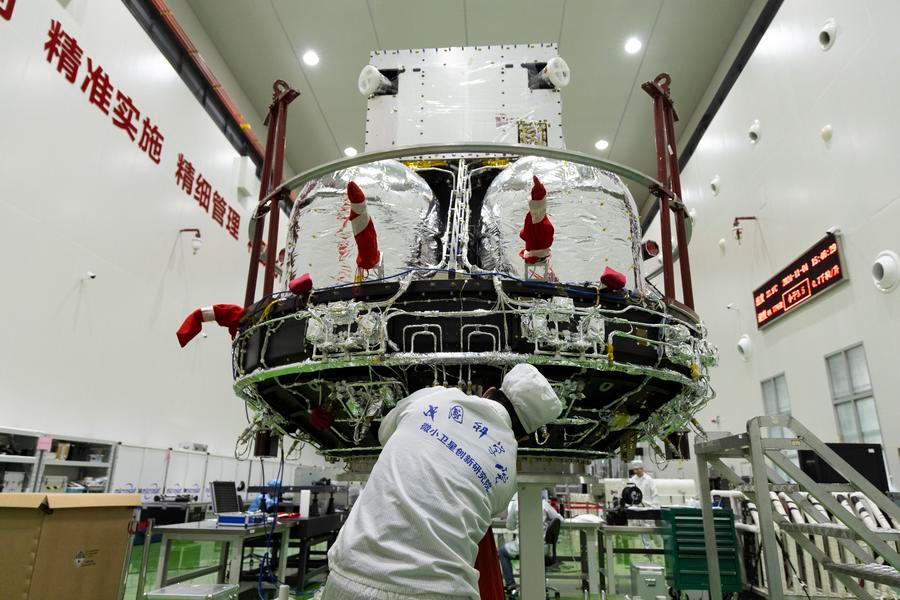
BEIJING, 26 mars (Xinhua) — Le satellite SMILE (Solar wind Magnetosphere Ionosphere Link Explorer), développé conjointement par l’Académie des sciences de Chine (ASC) et l’Agence spatiale européenne (ASE), a achevé tous les préparatifs de pré-lancement sur le site de lancement spatial de Kourou, en Guyane française, et son lancement est prévu le 9 avril, heure locale, a annoncé jeudi l’ASC.
La mission SMILE constitue la première mission issue d’une coopération approfondie et globale entre la Chine et l’ASE dans le domaine de l’exploration scientifique spatiale.
Le satellite utilisera la technologie d’imagerie par rayons X mous pour obtenir, pour la première fois, une vue globale de la structure à grande échelle de la magnétosphère terrestre. Il devrait notamment permettre une série de percées scientifiques dans des domaines tels que la prévision de la météorologie spatiale et la compréhension fondamentale de la physique magnétosphérique.
Le satellite SMILE a été monté sur un lanceur Vega-C.
A l’heure actuelle, la fenêtre de lancement a été déterminée, et l’équipe conjointe surveille et vérifie de près les conditions météorologiques sur le site de lancement, ainsi que l’état technique final de la fusée et du satellite.■
The jointly developed SMILE (Solar wind Magnetosphere Ionosphere Link Explorer) satellite is set to launch on April 9th local time from the Kourou Space Launch Base in French Guiana, according to an announcement on March 26th from the Chinese Academy of Sciences (ASC).
This mission marks the first collaborative effort between China’s ASC and the European Space Agency (ESA) encompassing a full range of scientific space exploration activities. The project underscores the growing international cooperation in advanced space-based research.
SMILE will employ soft X-ray imaging technology to capture a comprehensive view of the Earth’s magnetosphere’s large-scale structure for the first time. Scientists anticipate the data collected will lead to significant advancements in space weather forecasting and a deeper understanding of magnetospheric physics.
Currently, the launch window has been confirmed, and a joint team is closely monitoring weather conditions at the launch site, as well as conducting final technical checks on both the Vega-C rocket and the satellite itself. The satellite has been mounted on a Vega-C launcher.
The mission’s success could provide crucial insights into the complex interactions between the sun and Earth’s magnetic field, potentially improving our ability to protect critical infrastructure from solar storms.
