
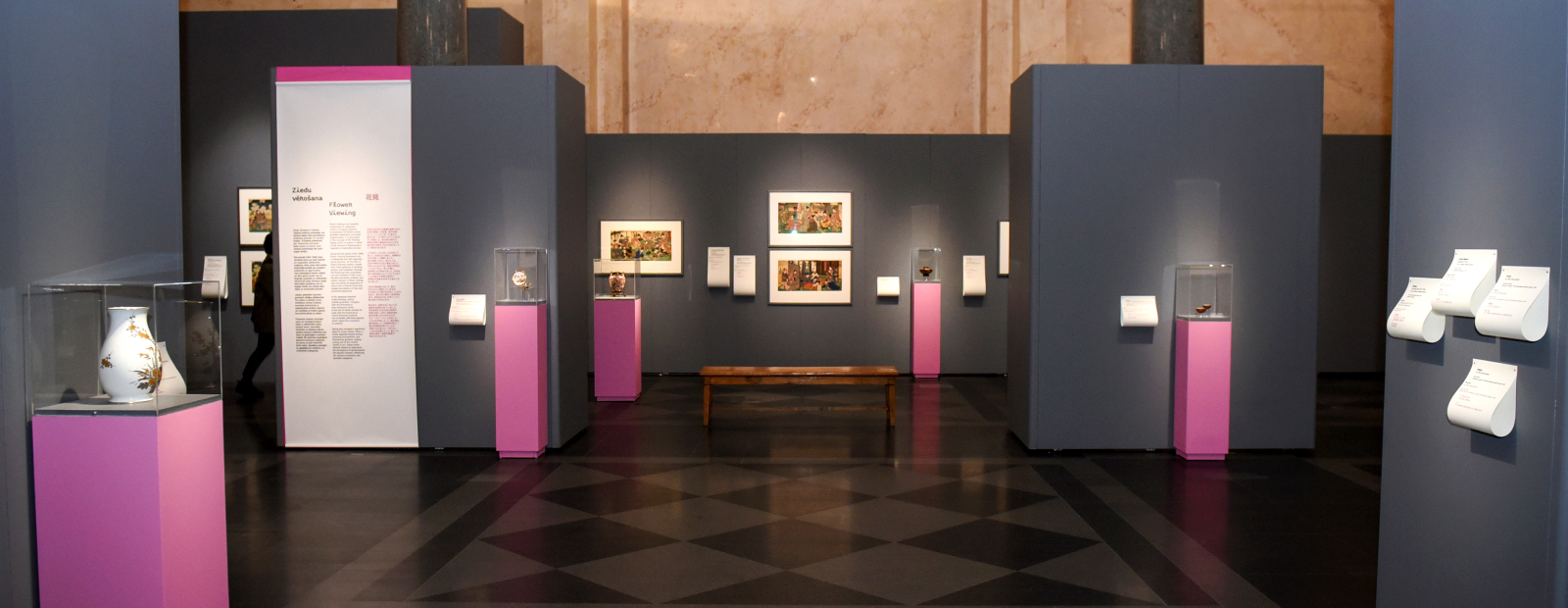
A new exhibition, Snow is Melting. Japanese Art, has opened at the Rīgas birža Art Museum, focusing on spring – a season that in Japanese culture blends the rhythms of nature, the cycle of human life, and the perception of the surrounding world into an integrated, symbolically rich experience. The exhibition marks the boundary between the old and the new in both nature and human life, becoming a crucial starting point for change.
The exhibition is divided into three sections. “This is one of the most popular places to view cherry blossoms,” curator Kristīne Milere notes, referencing the work Asuka Hill in the Eastern Capital by renowned Japanese artist and landscape master Utagawa Hiroshige from his 36 Views of Mount Fuji series.
This Japanese ukiyo-e woodblock print introduces the exhibition’s section dedicated to flower viewing, or hanami. It’s a vital Japanese tradition that combines an awareness of natural cycles, aesthetic experience, and social community. (A glossary of foreign words, Japanese art techniques, short author biographies, and descriptions of the cycles featured in the exhibition has been specially prepared for the exhibit – I. A.). During the Edo period, flower viewing became a widespread and organized public event, beginning with plum blossoms in late winter, reaching its peak with blooming cherry blossoms, and concluding with irises, marking the transition to summer.
A Changing World
In Snow is Melting. Japanese Art, hanami is revealed through ukiyo-e works, lacquerware, porcelain, and ceramic objects. “This Arita porcelain vase was made for export, as it is oversaturated with ornaments, but Japanese culture is characterized by empty space, or so-called negative space,” the curator emphasizes. The exhibition’s scenography is also created as a reference to this technique, to highlight and allow visitors to enjoy the exhibits as individual units.
The exhibition notes are designed in the form of a melting snow pile or evoke the impression of falling cherry blossoms, reminding viewers that hanami is a story about enjoying transient beauty. The exhibit offers a glimpse into a cultural practice deeply ingrained in Japanese society, and one that continues to resonate with audiences today.
Kristīne Milere explains that she has strived to create a connection between the exhibited objects and the ukiyo-e works, so that visitors can see how the specific object is inscribed in the “scenes of the floating world” (the literal translation of ukiyo-e – I. A.) and in Japanese life. Most of the ukiyo-e works in the Rīgas birža Art Museum collection are a gift from the Japanese Utagawa Society, but there are also works from the collections of local artists Gustavs Šķilters, Konrads Ubāns, and Ģederts Eliass, as Japanese art has influenced many authors around the world, including Latvian artists who encountered this art although studying in Paris or other locations.
A Blossoming Performer
“Please take off your shoes!” At the center of the exhibition is a space influenced by the tokonoma. In traditional Japanese architecture, it is a place in the home dedicated solely to the glorification of beauty. It’s a place to pause and breathe before continuing further. The lighting becomes darker as the visitor enters the kabuki section, which imitates the central part of the stage of this traditional Japanese theatrical form, extending into the audience. This is called hanamichi, literally translated as “flower path.”
In kabuki, spring is not just a season, but a dramatic, symbolic, and social magnitude that permeates the plots of performances, the visual language, and the audience’s experience. “It is against the backdrop of spring that sword fights, love intrigues, and other decisive events take place,” says the curator, adding that this season has been the most active time for theater attendance, as certain segments of society were given leave. In kabuki’s visual language, spring is embodied by blooming cherry blossoms and plum blossoms, often associated with the characters and fates of specific heroes.
Kristīne Milere draws attention to a scene from the dance performance A Smile Seems to Bloom Over Distant Hills. “This is the only work in which we do not see any depiction of spring flowers, but in this case, it is the actor himself who blossoms before the eyes of the audience during the performance like a plum blossom – this is also a moment of beauty fading, because after the performance everything ends,” the curator describes.
Wishes for the Year
The third part of the exhibition is dedicated to spring rituals that connect events in nature, purification, renewal of life, and social community. A particularly key holiday is Hinamacuri Day, celebrated on March 3rd. On this day, families display dolls representing the imperial court, praying for the health, happiness, and favorable future of their daughters. “We have a daira-bina, or a pair of dolls representing the Japanese emperor and empress. We received this set from Toshie Kawaguchi, the wife of former Japanese Ambassador Yasuhiro Kawaguchi, who was gifted it by her parents, but as they only have sons and no daughters to pass it on to, they donated the doll pair to the museum,” says Kristīne Milere. Visitors to the exhibition can also participate in a Japanese ritual – writing their wish for 2026 and attaching it to the interactive wall.
“With this exhibition, we are moving from chronological or retrospective exhibitions to conceptual expositions,” says Daiga Upeniece, head of the Rīgas birža Art Museum, about this year’s plans. In May, an exhibition of Latvian painter Jānis Avotiņš and, possibly simultaneously, Spanish artist Lidio Rico will open, where the work of both authors could be integrated into a whole. In autumn, an exhibition Horn of Plenty is expected, which will explore two themes. “Firstly, we will show an understanding of the horn of plenty in ancient heritage, Asian culture and European Christian heritage. Secondly, we will show the museum as a horn of plenty. The exhibition is conceived as an open question. Where are the boundaries? How does the meaning of the object change when it enters the museum collection? We wish not to provide ready-made answers, but to encourage visitors to deep reflection,” emphasizes the head of the Rīgas birža Art Museum.
Inhale, Exhale
The exhibition Snow is Melting. Japanese Art is complemented by a rich program of events. This Friday, March 13th, at 5:00 PM, the Rīgas birža Art Museum will host a musical conversation The Imagery and Atmosphere of Traditional Japanese Classical Music, with the participation of Boris Avramecs, emeritus professor of the Jāzeps Vītols Latvian Academy of Music. He will reveal how music in Japanese culture has been closely linked to observations of nature, especially in spring, when people gathered in parks, riverbanks, and near temples during the plum and cherry blossom seasons to experience the beauty and transience of the moment.
On March 17th at 6:00 PM, a masterclass Butō – a Moment Between Inhalation and Exhalation will be held by Simona Orinska, a butoh artist, choreographer, dance and movement therapist, producer, and pedagogue, where everyone will be able to get acquainted with the aesthetics of butoh art. During the masterclass, participants will learn the basic principles of butoh – slow gait, facial masks, character creation – and jointly create an improvised performance. On March 22nd at 11:00 AM, a family day Snow is Melting will take place, where the works of the exhibition will inspire creative activities, and on April 24th at 4:00 PM, a salon conversation Journey to Japan with art historian Vita Ozoliņa will be held, who will share her experience from her recent professional development trip to Japan, sketching the multifaceted cultural heritage of this country.
More information can be found on the website lnmm.gov.lv.
