
The months surrounding the April 8, 2024, total solar eclipse visible across parts of the United States marked both the best and worst of a professional career for one scientist. The best, he says, because experiencing such an event is “like going to your favorite band’s concert” and the energy is unparalleled, almost mystical. The worst, because he voluntarily embarked on a monumental challenge: broadcasting the eclipse for the first time from a scientific institution, streaming it live to the world. And, crucially, because that work took him to Washington D.C., away from the path of totality, where he could only observe the moon completely covering the sun. He missed “the day of Christmas for solar physicists,” as he defines eclipses.
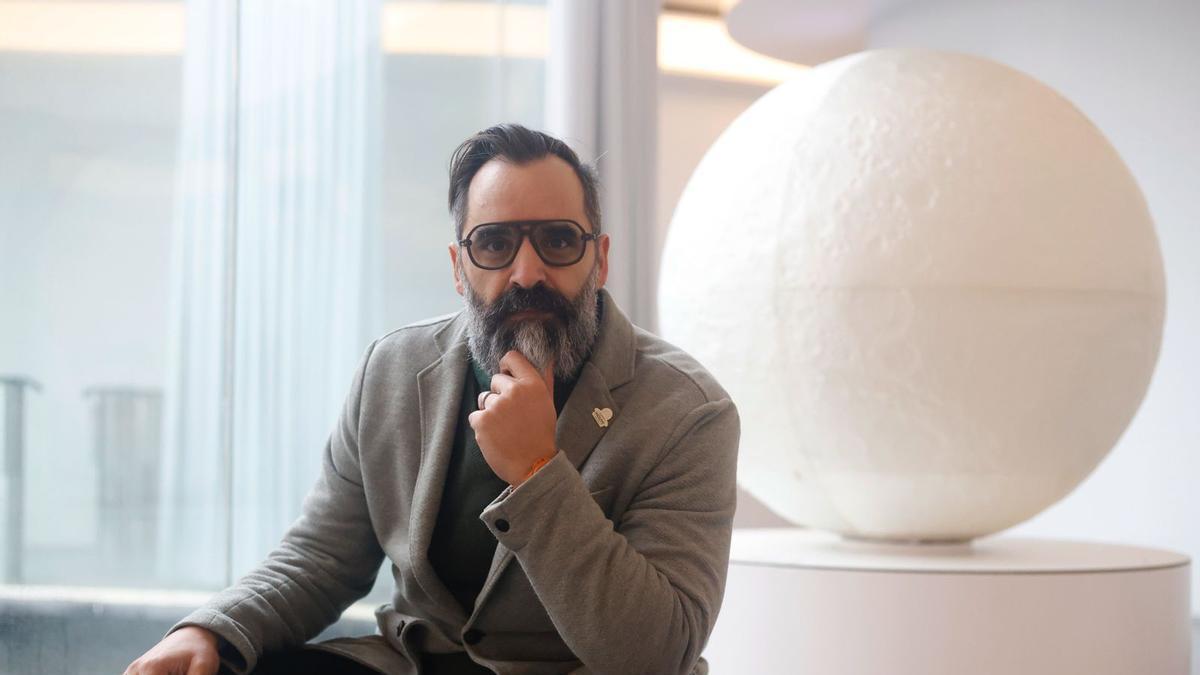
Now, he eagerly anticipates the trio of eclipses in 2026, 2027, and 2028. Jorge Pérez-Gallego is the Director of Education, Outreach, and Communications at the National Solar Observatory in the United States, the center responsible for terrestrial solar observations in the country. The observatory’s expertise in operating and building telescopes and technologies for observing the sun led him to the first Meeting of Communication, Science and Society ‘Astrojournalism: telling eclipses’ organized by the Association of Journalists of Aragon and the Center for Studies of Physics of the Cosmos of Aragon (CEFCA).
What generates so much curiosity or attraction for eclipses? Does that create them a special opportunity for scientific outreach?
Eclipses are Christmas Day for solar physicists. People don’t usually seem at the sun. they tend to get excited about the night sky, stars, planets, black holes, or dark matter. When I ask children in my work which is their favorite celestial object, they rarely say the sun. However, when I depart, they are all in love with the sun, because it is our star and we are here thanks to it. And it’s true that, in the days leading up to an eclipse, people start to become interested in the sun. It’s an opportunity to explain how we study it with telescopes and instruments and why it’s essential to do so, because the sun affects us. For example, the sun is responsible for solar storms: when they head towards Earth, they produce auroras borealis and australis, but they can also damage technological infrastructure such as communication satellites. Studying the sun allows us to better predict these storms and minimize damage, just as weather forecasting helps civilization.
In fact, in the media and conversation, the sun appears associated with danger, extreme heat, or climate emergency. Are eclipses an opportunity to improve that image?
It’s true, it may be a cultural issue. People say “don’t get too much sun,” but we must not forget that the sun does so much for us that without it we wouldn’t be here. It gives us vitamin D, feeds plants, and is responsible for almost all the energy we consume on Earth, except for nuclear energy. Gasoline, for example, comes indirectly from the sun, to name just one thing. It’s a fascinating star and the only one we can study in detail. Studying it helps us better understand other stars and the exoplanets that orbit them. The better we understand the Sun, the better we understand the rest of the universe.
In 2024, he was responsible for and led the broadcast of the total eclipse in the United States for the National Science Foundation (NSF) and the National Solar Observatory (NSO). He has said that the eclipse broadcast was the best and worst experience of his career. How do you organize a device to broadcast with scientific rigor but with appeal something that lasts only a few minutes?
We decided to seize advantage of the fact that people were paying attention to the sun to explain everything we do to research it. It’s important to remember that, in the United States, the National Solar Observatory is public and funded by taxes, so we also felt it was important to explain what that money is invested in. So, during the broadcast, we talked about the eclipse, why it happens, safety measures, but also about the telescopes, instruments, and research. It’s a unique opportunity for solar physics and to share what we do for the common fine. We did it with a broad device: we had a central studio in Washington D.C., outside the line of totality (the strip in which you can witness the moon completely covering the sun) and two mobile units with telescopes prepared to capture images of the sun and send them to the studio. We opted for two units because visibility depends on clouds and, although you usually choose the location based on historical statistics, there are no guarantees that you will be able to see it well. In fact, the day before, with more reliable forecasts, we moved one unit from Texas to Illinois. The group I communicated this to wasn’t exactly jumping for joy when I told them, but they understood the reason and understood that it was for the common good and to be able to communicate and celebrate the eclipse with all those who were not going to be in the totality strips. If you are in the totality strip, forget about mobile devices, broadcasts, enjoy it directly in the partiality phase with eclipse glasses, in the totality phase without them.
You mentioned telescopes as a means of capturing images. Is a lot of specific instrumentation needed to broadcast an eclipse?
A simple telescope works and then all you need is an adapter to convert that signal to digital, be able to send it to a computer and then send it to the producer so they can choose. From control we see telescope one, telescope two, ambient camera, presenter camera… Nothing more sophisticated than that is needed. Those sophisticated systems are to acquire scientific data during the eclipse, but that’s another story.
And what did you find? How do people react to a total solar eclipse?
The emotion and energy reached us in the central studios, you saw people jumping, getting excited, pointing at the sun, moving around. I sometimes compare it to the energy you feel at your favorite artist’s concert. You can listen to your favorite artist at home, but you go to concerts because, at the concert, something happens. Having the artist there and being surrounded by people who are also letting themselves be carried away by the music does something. Well, the artist is the sun, the sun and the moon, and you are there in the greatest celestial show there is, which can be enjoyed with our own eyes. It’s that sometimes I run out of words because it’s really a unique experience. Even if you live it in a group it is a very personal experience because it’s the scientific “open your eyes” moment, an experience that demonstrates that science makes sense. I have worked a lot in museums and two things are pursued: the “wow” and the “aha”. To amaze people to create interest and, once there is interest, to offer enough information so that people understand it. An eclipse gives you that raised to the nth power. That apart from a more personal or even dealing with the spiritual.
In other words, eclipses can be considered a vaccine against scientific denialism
Correct. That is, we can predict eclipses to the second centuries in advance, and we can also predict them backwards. In history, eclipses are used to date documents: if someone says: “The king died the day after the eclipse” we can accurately establish when they are talking about. Eclipses are exact. They are a demonstration of science. Lunar eclipses occur because the Earth’s shadow passes over the Moon, and it is a circular shadow. There is no room for flat-earthism.
What about the preparations in Spain for upcoming eclipses?
As far as I know, preparations are being made and there is coordination between agencies. An eclipse involves not only science, but also mobility, civil protection, and infrastructure. They generate a lot of mobility and, sometimes, very difficult to order. Think that many people will realize at the last moment the difference between a partial and a total eclipse and will move towards the totality strip when they realize that, from where they are, they will not see it complete. All this must be planned.
The Trump administration’s cuts to science gave the world pause. What’s it like working in a U.S. Public agency dependent on the current government?
As far as I can tell, we have enjoyed quite a bit of security due to the fact that the sun is very important to our day-to-day lives. A black hole is a fascinating celestial object, but it does not have an impact on our day-to-day lives, it will not be responsible for us not being able to communicate, it will not be responsible for damaging communication satellites. But the sun potentially is: for example, if there is a very, very large solar storm, it could even damage the terrestrial power grid. That’s why the administration understands that it is so important to study the sun and that’s why the National Solar Observatory has enjoyed a security that, unfortunately, other colleagues who are dedicated to other types of sciences have not enjoyed.
Subscribe to continue reading
