
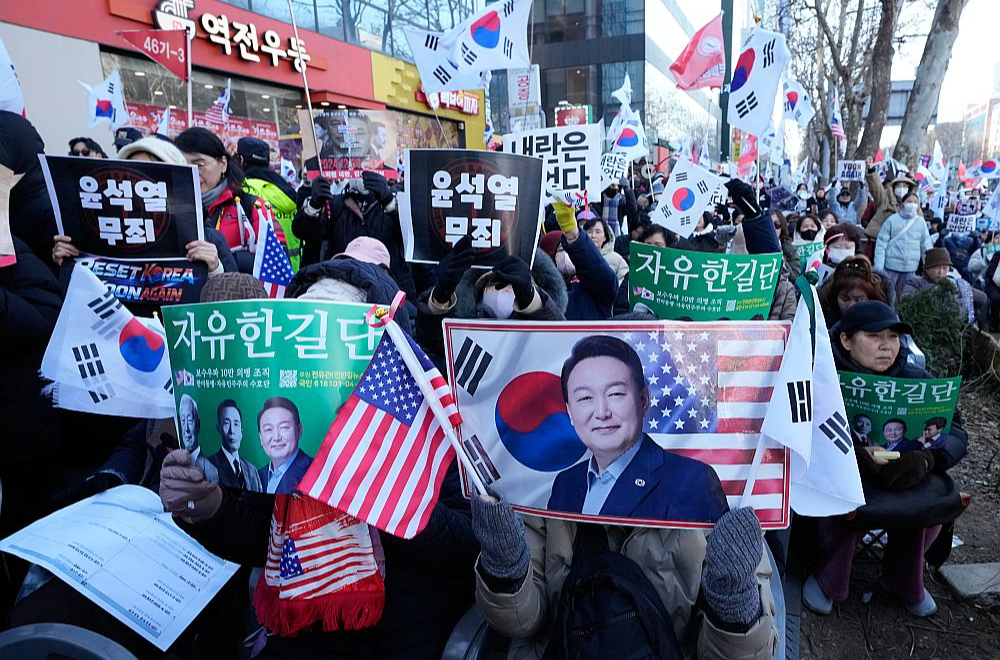
A South Korean court on Thursday convicted former President Yoon Suk-yeol of leading an insurrection related to the declaration of martial law in 2024 and sentenced him to life in prison.
The harsh sentence reflects the seriousness with which South Korea views authoritarian tendencies, given the country’s experience with military dictatorships in the 20th century. Martial law has been declared 16 times in the nation’s history since the end of World War II, with the last instance prior to Yoon’s occurring in 1979, before the country transitioned towards democracy in the latter half of the 1980s. This case underscores the fragility of democratic institutions and the potential for backsliding even in established democracies.
No Remorse Shown
“The declaration of martial law had enormous consequences for society and it is difficult to locate any indication that the defendant has expressed remorse for it,” Judge Ji Kwiyong stated during Thursday’s proceedings. Prosecutors had sought the death penalty for Yoon, arguing his actions threatened the country’s democracy. While the death penalty has not been carried out in South Korea since 1997, an unofficial moratorium is currently in place. Most observers predicted a life sentence for the former president, as his attempt to seize power did not result in any loss of life. Yoon has the right to appeal the verdict, though a reversal is considered unlikely. He had previously been sentenced to five years in prison for obstructing his arrest and faces further pending charges.
The major political crisis that gripped South Korea stemmed from Yoon’s decision on the evening of December 3, 2024, to declare martial law and dispatch troops to the National Assembly. Addressing the nation, Yoon cited threats from North Korea and “anti-state forces” as justification for the measure. However, just six hours later, Yoon was forced to rescind the declaration in response to a unanimous call from the parliament to do so. The imposition of martial law also sparked widespread protests. The parliament subsequently impeached Yoon on December 14, 2024, and the Constitutional Court officially removed him from office in April 2025. He had been detained since July.
Other Officials Also Sentenced
The conservative former president told the court he had declared martial law only to inform the public that the parliament, controlled by liberals, was paralyzing the government. He claimed he was prepared to consider the legislature’s views if they had voted against the declaration. Prosecutors dismissed this explanation, maintaining that Yoon attempted to block the parliament’s work and prevent lawmakers from voting on the martial law measure, exceeding his authority even during a state of emergency. The court found that Yoon’s aim was “to dispatch troops to the National Assembly, block the National Assembly building, and detain key figures, including the speaker of the National Assembly and leaders of the ruling and opposition parties, to prevent lawmakers from gathering for deliberation or voting,” the judge stated.
In connection with the insurrection led by Yoon, other high-ranking officials from his administration, including the former defense minister, police chief, and intelligence chief, also received prison sentences.
In a related case, former Prime Minister Han Duck-soo was sentenced to 23 years in prison in January for his role in the uprising. Separately, in January, Yoon’s wife, Kim Kyeong-hee, received a 20-month prison sentence for corruption.
Societal Polarization
Supporters of Yoon gathered outside the courthouse on Thursday, while opponents of the former president held a separate rally nearby. Observers note that South Korea has experienced increasing political polarization in recent times. The conservative camp is represented by Yoon’s People Power Party, while the liberal side is represented by the Democratic Party. It is believed Yoon decided to impose martial law because he was unable to cope with the situation in the country through other means, and there was no serious justification for such action. Following elections in April 2024, Yoon’s party lost its majority in parliament, with the newly empowered liberals obstructing the passage of the budget and attempting to impeach several members of Yoon’s administration. A corruption scandal involving his wife also eroded Yoon’s authority, making him increasingly unpopular even before the declaration of martial law. Yoon is not the first former South Korean president to be imprisoned. The BBC reports that virtually all former South Korean leaders convicted of corruption and imprisoned have eventually been pardoned after a few years in the name of national unity. It remains unknown whether the same fate awaits the sixty-five-year-old Yoon, who before his political career was a prosecutor and had himself pursued charges against high-ranking officials.
Choose your social media platform to follow LASI.LV: Facebook, X, Bluesky, Draugiem, Threads or Instagram. Join our readership to receive specially selected useful, practical and up-to-date content.
Subscribe to the LASI.LV editor’s newsletter here.
Subscribe to the newsletter and receive twice a week a detailed compilation of current news, competent opinions and interesting interviews from the LASI.LV chief editor.
You will receive:
- Diverse comments and competent opinions from Latvijas Mediju journalists and authors on current affairs
- Expert comments on various practical, useful topics
- Fascinating materials on history, psychology, culture
- A cartoon by Gatis Šļūka
- In your inbox every Thursday
