
Spain continues to see a surge in entrepreneurial activity, particularly among young adults seeking independence, but success isn’t guaranteed. The story of Noelia Tomé, a pastry chef in Viladecans, offers a revealing look at the challenges and pivotal decisions behind building – and nearly losing – a small business.Tomé’s experience, recently shared in a viral interview, highlights the often-unseen realities of scaling a business, managing staffing, and ultimately, pivoting to profitability.
In Spain, entrepreneurship is an increasingly popular career path, particularly among young people seeking independence and the opportunity to build their own projects.
However, many self-employed individuals argue that the road to entrepreneurship is fraught with risks, sacrifices, and challenges. Despite these hurdles, entrepreneurs consistently share a common trait: determination and hard work to succeed.
The story of Noelia Tomé, a Spanish businesswoman, has recently gone viral, offering a candid look behind the scenes of starting a business. After eight years working in a pastry shop, Tomé decided to launch her own venture. In an interview for Eric Ponce’s podcast, she explained her motivations and the reality that many don’t discuss when creating a company.
The Hidden Realities of Entrepreneurship
Tomé launched Noelia Bakery at the age of 24, a café-pastry shop in Viladecans focused on artisanal products. “We did everything there, it was all handmade,” she explained. The business quickly gained traction, requiring her to expand her team. From 2016 to 2020, the team grew to six people, managing social media and fulfilling orders. This growth in demand reflects the increasing consumer appetite for locally sourced, artisanal goods.
The arrival of the Covid-19 pandemic, however, forced a shift in the business model, with a focus on online orders. “We also started selling breakfast deliveries with artisanal products, and it took off, with 40 or 50 breakfasts,” Tomé said. This surge in online sales necessitated hiring additional staff—at one point, she had five pastry chefs—and required a larger production space.
Thanks to the success of online sales, Noelia’s business experienced rapid growth. She was able to purchase a second location as her original space became too small to handle the increased production volume. However, Tomé quickly realized this expansion was a misstep. “I started off on the wrong foot because I no longer had control of what was happening in both locations. The growth became overwhelming.”
“Problems started to pile up. I’d have 50 breakfasts ordered, and the pastry chef would call in the morning saying something was wrong. I was getting up at 5 a.m. every day to see who wasn’t coming in,” she recounted. “In our last year here, we billed 500,000 euros. But in the end, profit was only 15,000 or 20,000 euros because I had so many employees, and I had to buy raw materials. The problem with doing everything is that you need a lot of hands.”
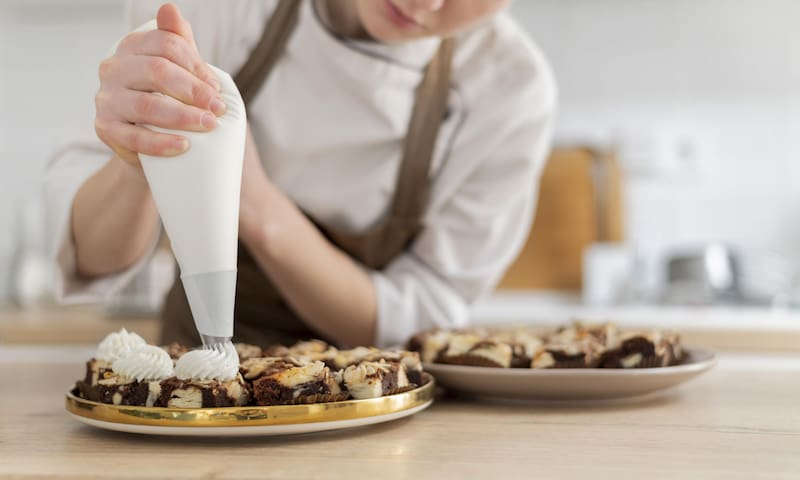
Staffing Changes That Saved Noelia Tomé’s Business
Despite the high revenue, Tomé found that the final profit margin was too low and didn’t justify the stress. “I saw that I was moving money, but I wasn’t really making money,” she said. This stress prompted her to overhaul her business model.
“I started to see that everything online worked very well and required fewer people. There was no need to have a physical location with someone waiting for customers; I was able to find the customers, showcase my product, and sell it. It’s very convenient in the end.” She then sold her café and stopped making breakfast deliveries, focusing solely on pastry production.
“I thought about what I could do to make money on my own: courses, advertising, a specific quantity of pastries.” This success on social media led to the publication of her cookbook, Oh, my cookie. “I diversified a lot of what I did and saw different business lines.” Tomé’s decision has not only increased her income but also allowed her to feel more relaxed and enjoy her passion: pastry making.
