
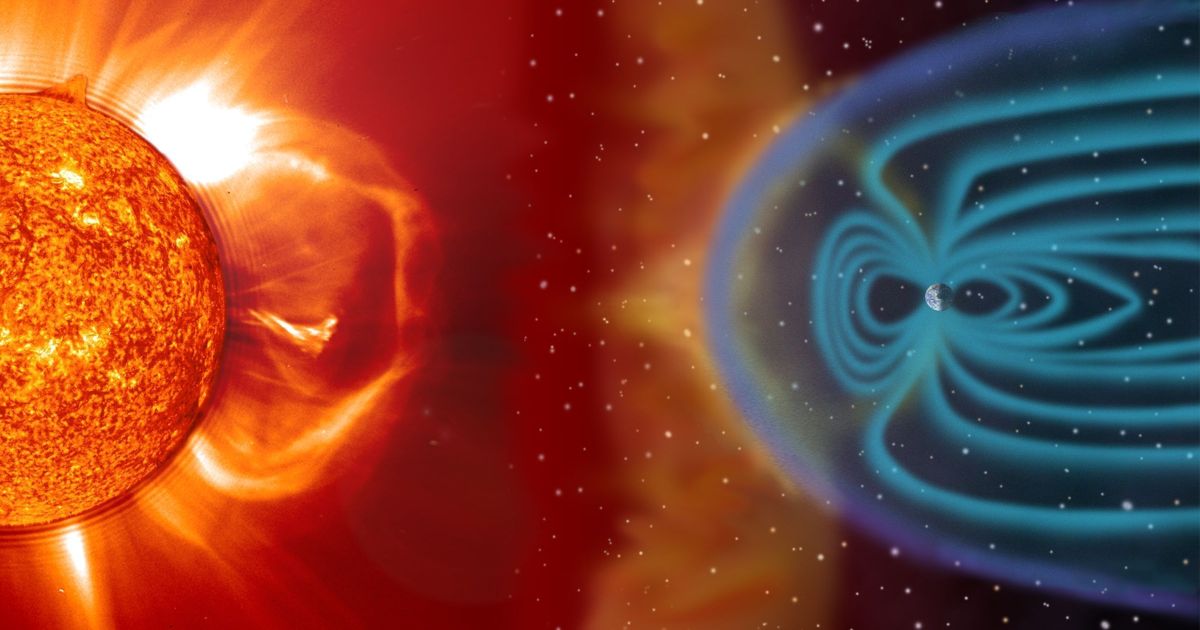
A solar storm is expected to impact Earth between today, March 20, and tomorrow, March 21, with a strength that has surprised scientists. Initial forecasts predicted a moderate-intensity storm, but conditions have intensified.
The information was released by the National Oceanic and Atmospheric Administration (NOAA).
The solar storm is now predicted to reach Category G3, considered strong. Previously, a G2, or moderate, storm was anticipated.
- March 20 – G3 – strong
- March 21 – G3 – strong
- March 22 – G1 – minor
Storm alerts range from G1 to G5, with G5 representing the most severe category.
The storms are a result of solar flares that caused a coronal mass ejection (CME) toward Earth.
A CME is essentially a large cloud of magnetic storm particles ejected from the sun, heading towards our planet. On March 16, a solar flare of class M2.7 occurred.
Solar flares are categorized by class, with X-class flares being the most severe and capable of disrupting satellites in Earth’s orbit. M-class flares, like the one that occurred on March 16, are considered moderate.
- X-Class – These are the most severe, with the potential to interfere with communications and cause significant radiation exposure, and generate intense auroras.
- M-Class – These are medium-sized and can cause brief radio communication disruptions and also generate auroras.
- C-Class – These are small and have few noticeable consequences on Earth.
According to NOAA, a G3 storm poses a risk primarily to satellite systems, which could experience significant overloads.
Fluctuations in power grids in extreme regions of the planet are also possible. Astronauts aboard the International Space Station may be restricted from spacewalks due to radiation risks.
GPS networks could also be affected.
Intense auroras are also expected, along with interference with radio systems.
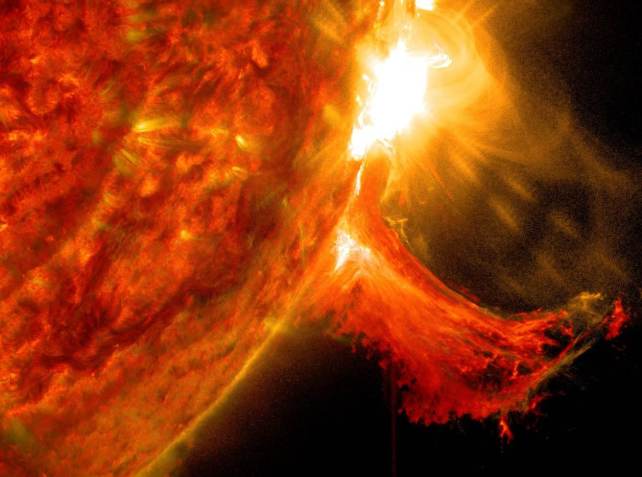
What is a Solar Flare?
Solar flares are common and occur several times a year, though a series of strong X-class flares in a few days is rare. You can learn more about solar flares here.
They are part of solar activity. The Sun has a magnetic activity, and these flares occur with some frequency, particularly when the Sun is more active.
The Sun operates on a cycle, averaging 11 years in length. During this period, the sun’s magnetic field reverses, causing variations like visible sunspots, and flares.
