
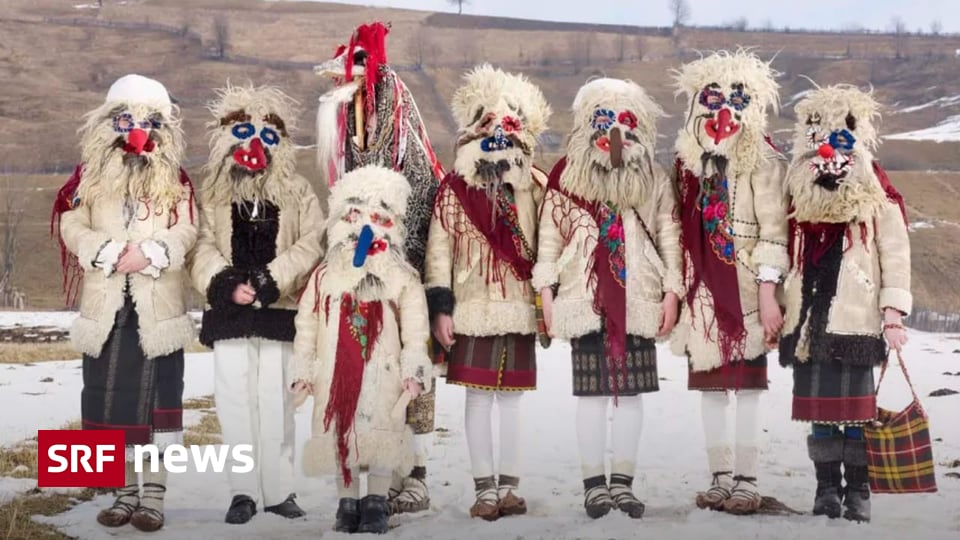
A Swiss exhibition featuring striking photographs captures a centuries-old tradition of winter rituals across Europe, prompting the photographer to reflect on the importance of satire and humor in modern society.
In Teufen, Switzerland, archaic figures known as the “Silvesterchläuse” roam the streets on New Year’s Eve, adorned in clothing made of fir branches or straw, some wearing demonic masks.
These rituals, and many others across Europe, have been captured in a new exhibition by French photographer Charles Fréger.
The exhibition, currently on display at the Zeughaus in Teufen, blends photographs from Switzerland with those taken elsewhere in Europe, showcasing traditional rituals intended to ward off evil spirits or the winter season. The project, titled “Charivari,” a word with Greek origins meaning cacophony and chaos, explores customs that create a state of collective disorder.
Anfang Bildergalerie
-
Bild 1 von 9. Maskerade der Ziege, Rumänien. Bildquelle: Charles Fréger.
-
Bild 2 von 9. Échelliers, Fête des Pailhasses, Languedoc, Frankreich. Bildquelle: Charles Fréger.

-
Bild 3 von 9. Tschäggättä, aus dem Schweizer Lötschental. Bildquelle: Charles Fréger.
-
Bild 4 von 9. S’Urtzu e sos Bardianos, Sardinien, Italien. Bildquelle: Charles Fréger.
-
Bild 5 von 9. Smrt (der Tod), Třebič, Tschechische Republik (links) und Caretos, Vila Boa de Ousilhão, Portugal (rechts). Bildquelle: Charles Fréger.
-
Bild 6 von 9. Mascarita, Alsasua, Baskenland, Spanien (links) und Burryman, Queensferry, Schottland (rechts). Bildquelle: Charles Fréger.
-
Bild 7 von 9. Arkouda (Bär), Monastiraki, Griechenland (links) und Nevesta, Begnishte, Mazedonien (rechts). Bildquelle: Charles Fréger.
-
Bild 8 von 9. Sauvages (Wilde), Le Noirmont, Schweiz. Bildquelle: Charles Fréger.
-
Bild 9 von 9. Mechkari, Prilep, Mazedonien (links) und Laufr (Springer), Třebič, Tschechische Republik (rechts). Bildquelle: Charles Fréger.
Ende der Bildergalerie
A Call for Satire
Fréger describes his work as a plea for a world where it’s acceptable to make fun of things. He believes these customs allow for “a kind of reset of the community.” Yet, he suggests the traditional function of festivals like Carnival – to upend all norms – is fading, finding expression elsewhere in modern society.
“Today, the venting function of masquerade is more likely found in social networks,” he said. “Instead of masks, people use avatars or pseudonyms. Like masks, they offer freedoms from the rest of the world.”
Fréger is interested in the photographed rituals as moments of connection between people, often focusing on small villages where close-knit groups come together in disguise.
Caricature of the Other
Often, the figures in Fréger’s “Charivari” are caricatures of outsiders. “There are many representations in European masquerades that are not consensual. It’s about the confrontation between communities, memories of invasions and wars,” the photographer explained.
He stresses the importance of providing space for such expressions, stating, “We must revive our ability to mock.” He feels surrounded by “a world where it is currently impossible to make fun of anything.”
We must revive our ability to mock.
The “Charivari” also holds a central place in the Basel Carnival. Fréger felt most at home during his tour of Switzerland at the Schnitzelbänke in Basel. “I really liked this jester-like quality.”
However, Fréger also emphasizes that “satire only works if you are willing to make yourself gaze ridiculous.”
He was particularly fascinated by the “Nünichlingler” in Switzerland: men in long black coats, bells around their necks, and incredibly tall cylinders, who roam the village of Ziefen in the Basel region like ghosts on Christmas Eve. Originally, these figures were meant to frighten children, rewarding the obedient and punishing the disobedient.
For Fréger, the common thread in “Charivari” is that people produce their own absurdity: the mayor runs through the streets as a pig, the politician sits on a donkey, people give themselves grotesque bodies.
“Charivari is not just the freedom to drink too much, to eat too much, to do what you want. It is also the moment when you look in the mirror and are ridiculous and laugh at yourself,” Fréger said, adding that such opportunities are currently lacking.
