
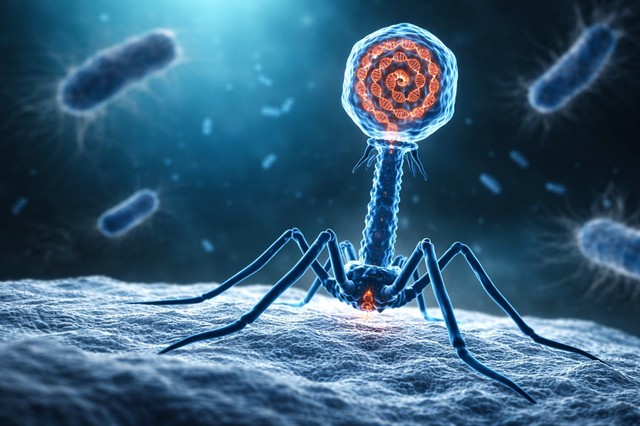
A new genetic engineering technique is allowing researchers to design and produce viruses capable of destroying bacteria directly from genetic information. The method could accelerate the development of targeted therapies against antibiotic-resistant infections, a major public health challenge.
Researchers have demonstrated that bacteriophages – viruses that infect and destroy bacteria – can be created entirely in the laboratory starting only with DNA sequences. This offers a faster and more flexible alternative to traditional methods, which rely almost exclusively on naturally occurring viruses that are tough to modify. The rise of antibiotic resistance makes finding new ways to combat bacterial infections increasingly critical.
Bacteriophages have been used for over a century to treat bacterial infections, but interest in these therapies has grown recently due to the accelerating spread of antibiotic-resistant bacteria. Progress has been slow, however, because engineering natural bacteriophages is laborious, difficult, and limited to a few well-studied models.
In a study published in Proceedings of the National Academy of Sciences, researchers from New England Biolabs and Yale University describe the first fully synthetic system for engineering bacteriophages that target Pseudomonas aeruginosa, a bacterium with increased resistance to antibiotics and a major global impact. The method is based on the High-Complexity Golden Gate Assembly platform, developed by New England Biolabs, which allows the production of synthetic viruses based on genetic information, without the necessitate for existing viral samples.
Using this approach, the team assembled a bacteriophage for Pseudomonas aeruginosa from 28 synthetic DNA fragments. The virus was then subjected to genetic modifications through the insertion and deletion of DNA fragments. These changes allowed the virus to infect other types of bacteria and made the infection process visible in real time through the introduction of fluorescent markers.
The authors emphasize that, until now, bacteriophage engineering has required years to develop functional methods for a single model virus. The new synthetic system significantly reduces the complexity of the process and increases the speed and safety with which genetic modifications can be made.
The Golden Gate Assembly platform allows the complete assembly of the viral genome outside the cell, using short DNA fragments, where all modifications are planned in advance. After assembly, the genome is introduced into a safe laboratory strain, where it becomes an active bacteriophage. This procedure eliminates the need for fragile virus collections and specialized host bacteria, which are difficult to manage, especially when dealing with pathogens dangerous to humans.
Compared to other DNA assembly methods, which use longer fragments, Golden Gate Assembly utilizes shorter sequences that are easier to produce and less toxic to host cells. The method too tolerates repetitive sequences and high guanine and cytosine content, characteristics frequently found in bacteriophage genomes.
Collaboration between researchers at New England Biolabs and bacteriophage specialists at Yale University was essential for developing this technology. The platform was initially tested on a well-known virus, bacteriophage T7, which infects Escherichia coli (E. Coli), and then expanded to bacteriophages targeting bacteria with increased antibiotic resistance.
Related research, which used the same method to construct bacteriophages with a genome rich in guanine and cytosine that infect mycobacteria, was published in PNAS in November 2025, in collaboration with the University of Pittsburgh and Ansa Biotechnologies.
In another project, described in a study published in December 2025 in ACS, researchers at Cornell University and New England Biolabs created synthetic T7 bacteriophages used as biosensors for detecting Escherichia coli in drinking water.
The study authors believe this approach opens the possibility of developing bacteriophages designed precisely for research applications and, in the long term, for combating antibiotic resistance without the need to directly modify viruses in living cells. This advancement could pave the way for more personalized and effective treatments for bacterial infections.
