
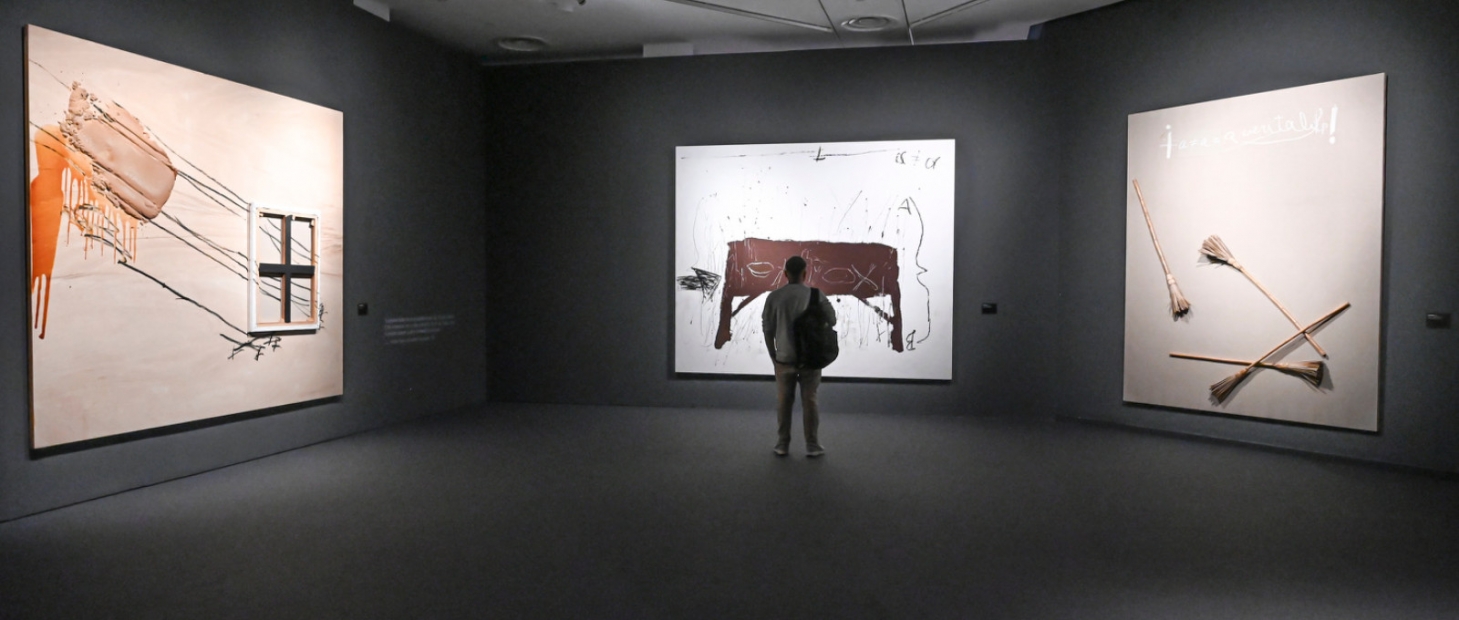
Tàpies. Última década (2002-2012) en la Fundación Bancaja, Valencia, España, 2026. Imagen cortesía de Fundación Bancaja” title=”Vista exposición Tàpies. Última década (2002-2012) en la Fundación Bancaja, Valencia, España, 2026. Imagen cortesía de Fundación Bancaja” loading=”lazy”/>
Vista exposición Tàpies. Última década (2002-2012) en la Fundación Bancaja, Valencia, España, 2026. Imagen cortesía de Fundación Bancaja
Some artists seem to reveal all their creative depths in retrospective shows. But with Antoni Tàpies, it’s quite the opposite: the closer you get to the end of his career, the more apparent it becomes that the central question driving his entire body of work remained unresolved. Tàpies. Última década (2002-2012), currently on view at the Fundación Bancaja in Valencia, delves into that very territory of persistent inquiry, where painting ceases to be merely an image and transforms into a surface laden with signs, materials, and thought.
The exhibition focuses on the final phase of the artist’s life, a period often considered marginal within his extensive oeuvre, but one that actually offers a particularly clear view of the consistency of his artistic language. Curated by Fernando Castro Flórez, the show brings together twenty-two large-format works, allowing viewers to examine how Tàpies continued to develop his visual vocabulary until the very end of his life. Several of these pieces are being shown to the public for the first time, adding a revealing dimension to the experience.
The presentation reinforces this intention. The galleries are dimly lit, with focused illumination highlighting each work. Visitors find themselves surrounded by monumental surfaces that seem to float in the darkness, creating an atmosphere of contemplation unusual for contemporary exhibition spaces. The arrangement of the pieces avoids visual saturation and encourages a direct relationship with each artwork. The paintings appear as autonomous objects demanding sustained attention.

Vista de la exposición Tàpies. Última década (2002-2012) en la Fundación Bancaja, Valencia, España, 2026. Imagen cortesía de Fundación Bancaja
This type of staging is particularly fitting for Tàpies’ work. From the mid-20th century onward, the artist constructed a language based on material, trace, and sign. His surfaces, loaded with dense pigments, sands, or heterogeneous materials, evoke walls eroded by time. Painting ceases to function as a space of representation and transforms into a place where matter takes center stage.
The works assembled at the Fundación Bancaja maintain this principle with full intensity. Tàpies’ visual repertoire is condensed into a series of recurring elements: letters, numbers, crosses, fragments of the human body, or everyday objects incorporated into the painted surface. In some pieces, brooms, fabrics, or wood intrude into the space of the canvas. These elements aren’t simply formal additions; they’re part of a strategy the artist developed over decades to integrate the everyday into painting and question traditional hierarchies between the noble and the ordinary.
Matter doesn’t appear solely as a plastic resource but almost seems like a metaphor for human existence, with its layers and layers of meaning. The rough surfaces, cracks, or wear and tear evoke an experience marked by time and fragility.
Historically, this approach connects Tàpies’ work with European Informalism of the post-war period, though his work never limited itself to that framework. The artist introduced a reflective dimension into painting, bringing it closer to both philosophical thought and certain Eastern spiritual traditions. Matter doesn’t appear solely as a plastic resource but almost seems like a metaphor for human existence, with its layers and layers of meaning. The rough surfaces, cracks, or wear and tear evoke an experience marked by time and fragility.
the late work of Tàpies can be read in relation to a philosophical tradition that runs through the 20th century. The insistence on matter and trace recalls Martin Heidegger’s reflection on the material presence of the world. At the same time, the economy of signs and attention to emptiness evoke the influence of Zen thought, which the artist studied for years. Both traditions share a common intuition: reality isn’t revealed through grand images, but through minimal gestures and their accumulation.

Vista de la exposición Tàpies. Última década (2002-2012) en la Fundación Bancaja, Valencia, España, 2026. Imagen cortesía de Fundación Bancaja

Vista de la exposición Tàpies. Última década (2002-2012) en la Fundación Bancaja, Valencia, España, 2026. Imagen cortesía de Fundación Bancaja
As you move through the show, you can see how this conception of existence remained with the artist throughout the last decade of his life. The works don’t present a spectacular evolution or an abrupt change of language. What you perceive is a progressive refinement without losing any coherence. The signs become more sparse, the surfaces more sober, and the incorporated elements acquire a greater symbolic weight. Instead of multiplying formal resources, Tàpies reduces them to achieve a form of expressive concentration that viewers appreciate without mediation.
Among the recurring motifs is the figure of the human body, though never in the form of traditional figurative representation. Mouths, eyes, or limbs emerge as fragmentary traces alluding to physical presence. The body manifests as a mark. This strategy introduces an existential dimension into the work, where the human figure is associated with vulnerability and wear.
Another central element is the leverage of graphic signs that resemble inscriptions or annotations. Letters and crosses function as units of a visual language that Tàpies developed throughout his career. These signs have sometimes been interpreted as religious references, though their meaning is more complex and not always so obvious—after all, a cross is a cross. The artist used them as tools for thought capable of condensing an experience or idea that connects with the observer.
The persistence of these resources confirms that the final stage of his production doesn’t represent a break with the past, but a preparation of a legacy. Rather, it’s a process where the artist revisits his own visual vocabulary with an attitude of synthesis. Each work seems to insist on the same question: what can painting do when it abandons representation and confronts matter directly?

Vista de la exposición Tàpies. Última década (2002-2012) en la Fundación Bancaja, Valencia, España, 2026. Imagen cortesía de Fundación Bancaja
The curation by Castro Flórez underscores this reflective dimension. The tour insists on the relationship between the signs, the body, and the incorporated objects—three elements that run through Tàpies’ work from his earliest material investigations. The selection allows you to observe how these motifs reappear with particular intensity, as if the artist had decided to condense the essential principles of his language into each piece.
The excellent reception this exhibition has received confirms the continued relevance of his art. Numerous critical comments have pointed out that the late works of Tàpies maintain a radicalism rarely seen in artists of his generation. Instead of offering a conciliatory recapitulation of his trajectory, the painter continued to explore the possibilities of matter and sign with surprising energy. The show, which runs through August 30, 2026, adds to a growing interest in the artist’s legacy following the centenary of his birth.
Painting doesn’t aspire to offer conclusive answers. It functions more like a field of interrogation where matter preserves the memory of what has been touched, used, or transformed.
This persistence has something of an ethical gesture. In an artistic context where innovation is often presented as an indispensable requirement, the appear proposed by Tàpies demonstrates that depth can arise from the conscious repetition of a problem. Each work returns to the same question: how to transform painting into a place where human experience can leave its mark.
Faced with the rough surfaces of the paintings, the spectator confronts something that cannot be resolved through immediate reading. The signs appear as fragments of a language that never quite completes itself. The traces of the body recall the fragility of all presence. The incorporated objects introduce the everyday world into a territory that for centuries had been reserved for representation.

Vista de la exposición Tàpies. Última década (2002-2012) en la Fundación Bancaja, Valencia, España, 2026. Imagen cortesía de Fundación Bancaja
Perhaps that’s where the most philosophical dimension of Tàpies’ late work lies. Painting doesn’t aspire to offer conclusive answers. It functions more like a field of interrogation where matter preserves the memory of what has been touched, used, or transformed. Instead of illustrating concepts, these surfaces force you to think from the direct experience of the material. The canvas becomes a place where time leaves visible marks, where the human gesture is fixed as a scar.
Contemplating these pieces involves accepting that painting can be a territory where uncertainty takes on tangible form. It’s not about understanding a hidden message or deciphering a closed symbolic system. It’s about remaining before the matter and recognizing that it inscribes something fundamental of the human experience: the passage of time, the fragility of the body, and the persistence of gestures.
The last decade of Tàpies appears as a final reflection on the very meaning of painting. When language is reduced to essential signs and bare surfaces, the work approaches a form of material meditation. Instead of seeking novelty at any cost, the artist returns to the same elements with an obstinacy that recalls the attitude of someone examining a question without expecting a definitive answer.
the paintings gathered at the Fundación Bancaja don’t present themselves as a complacent epilogue. They function as a reminder that art can still be a place of thought. Where the gesture seems minimal and the image becomes most silent, painting recovers its ability to question the world. And perhaps that’s the great lesson after visiting the show: painting doesn’t run out.
