
Thailand is at a critical juncture in its economic future, facing pressures from shifting global trade dynamics and the escalating impacts of climate change. Recent analysis from Kasikorn Research Center, presented at the Bangkok Industrial Gas Co., Ltd.’s “Generating a Cleaner future Forum 2025,” underscores the need for urgent industrial reform and a strategic embrace of renewable energy. As geopolitical tensions rise and international climate commitments falter, Thailand must navigate a complex landscape of carbon taxes, ideological conflicts, and emerging economic blocs to secure its competitiveness and attract vital foreign investment. The findings highlight both meaningful challenges and promising opportunities for the nation to position itself as a key player in the transition to a low-carbon economy.
Bangkok Industrial Gas Co., Ltd. (BIG) hosted its 3rd “Generating a Cleaner Future Forum 2025,” where Kasikorn Research Center’s Managing Director and Chief Economist, Burin Adulwattana, outlined key factors influencing Thailand’s energy transition and industrial shifts within the context of a low-carbon economy. His remarks came as the world navigates geopolitical instability and increasingly challenging climate goals. Adulwattana delivered his analysis during a special presentation titled “Decoding the Global Economy 2026.”
“From an economist’s perspective, the COP30 discussions were rather disappointing, as many commitments remain unfulfilled,” Adulwattana stated. “Most scientists now believe it will be impossible to limit global temperature increases to below 1.5 degrees Celsius by the year 2100.”
“As the goal of temperature control drifts further out of reach, all countries and industries must prepare to adapt to a warming world. Furthermore, the financial and logistical support expected from developed nations to aid developing countries has not materialized, hindering progress on carbon reduction commitments.”
Geopolitical Trade Dynamics and Ideological Conflicts
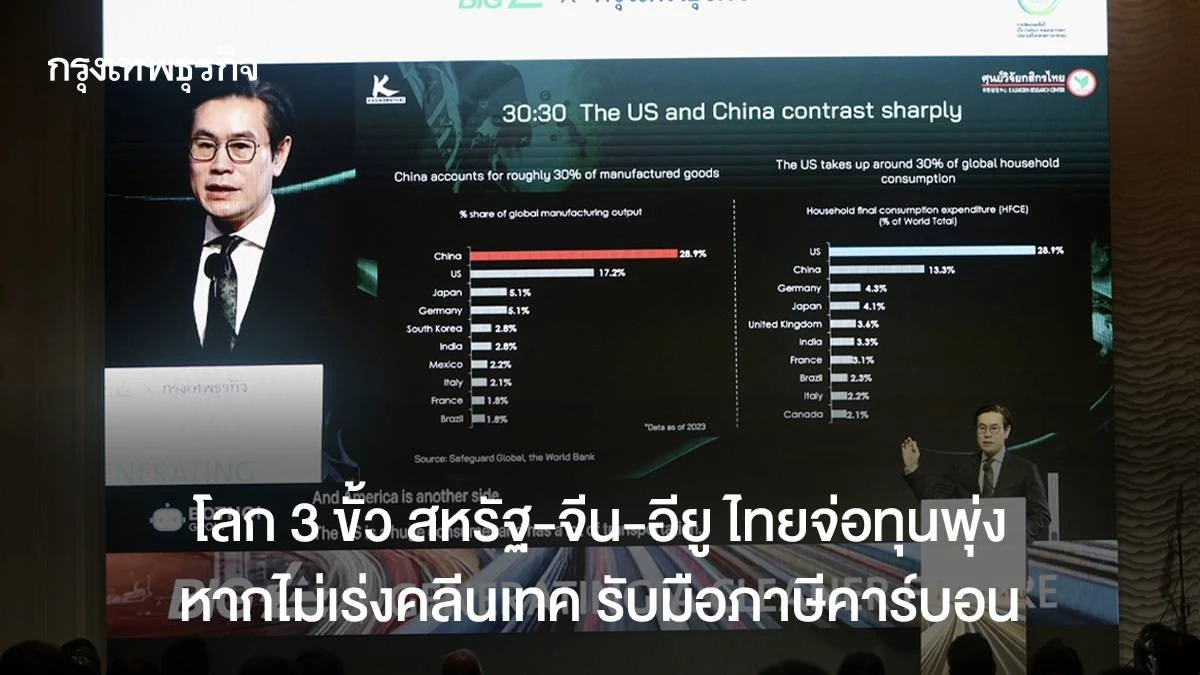
The global landscape is increasingly defined by geopolitical competition, particularly between the United States and China, which Adulwattana described as a “Clash of Ideology.” He outlined a division of the global economy into three primary blocs, each representing approximately 30% of the whole (30-30-30):
- United States – 30% Consumer Pole: The U.S. accounts for 30% of global household consumption, driven by high consumer spending. Despite a current credit card debt of $1 trillion, the U.S. remains a major producer and exporter of oil and natural gas, leading it to downplay the urgency of climate change concerns to protect its energy exports.
- China – 30% Manufacturing Pole: China produces roughly 30% of the world’s goods and is currently experiencing prolonged deflation due to price competition among manufacturers. Facing energy security concerns – importing 60-70% of its oil – China is actively reducing its carbon footprint and investing heavily in renewable energy. The country is leveraging “Clean Tech” and new energy technologies, such as electric vehicles, batteries, solar panels, and wind turbines, to drive economic growth and boost exports.
- European Union – 30% Regulatory Pole: Unable to compete with the U.S. and China in either manufacturing or consumption, the EU is focusing on establishing regulations and standards that impact approximately 30% of global trade. These regulations, including the Carbon Border Adjustment Mechanism (CBAM) and other standards, are designed to protect domestic companies and shield the EU from external pressures.
“This ideological conflict is fueling trade barriers. The U.S. is actively blocking Chinese vehicles from entering the country, resulting in limited market presence for Chinese automakers. This situation benefits Japanese and German car manufacturers, while prompting China to relocate production, particularly in the battery and new energy vehicle sectors, to countries like Germany, Spain, Hungary, and Southeast Asian nations including Indonesia, Thailand, and Vietnam, due to the perceived uncertainty of U.S. policy.”
Carbon Taxes and Industrial Reform
“The future of global trade will be different,” Adulwattana warned. “The world is erecting trade barriers not through traditional tariffs, but through carbon taxes (CBAM) and other regulations. These represent costs that will increase competitive pressures. If other countries adopt similar CBAM-like rules, Thailand could face additional costs in the tens of billions of baht.”
“Thailand needs to prioritize industrial reform. Delaying action could be detrimental, as other nations have already begun implementing these measures.”
Opportunities for Thailand as a Renewable Energy Hub
Adulwattana highlighted Thailand’s potential to attract foreign direct investment (FDI) by establishing itself as a Renewable Energy Hub, citing the following opportunities:
- Solar Energy: Thailand possesses significant potential for solar energy, receiving over 8 hours of sunlight per day for approximately 325 days a year. Currently, renewable energy accounts for just over 10% of Thailand’s energy mix, with solar contributing only 5-6% – a figure considered low. The goal is to increase the share of solar energy to 20-25%.
- Data Centers: A growing number of data centers are relocating to Thailand due to energy constraints in Singapore and Malaysia. Supportive government policies promoting solar farms with direct sales to data centers, coupled with battery storage for 24/7 clean energy access, would give Thailand a competitive advantage in attracting FDI.
Beyond building clean energy infrastructure, the government must also prepare to upgrade the electricity transmission system to accommodate this evolving trend. In conclusion, driving Thailand towards a low-carbon and clean energy society requires integration and collaboration between the government, policymakers, the private sector, and citizens to foster sustainable growth in the future.
