
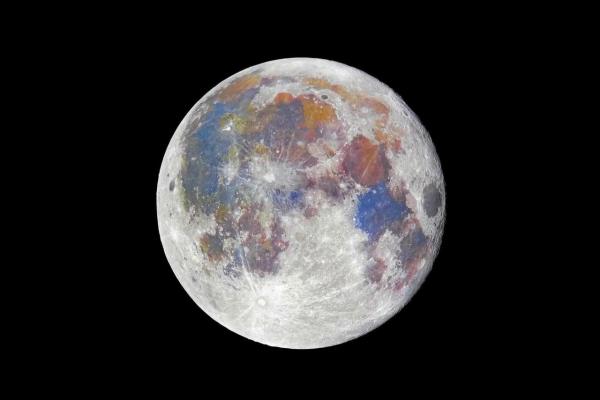
NASA’s Artemis II mission has reached a historic milestone, not only by sending humans back toward the Moon for the first time in over 50 years but by capturing stunning fresh data that reveals the lunar surface is far from monochromatic. Using advanced astronomical imaging technology, the mission has unveiled the Moon’s true, colorful face.
The viral photos of the Moon’s colorful surface highlight the presence of titanium and iron, providing a deeper understanding of the satellite’s diverse colors and mineral composition. This discovery comes as part of Artemis II’s capture of the Moon’s colored side, a mission that has also set a record for the farthest human spaceflight.
Launched on April 1, 2026, at 6:35 p.m. EDT from Launch Pad 39B at the Kennedy Space Center in Florida, the mission utilized the Space Launch System (SLS) rocket to send four astronauts aboard the Orion spacecraft. The crew—consisting of NASA astronauts Reid Wiseman, Victor Glover, Christina Koch, and Canadian Space Agency (CSA) astronaut Jeremy Hansen—embarked on a planned 10-day test flight around the Moon.
The mission serves as a critical demonstration of deep space capabilities, including the first crewed test of life support systems. According to NASA Administrator Jared Isaacman, the flight is a foundational step toward a permanent human presence. “Artemis II is the start of something bigger than any one mission,” Isaacman stated. “It marks our return to the Moon, not just to visit, but to eventually stay on our Moon Base, and lays the foundation for the next giant leaps ahead.”
By integrating high-resolution imaging with crewed exploration, NASA is paving the way for future surface missions and the eventual goal of sending humans to Mars. This intersection of cutting-edge imaging and human endurance highlights the ongoing evolution of deep-space exploration technology.
