
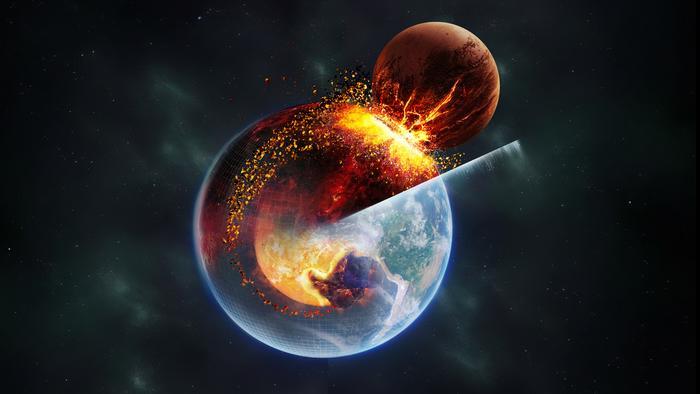
For decades, scientists have debated the origins of Earth’s Moon, with the leading theory positing a collision between early Earth and a Mars-sized planet named Theia. Now, a new study published in Science offers the most precise reconstruction yet of Theia’s composition and origins. researchers analyzed lunar samples and terrestrial rocks to pinpoint where the impacting planet formed, possibly reshaping our understanding of the early solar system and the conditions that allowed for the emergence of life on earth. The findings suggest Theia and Earth were likely neighbors within the inner solar system.
A new study published in Science may have finally solved a longstanding mystery surrounding the formation of Earth’s Moon: the origin of Theia, the ancient planet that collided with early Earth.
Researchers at the Max Planck Institute for Solar System Research and the University of Chicago compared the chemical signatures of lunar samples, Earth rocks, and meteorites. By examining isotopic ratios with unprecedented precision, they reconstructed the likely composition of both Theia and the proto-Earth before their cataclysmic impact approximately 4.5 billion years ago.
Theia and Earth Were Neighbors
The analysis points to a compelling conclusion: the bulk of Theia’s building blocks appear to have originated in the inner solar system, potentially even closer to the Sun than early Earth. This suggests the two planets were neighbors long before their violent encounter reshaped the Earth-Moon system. Understanding the origins of planetary bodies like Theia is crucial to unraveling the early history of our solar system.
The research team arrived at this finding by running multiple formation scenarios and eliminating combinations that didn’t match the isotopic fingerprints found in lunar and terrestrial rocks. This rigorous process narrowed down the possibilities and strengthened the evidence for a shared origin within the inner solar system.
While Earth’s composition can largely be explained by known classes of meteorites, Theia’s composition appears to include material not currently represented in meteorite collections – further evidence of its inner solar system origins. Although many details of the giant impact remain uncertain, these findings more precisely define Theia’s birthplace than ever before.
