
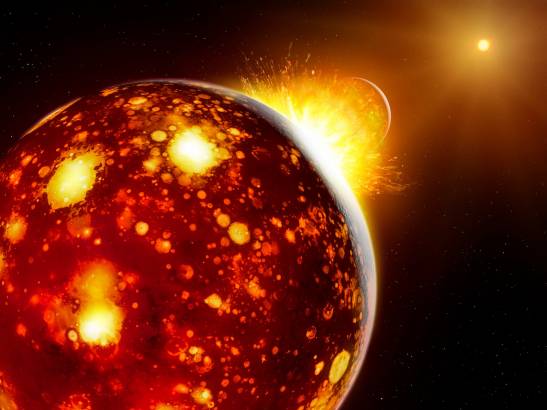
New research published this week in Science offers a refined understanding of the Moon’s violent birth, suggesting the impacting body-named Theia-formed within the inner solar system, perhaps even closer to the Sun than Earth. The study, led by researchers at the University of Chicago and the Max Planck Institute, analyzed iron isotopes from Apollo-era lunar samples to pinpoint Theia’s origins. Understanding the Moon’s formation is key to deciphering the early evolution of our planet and the conditions that ultimately allowed for the emergence of life.
A new study is shedding light on the origins of the Moon, suggesting the celestial body that collided with Earth billions of years ago – often referred to as Theia – formed closer to the Sun than previously thought. Understanding the Moon’s formation is crucial to unraveling the early history of our solar system and the conditions that allowed life to emerge on Earth.
Theia is believed to have collided with Earth 4.5 billion years ago, leading to the formation of the Moon.
The prevailing “giant-impact” theory posits that Theia, a hypothetical planet, crashed into Earth approximately 4.5 billion years ago. Debris from this collision coalesced to form the Moon, which then began orbiting our planet. While the theory is widely accepted, the precise origin of Theia has remained a mystery – until now.
An international research team led by the University of Chicago (U.S.) and the Max Planck Institute (Germany) has uncovered new clues about Theia’s formation. Their findings, published in Science, indicate that this planetary giant likely originated in the inner solar system, and potentially even closer to the Sun than Earth.
Isotopic Signatures
The researchers analyzed rocks collected from both the Moon and Earth, focusing on the isotopic composition of iron. Isotopes are different versions of an element, varying in the number of protons and neutrons they contain. By examining these variations, scientists can trace the origins of materials in the solar system.
“We utilized high-precision analysis of iron isotopes from lunar samples brought back by the Apollo missions. These measurements help us differentiate between material that formed in the inner solar system and that which originated further out,” explains Timo Hopp, the study’s lead author.

“These measurements are used to discriminate between material that formed in the inner Solar System and that which was created in the exterior.”
Timo Hopp, lead author

The study reveals that the proto-Earth and the Moon share similar iron isotope compositions, and these compositions align with those found in non-carbonaceous meteorites – a type of celestial body formed in the inner solar system. This suggests a common origin for the materials that formed both our planet and its satellite.
Furthermore, the team integrated these findings with previously published isotopic data from other elements and performed mass-balance calculations for Theia and the proto-Earth. This allowed them to refine their understanding of the impact event and the composition of the colliding bodies.
“This is how we concluded that Theia formed from material even closer to the Sun than Earth did,” Hopp notes. The research provides a more detailed picture of the conditions present during the early stages of our solar system’s development.
While the findings offer valuable insights into the Moon’s origins, the authors emphasize that further analysis is needed to fully confirm Theia’s role in the formation process. This research underscores the ongoing efforts to understand the complex history of our solar system and the forces that shaped the planets we know today.
Reference:
Timo Hopp et al. The Moon-forming impactor Theia originated from the inner Solar System. Science (2025).
Rights: Creative Commons.
