
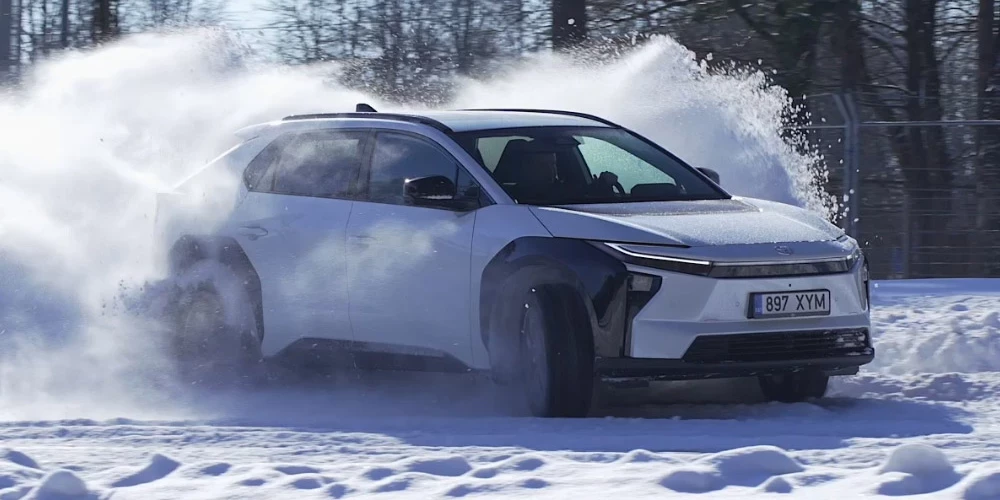
Initial impressions might suggest the bZ4X isn’t well-suited for winter driving, with electronic controls initially hindering wheel engagement. However, holding the relevant button slightly longer resolves the issue. A key challenge in winter conditions is modulating power, as the vehicle lacks the engine sound typically associated with acceleration. Despite this, the Toyota bZ4X AWD stands out as a surprisingly enjoyable vehicle to drive in the snow.
The bZ4X boasts 343 horsepower and offers the ability to disconnect systems, a feature not commonly found in Japanese electric vehicles. This unique characteristic sets it apart in the growing EV market.
But how does the bZ4X perform when longer distances are required, prioritizing range over rapid acceleration? Last winter proved challenging for electric vehicles, with slow charging speeds being a greater concern than battery size. Toyota has addressed this issue with the updated bZ4X. The vehicle now includes battery pre-conditioning and a faster charging capability of up to 150 kW. Although not a record-breaking speed, it represents an improvement over previous models, and the batteries themselves have increased capacity.
The bZ4X is available with either a 58 kWh or 73 kWh battery. Without increasing the overall battery size, Toyota has managed to incorporate more cells, increasing the overall capacity to 58 or 73 kWh. Theoretically, the range exceeds 550 kilometers, and in actual winter conditions, it consistently achieves over 300 km.
