
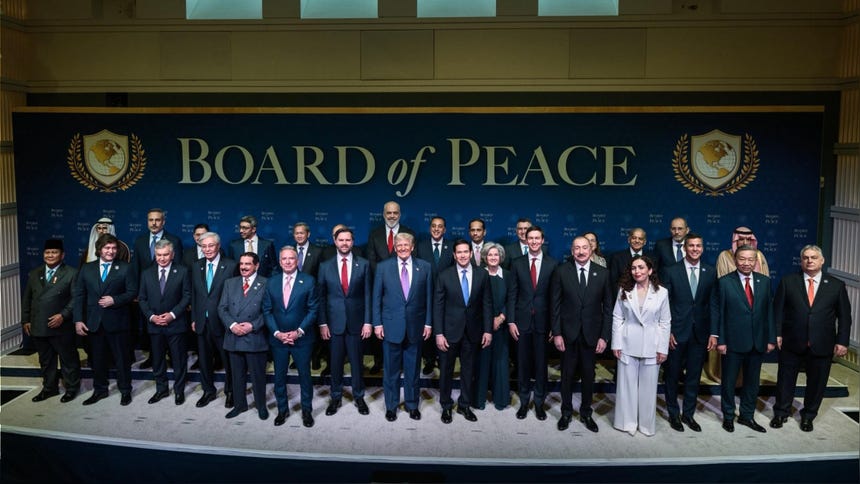
The body tasked with rebuilding the Gaza Strip, according to the peace plan of Donald Trump, held its first meeting in Washington, but with an eye toward conflicts beyond the Middle East and many questions remaining on the path to its main objective. The U.S. President said that countries involved in the so-called board have already contributed $7 billion for reconstruction, but that represents just 10% of the estimated cost.
“We are going to make Gaza a incredibly prosperous and safe place. And maybe we’ll go even a step further.” With that outlook, Donald Trump concluded his opening speech for the Peace Board, comprised of around twenty countries, which aims to unite efforts in the reconstruction of Gaza.
Reinforcing fears among many global actors that the body will serve to establish a latest multilateralism tailored to Trump, the U.S. President anticipated: “wherever we see hotspots of conflict in the world, we will probably be able to deal with them very easily, with this extraordinary group of powerful and brilliant people.”
The Republican leader announced that Kazakhstan, Azerbaijan, the United Arab Emirates, Morocco, Bahrain, Qatar, Saudi Arabia, Uzbekistan, and Kuwait have pledged $7 billion to a fund for the reconstruction of the enclave devastated by the war between Israel and Hamas.
That amount is scarcely 10% of the estimated cost to rebuild Gaza, which, according to calculations by the United Nations, the European Union, and the World Bank, is close to $70 billion.
Trump also announced that his administration plans to contribute $10 billion to the Peace Board, although he did not specify where those resources will come from or if he plans to seek authorization from Congress to commit them.
He also said that FIFA (whose president Gianni Infantino attended the first meeting) will raise $75 million for projects related to soccer and that $2 billion in humanitarian aid will be provided by the United Nations.
Those unable to attend were members of the Belarusian delegation, a close ally of Russia frequently questioned for its negative record on human rights, which, despite accepting Trump’s invitation to join, did not receive a visa to enter U.S. Territory.
Trump envisions a three-year rescue plan to transform Gaza into the futuristic and modern region outlined by his son-in-law Jared Kushner when he presented his project for the enclave at the Davos Forum, but the United Nations estimates that collecting rubble and demining alone will take that long.
Yet, all those forecasts are subject to a key step to advance the peace plan: the disarmament of Hamas and the withdrawal of Israeli troops, two conditions that do not appear close to being met, despite pressure from Benjamin Netanyahu for the demobilization of the Palestinian organization.
United Nations: Stronger or Weaker?
There are no Palestinian representatives on the Gaza Peace Board, although a majority of members from the Middle East are present, including Qatar and Turkey, two countries that have raised Israel’s distrust due to their proximity to Hamas.
Nor are several fundamental actors from the West and the European Union present, such as Germany, Italy, Norway, Switzerland, or the United Kingdom, who did not attend Trump’s invitation to join the body, but did attend as observers at the installation.
Trump hopes they will eventually join, and on February 19th announced that Norway will host a new meeting of the Board in the future, but Oslo denied any intention of joining the body.
The host added that many of the members are willing to send troops for the International Stabilization Force planned in a later phase of the peace plan.
Currently, Indonesia, Morocco, Kazakhstan, Kosovo, and Albania have pledged 8,000 men for that purpose, and their deployment will begin at the Rafah crossing.
Trump did not hide his intentions for his Peace Board to go beyond Gaza, reiterating his promise that he will investigate “hotspots” around the world, but responded to critics who wonder if he intends to de facto replace the UN Security Council.
That oversight does not seem to include compliance with economic obligations (with which the United States is in arrears) or global recognition for the alternate body.
For example, European Commission President Ursula von der Leyen faced criticism for the fact that a European Commissioner, Dubravka Suica, Commissioner for the Mediterranean, attended the meeting of the Peace Board.
“The European Commission should never have attended the Peace Board meeting in Washington today, as it had not received a mandate from the Council (European) to do so,” French Foreign Minister Jean-Noël Barrot questioned on X.
Former European diplomacy chief Josep Borrell was even more blunt, directly transferring responsibility for Suica’s attendance to Von der Leyen.
“I don’t think it’s a great decision, but I didn’t expect anything less from Von der Leyen, whom we all know which foot she’s on: she is a convinced Atlanticist and a militant Zionist; and that is not a criticism, it is a description of reality,” Borrell said to journalists.
Two Stones in the Shoes
The presentation of the Peace Board came at a time when the United States is on the verge of initiating a conflict with Iran and also under the threat from Israeli Prime Minister Benjamin Netanyahu to disarm Hamas “peacefully or by force.”
From Gaza, militant group spokesperson Hazem Qassem responded through a statement challenging the Peace Board to force Israel to respect the ceasefire agreed upon since October.
In the document, Qassem asserted that the new body’s great challenge “lies in its ability to force the occupation to stop its violations of the ceasefire, force it to fulfill its obligations and launch a genuine effort of aid to start the reconstruction process.”
Secretary of State Marco Rubio made it clear that the Peace Board has a clear task ahead: “We have to get this right. There is no Plan B for Gaza. Plan B is to go back to war. Nobody here wants that.”
