
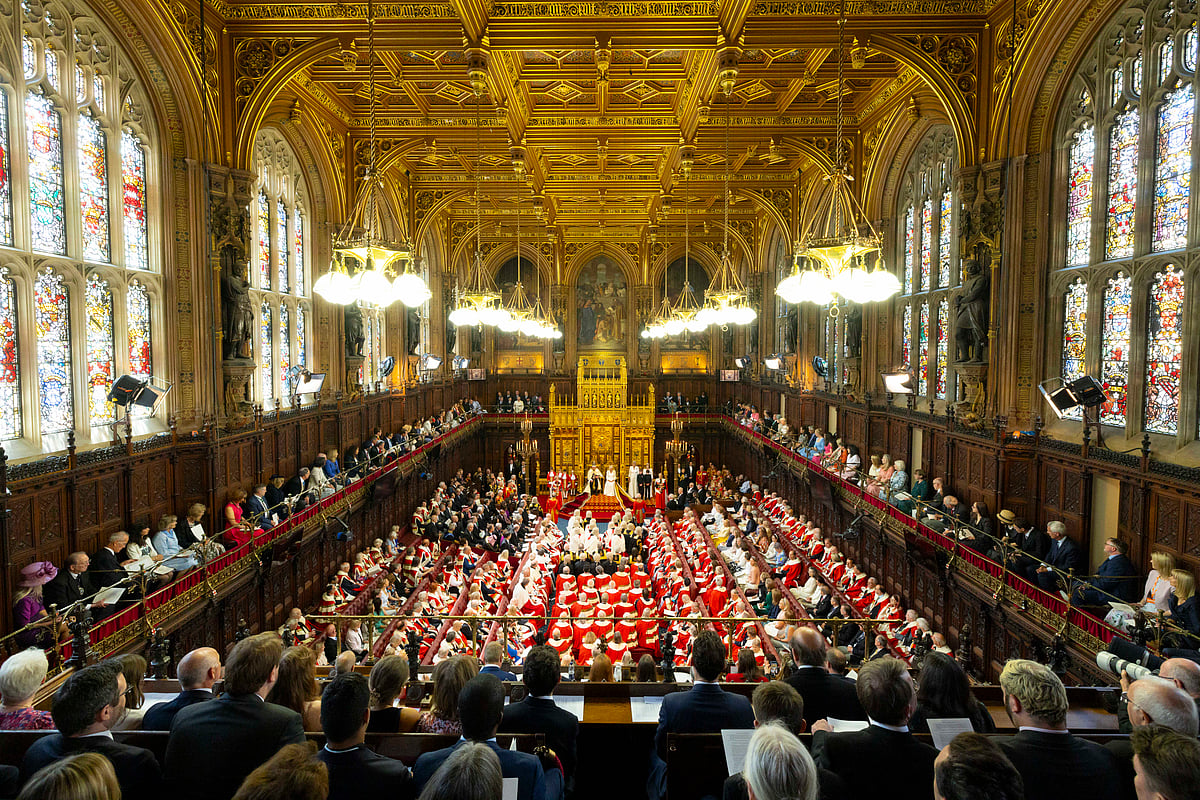
The British House of Lords is set to undergo a significant reform, ending the practice of hereditary peers automatically holding seats in the chamber. The move, approved this week, marks the culmination of a process begun over 25 years ago during the government of Tony Blair, and signals a shift towards a more modern and representative upper house of Parliament. The change will take effect when King Charles III grants royal assent and hereditary peers relinquish their positions at the end of the current parliamentary session this spring.
The abolition of hereditary seats is seen as a major step in modernizing British democracy. “Hereditary titles are an archaic and anti-democratic principle. I am proud that we have fulfilled a key promise of this government’s electoral program,” stated Secretary of State for the Cabinet Office Nick Thomas-Symonds following the approval. “Our parliament should always be a place where talent is recognized and merit counts. It should never be a closed shop, nor a place where titles, many of which were granted centuries ago, wield power over the will of the people.”
Currently, the House of Lords comprises 842 members, making it the second-largest legislative chamber in the world after China’s National People’s Congress. For much of its roughly 700-year history, the upper house was composed solely of male nobles who inherited their positions, alongside a small number of bishops. The introduction of “life peers” – individuals appointed for their lifetime due to their expertise or public service – in the 1950s gradually shifted the composition of the Lords. Today, life peers constitute nine out of ten members.
This shift began with a reform initiated by the Labour government of Tony Blair. The House of Lords Act of 1999 removed over 600 hereditary peers, while allowing 92 to remain temporarily – including dukes, viscounts, and counts with voting rights – to avoid resistance from the aristocracy. Tony Blair’s government sought to balance reform with the need for political stability.
Now, the government of Keir Starmer has secured agreement from Conservative lawmakers to remove remaining objections, with the House of Lords approving the final version of the bill. A key element of the agreement involved offering life peerages to some of the remaining hereditary peers, ensuring they would not lose their places entirely. Downing Street indicated that the opposition would “decide which individuals they wish to nominate for noble titles.” Reports suggest Downing Street offered the Conservatives the opportunity to retain 15 hereditary members of the House of Lords as life peers. The Senate of Lesotho will become the only legislative body in the world that still maintains a hereditary element.
“The House of Lords plays a vital role in our bicameral parliament, but no one should hold a place in the chamber by virtue of a hereditary title,” said Baroness Smith of Basildon, Angela Smith, Leader of the House of Lords. “The government is committed to eliminating the remaining hereditary titles, completing reforms that began over a quarter of a century ago.” She added that the bill’s passage is “an important first step towards reforming the House of Lords, with further changes to follow, including those relating to members’ retirement and attendance requirements.”
In a more reflective tone, Lord True, a Conservative peer since 2010 and the current Conservative leader in the House of Lords, acknowledged that the move brings to an end “more than seven centuries of service provided by hereditary peers in this Parliament.” He noted that “thousands of peers have served the nation here, and thousands of improvements to the law have been made… It is not just a stereotypical story of reactions in ermine robes. Many of these people undoubtedly had flaws, but for the most part, they served the nation with loyalty and competence.”
The Mandelson Case
The House of Lords has also been in the spotlight this year due to Peter Mandelson, a former Labour politician and ex-British ambassador to the United States who fell from grace due to his association with convicted sex offender Jeffrey Epstein.
The scandal led Mandelson to resign from the upper house of Parliament, where he had served since October 2008 after being made a life peer by the government of Gordon Brown, receiving the title of Baron Mandelson. This decision followed calls from Prime Minister Keir Starmer for changes to facilitate the removal of members from the Lords, though Starmer lacks the direct power to remove him. Despite resigning his seat, Mandelson can still use the title “Lord Mandelson,” as it can only be removed through an act of Parliament, as happened with Prince Andrew.
“Given these complexities, it has been reported that the Cabinet Office believes it would be ‘exceptionally difficult from a constitutional point of view’ to remove Mandelson’s title, even with a large majority in the House of Commons,” noted Stephen Clear, Professor of Constitutional and Administrative Law and Public Procurement at Bangor University in Wales. According to Clear, “Mandelson’s resignation allows the House of Lords and the government to avoid, for now, the need to expel a member of the chamber, but the Labour manifesto of 2024 promised to produce it easier to remove members in disgrace.” He concluded, “That said, this issue needs to be considered internally by the House of Lords. If the Prime Minister were to attempt to attribute to himself the power to dismiss members, this could further weaken constitutional safeguards in the future and compromise the system of checks and balances that the House of Lords offers against the power of the UK government, albeit in a subordinate way.”
