
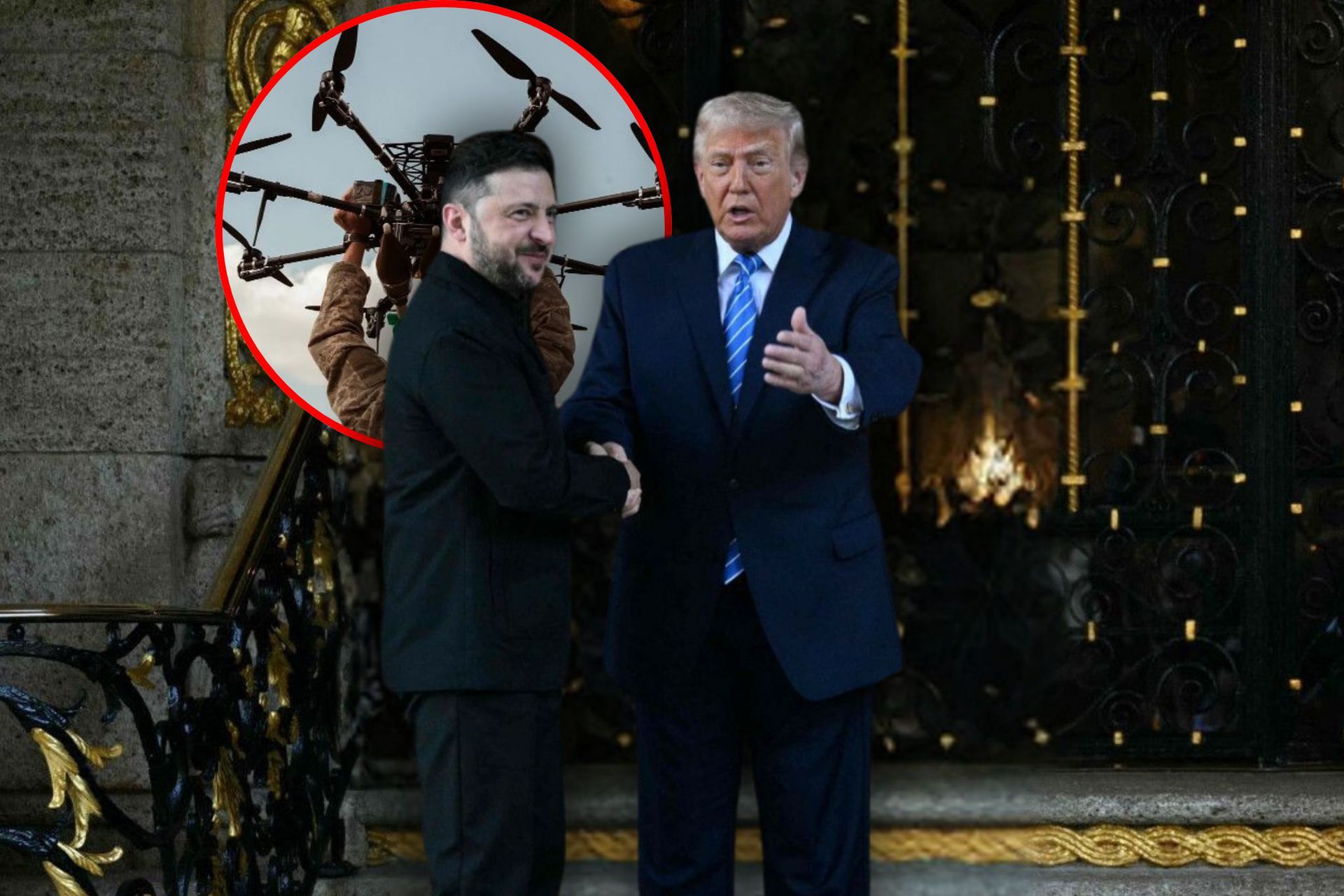
Just over a year ago, during a meeting at the White House, Donald Trump sought to humiliate Ukrainian President Volodymyr Zelenskyy by stating that the Ukrainian president “had no cards to play” in negotiations with the United States. He subsequently temporarily blocked tranches of further aid to Ukraine.
Now, that same Trump is requesting assistance from Zelenskyy. The shift comes as the United States struggles to counter Iranian drones, with damage to radar installations and communication systems at two American bases in Bahrain and Kuwait demonstrating the vulnerability. Washington has now turned to a nation with greater experience in combating these aerial threats.
NATO involvement in conflict? Expert discusses Trump’s stance
“Ukraine is helping partners”
The possibility of cooperation between Kyiv and Washington was initially proposed by Zelenskyy in July of last year. The arrangement would involve Ukraine sharing its anti-drone technology in exchange for American weaponry. A task force was even established within the Pentagon to counter drones, making multiple visits to Ukraine to learn effective combat strategies. Most recently, the team led by Gen. Matt Ross was in Ukraine just before the launch of “Epic Fury” – the operation targeting Iran that began on February 28th.
Upon returning, the general stated at a conference in Virginia: “I went to Ukraine and wanted to understand the technology they are using to protect their facilities and people from the threat of unmanned systems.” He simultaneously assessed Ukrainian tactics and procedures as “very effective.”
The development suggests a potential agreement – drone and anti-drone technology in exchange for arms – may be reached. Zelenskyy stated that “we are helping to defend against war those who help us, Ukraine, to achieve a just end to the war with Russia.” In a social media post, he added: “Ukraine helps partners who care about our security and the protection of the lives of our citizens.”

A similar agreement already exists between Ukraine and Poland, which provided Kyiv with MiG-29 aircraft in exchange for drone technology. This arrangement could also benefit Poland, as Ukrainian manufacturers utilize Polish components and WB Electronics even maintains production facilities within Ukraine.
Extensive Ukrainian Experience
Currently, the Ukrainian military possesses the most experience in neutralizing enemy drones globally. Russia has launched approximately 60,000 flying bombs from the Shahed 136 and Geran 2 families against Ukraine, forcing Kyiv to develop a comprehensive, multi-layered defense system.
This system comprises elements of traditional air defense, electronic warfare systems, a network of short-range radars, mobile anti-aircraft teams, and – crucially – inexpensive interceptor drones. This system is not the result of peacetime planning, but rather the product of several years of intense warfare and continuous improvisation.
And We see this practical knowledge that is now invaluable to the West. It has become clear that Ukraine holds significant leverage with Washington. First, the operational experience gained in the largest drone war in history. Second, proven tactical and technological solutions developed under real combat conditions. Finally, Ukraine possesses a drone industry capable of producing inexpensive, mass-produced interceptor systems.
What the Americans Need
Washington is primarily interested in low-cost solutions. The focus is on systems that can engage drones massively and inexpensively, without using strategically important missiles that are too costly to waste on such inexpensive targets as those attacking American bases in the Middle East.
The Pentagon is initially focused on interceptor drones. Ukraine has developed rapid quadcopters capable of physically destroying Shaheds through impact or detonating a small explosive charge. The STING drone, for example, reaches speeds exceeding 300 km/h and costs only a few thousand dollars. During combat over Ukraine, it has achieved a 70% effectiveness rate, which manufacturers plan to increase to over 80% with new guidance systems.
The second category is electronic warfare systems. Ukrainians have developed numerous mobile sets that jam drone navigation and communication signals. For many drones, the loss of GPS signal or control results in loss of flight stability or premature crash. Polish manufacturers WB Electronics, Hertz, and APS, who have long collaborated with Ukrainians in designing such systems, play a significant role here.
The third category is small target detection systems. Many Western radars were designed for aircraft and cruise missiles, not for small drones flying low to the ground. While artillery radars could help, this is only a partial solution. Ukraine has created a network of inexpensive radars and acoustic sensors that enable early detection of incoming drones. Here, too, Polish companies could see an opportunity for participation.
For the United States, cooperation with Ukraine offers the opportunity to quickly acquire proven solutions. Instead of years-long research programs, they can leverage technologies and procedures tested in actual combat. This need, as it turns out, is urgent.
Sławek Zagórski for Wirtualna Polska
