
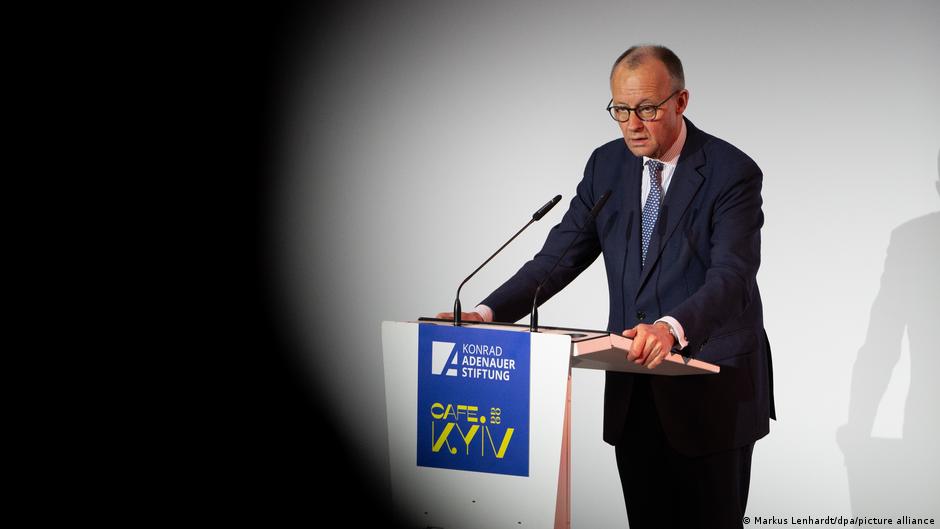
Berlin – A leading German politician publicly stated on Monday, February 23, 2026, that Ukraine “must win,” a sentiment not often voiced by top German officials. Annegret Kramp-Karrenbauer, chair of the Konrad Adenauer Foundation and former leader of the Christian Democratic Union (CDU), made the declaration at the Café Kyiv forum held in Berlin. The statement comes as debate continues over the long-term support for Ukraine and the future of Ukrainian refugees in Europe.
Merkel-era Leader Calls Out Russian “Barbarism”
Friedrich Merz, the current leader of the CDU, opened the forum by detailing the hardships faced by Ukrainians during four years of Russian aggression, citing examples of citizens surviving without heat or electricity following Russian military strikes. He reaffirmed Germany’s support for Ukraine and referenced the case of Vladyslav Geraskevych, a Ukrainian athlete disqualified from the recent Winter Olympics for wearing a helmet displaying the images of Ukrainian athletes killed in the war.
Merz sparked discussion with his characterization of Russia, noting a long-standing “ambivalent” attitude toward the country within Germany, dating back 200 years. He quoted a 19th-century French historian who described Russia as a place where “the deepest barbarism exists alongside the highest civilization.” Merz repeated the word “barbarism” several times, urging a rejection of any doubts about the current Russian regime. Some in the Ukrainian audience expressed surprise at the comparison, with one resident of Kharkiv questioning whether they were experiencing the “high civilization” Merz described.
Others acknowledged Germany’s evolution over the past four years, becoming a key partner in providing military aid to Ukraine.
Future of Ukrainian Refugee Status in EU Uncertain
The Café Kyiv conference originated as a “gesture” following Russia’s full-scale invasion of Ukraine and has since grown into the largest German-Ukrainian forum, attracting hundreds of participants – activists, politicians, and experts – to Berlin’s Colosseum cinema for dozens of discussions. The event featured a diverse range of exhibitors, from a German drone manufacturer to representatives of Crimean Tatar organizations offering coffee and pastries.
One discussion focused on the future of Ukrainian refugees, the first of whom arrived in the European Union four years ago. The EU initially granted all refugees temporary protection under paragraph 24, providing access to social support and employment. This status has been repeatedly extended and is currently valid until March 2027, but its further renewal appears uncertain. EU leadership is now recommending that individual countries manage the situation at a national level.
Currently, over four million Ukrainian refugees reside in the EU, with approximately a quarter living in Germany. While the war continues, We find no plans to compel them to return home. Estimates suggest that between 50 and 60 percent intend to remain even after a potential ceasefire, but whether they will be permitted to do so remains unclear.
Several countries, including the Czech Republic and Austria, have already begun issuing five-year residency permits to Ukrainian citizens, typically requiring proof of employment.
Germany Advises Ukrainians to Adjust Their Status
Germany does not plan to introduce a new specific status for Ukrainians, according to Hans-Ulrich Benra, head of the Ukraine group within the Federal Ministry of the Interior, speaking at the Berlin conference. He indicated that a transition period is likely after March 2027, but could not provide details on its duration or conditions.
Benra highlighted the availability of various residency permits in Germany and encouraged Ukrainians to proactively adjust their status, warning that a surge in applications at the last minute could overwhelm already strained foreign affairs offices. Qualified professionals with job offers and German language skills are eligible for residency. He noted that 38 percent of Ukrainian refugees are currently employed.
Those working in low-wage sectors or unemployed may face greater challenges remaining in Germany after the war, potentially being among the first to be encouraged to return to Ukraine. Kyiv is working to maintain ties with refugees and develop assistance programs for returnees, according to Ilona Gavronska, Deputy Minister of Social Policy of Ukraine, who spoke at the conference. She stated that Kyiv is drawing on its experience with internally displaced persons – of which there are approximately three million – but emphasized that a “just peace” will be a crucial factor for Ukrainians considering a return home.
The discussion surrounding refugee status is likely to evolve as Ukraine progresses toward EU membership, potentially creating additional opportunities due to the EU’s principle of free movement of labor.
Ukraine’s EU Accession and the 2027 Timeline
The timeline for Ukraine’s EU accession remains a key question. Forum participants suggested that Ukraine’s entry may require reforms to the EU’s organizational structure. Merz reiterated Germany’s support for Ukraine but also emphasized the need for domestic reforms, specifically mentioning concerns about corruption. This served as a reminder that the 2027 date, cited by Ukrainian President Volodymyr Zelenskyy in the context of peace negotiations, is unlikely to be met.
