
Image source, Reuters
-
- Reporter, Reporter
- Affiliation, News Outlet
- Location, Spartanburg, South Carolina
-
Reading time: 9 min
Until last year, pediatrician Stuart Simko had only seen historical cases of measles—cases that occurred before a vaccine existed.
But in the past two months, he has treated six patients in person with the disease’s hallmark red, spotted rash—the first cases he has seen in his career.
The children, he said, were “very ill,” with high fevers that were hard to bring down.
“It’s a terrible, terrible disease that can be fatal, and we’re not saying this to scare people, but they need to understand the risks,” Simko, who works for Prisma Health, said. “It’s hard to see a sick child when you know it could have been prevented.”
Simko’s six patients are among the 847 people infected in South Carolina in recent months, the overwhelming majority of whom are unvaccinated children.
It’s the largest measles outbreak in the United States since the disease was declared eliminated in 2000.
The country, which has seen outbreaks in several states, now teeters on losing that status, following the United Kingdom and Canada. Two school‑age children died in a Texas outbreak last year.
Public‑health experts warn that the disruption caused by measles and other preventable, dangerous diseases could become the new normal in many U.S. Communities where vaccination rates are falling.

Image source, Colin McCawley SCETV
The outbreak has spread through northwestern South Carolina, centered in Spartanburg County—a region of former industrial towns with roughly 370,000 residents.
Kate Martin says it reminds her of the pandemic. Several cases appeared at her children’s school, even though they are vaccinated.
“It’s a lot like COVID‑19, where each day there are cases in another school,” she said.
Dozens of unvaccinated students at her children’s school ended up quarantining for 21 days.
Measles vaccination coverage among school‑age children in Spartanburg County is about 90%, though some schools have much lower rates because of religious exemptions.
The United States recommends two doses of the measles‑mumps‑rubella (MMR) vaccine for children ages 1 to 6, which provides about 97% protection.
Herd immunity—reducing spread and protecting those who can’t be vaccinated—requires roughly 95% of the population to be immunized.
In local supermarkets and restaurants, Spartanburg residents noted that hundreds of the city’s children have contracted measles.
Most said they knew someone who had been sick, but many added that no one wanted to talk about it or seemed to care.

Image source, Kate Martin
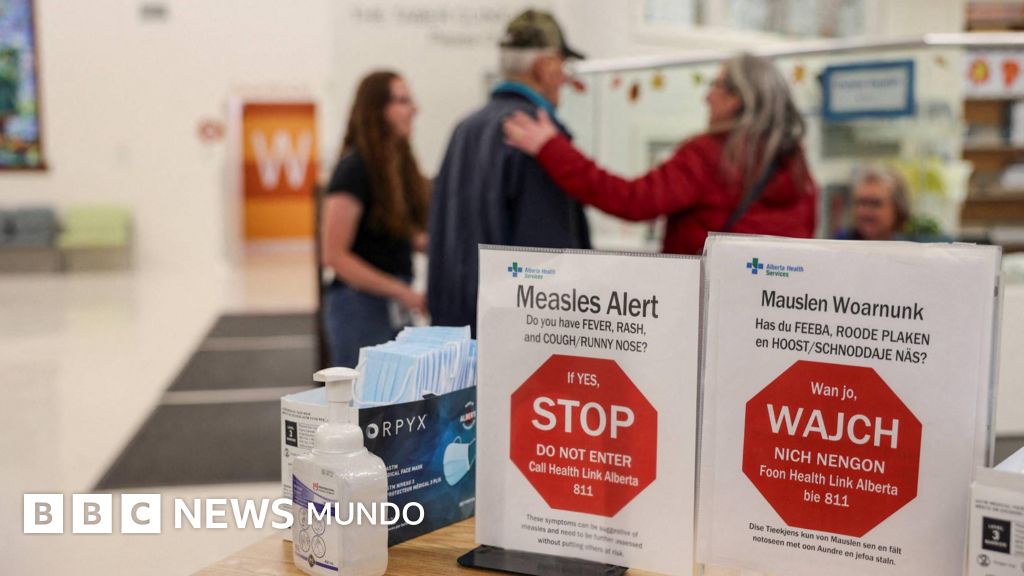
Unlike the Texas outbreak, where billboards warned of measles along highways and people queued for testing, the only notice in the county was a sign at an urgent‑care clinic asking symptomatic individuals to wait in their cars.
“The situation is truly serious here,” Martin said. “But the average person just doesn’t reckon it’s a sizeable deal.”
Conspiracy theories
For weeks, state Senator Josh Kimbrell avoided weighing in on the measles outbreak. The Republican, who has criticized the federal pandemic response—including mandatory COVID‑19 vaccination—said he hoped the situation would “correct itself.”
But in December, he received a call from a man whose wife was hospitalized with measles—a roughly 50‑year‑old elementary‑school teacher who had been vaccinated as a child but contracted the disease from a student, landing her in intensive care for two weeks, Kimbrell said.
“I thought we were on the brink of our first death,” Kimbrell said. “It’s truly tragic for people who chose to vaccinate and now face a serious public‑health threat.”
Kimbrell turned to social media with a statement aimed at striking a “balance,” backing the “personal choice” narrative while stressing that the outbreak now required public‑health measures, including—he told the BBC—restricting venues that unvaccinated people can access.
He received praise but also criticism from vaccine‑skeptical parents, who accused him of violating their rights. Still, Kimbrell felt he had no other option.
“The numbers are so high I may have to attend a teacher’s or a child’s funeral, and that’s something avoidable,” he said. “If it happens, I’ll be very upset.”

Local officials and physicians say the recent outbreak has primarily affected Russian and Ukrainian immigrants in South Carolina, though others have also been infected.
The state has resettled hundreds of Ukrainian refugees, and thousands of Slavic immigrants have moved to the area in recent years, according to population estimates.
Slavic churches have experienced multiple measles exposures, and Kimbrell added that some hold religious views opposed to vaccination. Some community schools have vaccination rates as low as 20%.
Kimbrell noted that misinformation claiming the MMR vaccine contains fetal cells—a common conspiracy theory—has been circulating, and he countered it by reiterating the vaccine’s safety and mechanisms.
“We’re more worried about the vaccine”
Inna, a member of Spartanburg’s Ukrainian immigrant community who declined to supply her last name for privacy, has not vaccinated her children against measles.
So far, the family has avoided the illness, but they know many who have not.
When asked whether she worries her children might become infected, Inna shrugged.
“We’re more worried about what’s in the vaccine,” she said, adding that she had heard it was linked to autism—a claim that has been debunked.
“They had chickenpox and recovered,” she said of her children. Measles carries a far greater risk of potentially fatal complications than chickenpox.

Image source, Getty Images
Some parents are more concerned about vaccine risks than the previously low risk of contracting measles, noted Jennifer Grier, associate professor of immunology at the University of South Carolina School of Medicine in Greenville.
“Unfortunately, catching measles is no longer a low risk,” she said.
Hundreds of people have fallen ill in a spreading measles outbreak along the Utah‑Arizona border, miles away.
Lorna White, 23, a mother of four from the modest town of Kanebed, Arizona, chose not to vaccinate her children against measles, fearing it would be “too much for such a small body.”
“If I were to give my kids the MMR and they suffered an adverse reaction, that would be on me,” she explained.
She and her children contracted measles at Christmas.
“Either we were all lucky with mild cases, or measles isn’t as serious as they say,” she said in January.
However, some effects may not appear for years. Measles can cause long‑term complications such as encephalitis and immune amnesia, which rewires the immune system and limits its ability to fight new infections.
Those are the risks Simko discusses with vaccine‑hesitant patients. He also acknowledges that vaccines carry rare, minor risks, but stresses they are negligible compared to the threat of measles.
“Some will continue to opt out of vaccination,” he added. “It’s not ideal, but I can’t force anyone.”

Image source, South Carolina Department of Public Health
South Carolina’s Department of Public Health has made modest gains, vaccinating 62 people—42 adults and 20 children—at mobile clinics since October.
However, public‑health experts say the federal government—and specifically the U.S. Vaccination‑policy overhaul driven by Health Secretary Robert F. Kennedy Jr.—has hampered efforts.
Under Kennedy’s leadership, the U.S. Centers for Disease Control and Prevention sharply cut the number of recommended childhood vaccines, though not the MMR.
Kennedy has voiced mixed opinions on the MMR vaccine, sometimes calling it the best protection against the disease, while at other times questioning its safety.
His words and skepticism carry weight in Spartanburg, residents said.
“He’s highly respected here,” Martin said. “I think that definitely influences vaccine hesitancy.”
Silence on the South Carolina outbreak
In recent weeks, Kennedy—long a vaccine skeptic—has remained silent on the South Carolina outbreak.
In a statement to the BBC, the Department of Health and Human Services said vaccination is “the most effective way to prevent measles, and the Secretary has been clear and consistent on that.”
Some Kennedy allies have downplayed concerns about the cases. When asked last week whether the looming loss of measles‑free status was significant, CDC deputy director Ralph Abraham replied, “Not really.”
That same week, Kirk Milhoan, appointed by Kennedy to lead an independent vaccine advisory panel, said polio and measles vaccines should be optional.
He suggested this would allow better data collection on measles risks.
“What we’ll get is real‑world experience of when unvaccinated people contract measles: what’s the new hospitalization rate? What’s the death rate?” he said on the podcast “Why Should We Trust Them?”

For medical experts, it’s no mystery.
The disease will spread through communities with low vaccination rates, infecting many before moving on to the next large group of unvaccinated people, said Chris Lombardozzi, medical director of the intensive‑care hospitals in the Spartanburg Regional Health System.
“I’m concerned about all the diseases we vaccinate against that used to be common,” he said, citing polio, mumps and rubella.
Such an experiment, and the loss of measles‑free status, could have deadly consequences for American children, medical experts warned.
“It would be a public‑health failure in our nation,” Grier said. “We have the tools to stop infections, we know the risks, yet the disease has returned to our community.”
Subscribe here to receive our new newsletter every Friday with a selection of our best weekly content. And remember you can get notifications in our app. Download the latest version and enable them.
