
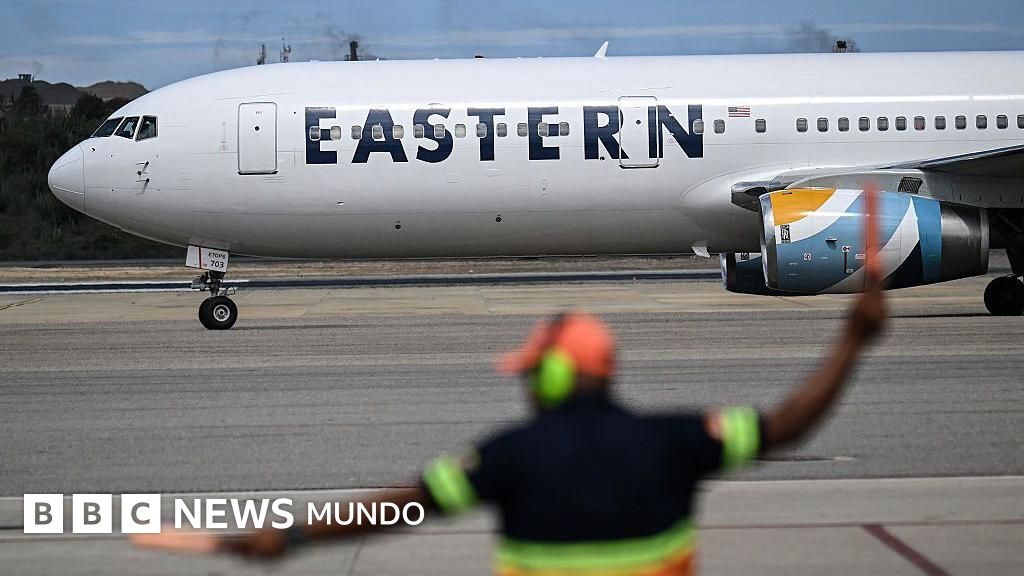
Escalating tensions between the United States and Venezuela have taken a new turn with a controversial announcement from President Trump regarding Venezuelan airspace. The move, made amid ongoing U.S. military activity in the Caribbean,has prompted a swift rebuke from Caracas and raised questions about its legality and potential impact on regional stability. The situation is further complicated by conflicting reports regarding potential diplomatic talks and the possibility of military intervention.
Fuente de la imagen, Getty Images
-
- Autor, Redacción
- Título del autor, BBC News Mundo
-
Tensions between the United States and Venezuela are escalating amid ongoing U.S. military maneuvers in the Caribbean, which have involved the deployment of thousands of personnel and the nation’s largest warship.
On Saturday, President Donald Trump announced that airspace “over” and “around” Venezuela would be closed “completely.”
In a message posted on his Truth Social platform, the president wrote: “To all airlines, pilots, narco-traffickers and human traffickers: please consider that the airspace over Venezuela and its surroundings will remain completely closed.”
Venezuelan officials responded with a statement denouncing what they called a “colonialist threat” to the country’s airspace sovereignty, describing it as “a new extravagant, illegal and unjustified aggression against the people of Venezuela.”
The White House has not immediately responded to a request for comment from the BBC. It remains unclear how the announced airspace closure would be implemented.
According to the New York Times, Trump lacks the authority to close Venezuelan airspace, though his statement could dissuade airlines from flying to and from the country.
While Trump provided no further details, the announcement adds further pressure on the government of Nicolás Maduro.
Washington maintains that the purpose of its military deployment in the Caribbean is to curb drug trafficking to the U.S., but both Caracas and numerous observers believe the goal is to force a change in government in Venezuela.
Since early September, the U.S. Navy has engaged with approximately twenty suspected drug smuggling vessels, primarily in the Caribbean, but also in the Pacific, resulting in over 80 fatalities. Some human rights organizations have described these incidents as “extrajudicial executions” violating international law.

Fuente de la imagen, Getty Images
Air Travel Disrupted
Meanwhile, air travel to and from Venezuela has been severely affected for the past week following an alert issued by the U.S. aviation authority recommending airlines exercise caution when operating in Venezuelan airspace “due to the deteriorating security situation and increased military activity in or around Venezuela.”
“Threats could pose a potential risk to aircraft at all altitudes, including during overflight, arrival and departure phases of flight, and/or to airports and aircraft on the ground,” the FAA stated in its communication last week.
This warning prompted airlines such as Iberia, Air Europa, LATAM, Avianca, TAP, Plus Ultra, and Turkish Airlines to suspend their operations in Venezuela.
Venezuela’s National Institute of Civil Aeronautics (INAC) gave these airlines 48 hours to resume operations, under threat of revocation of their traffic rights, which grant landing and takeoff slots at airports.
When the airlines did not comply, INAC revoked the air traffic rights of Iberia, TAP, Avianca, LATAM Colombia, Turkish Airlines, and Gol on Thursday.
Thousands of passengers have been stranded in Venezuela and abroad over the past week, while the number of flights to and from the Caribbean nation has decreased by 24.7%, falling from 105 to 79 per week, according to Spanish news agency EFE.
Destinations that remain officially active include Mexico (Santa Lucía and Cancún), Colombia (Bogotá), Panama, Peru (Lima), Curaçao, Cuba (Havana), St. Vincent and the Grenadines, and Barbados.
Venezuela’s state-owned airline, Conviasa, also offers flights to China (Guangzhou), Russia (Moscow and St. Petersburg), and Varadero (Cuba), according to its website.

Fuente de la imagen, Pete Marovich/Getty Images
Conflicting Messages
In recent hours, messaging regarding tensions between Venezuela and the U.S. has been contradictory.
Two days before Trump announced the closure of Venezuelan airspace, the president threatened to begin “very soon” to arrest Venezuelan “narco-traffickers” “on the ground.” He made the remarks during a virtual audience with members of the Armed Forces in celebration of Thanksgiving.
Hours later, the American newspaper The New York Times revealed that the U.S. president had spoken by telephone with the Venezuelan leader.
The conversation, according to the newspaper citing anonymous sources, reportedly took place last week and involved discussions about the possibility of a face-to-face meeting.
The call, which reportedly included Secretary of State Marco Rubio, occurred days before the State Department’s designation of Maduro as a leader of the “Cartel of the Suns,” which they classify as a terrorist organization.
This designation grants U.S. law enforcement and military agencies greater authority to identify and dismantle the organization.
Venezuela’s Ministry of Foreign Affairs has categorically, firmly, and emphatically rejected the designation.
Interior and Justice Minister Diosdado Cabello has long dismissed it as an “invention.”
Some U.S. media outlets suggest that an announcement to close airspace like the one made by Trump on Saturday could be a prelude to a bombing campaign.
According to information from the New York Times, sources familiar with deliberations within the Trump administration indicated that, should a bombing occur, initial targets could be facilities related to drug trafficking used by Colombian cartels in Venezuela.
“Other options have included oil facilities. Such strikes could be justified as part of a drug-fighting initiative, although they would likely be an attempt to weaken Maduro’s control by cutting off his access to funding and dramatically increasing pressure on him,” the newspaper noted.
![[]](https://ichef.bbci.co.uk/ace/ws/800/cpsprodpb/2431/live/dbd80d70-cd2c-11f0-a892-01d657345866.png.webp)
Subscribe here to our new newsletter to receive a selection of our best content each Friday.
And remember you can receive notifications in our app. Download the latest version and activate them.
