
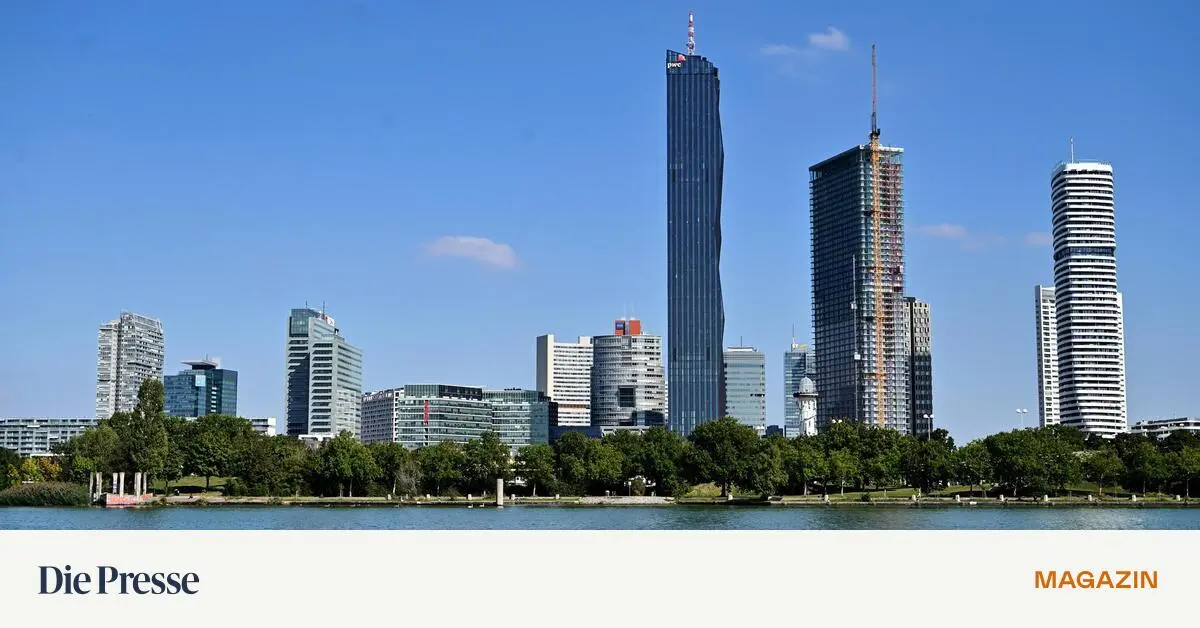
Vienna’s office market demonstrated resilience in 2025, achieving a total rental volume of approximately 230,000 square meters despite challenging economic conditions, according to the EHL office market report. This represents a 30 percent increase year-over-year and marks the highest annual figure since 2018. The strong performance underscores the continued demand for quality office space in the Austrian capital, even amidst broader economic uncertainty.
However, the market faces a potential slowdown, with new construction completions expected to decline sharply to just under 31,500 square meters in 2027. “Long-term, speculative project developments have develop into significantly less common,” says Elisa Stadlinger, Head of Commercial Real Estate at ÖRAG.
Against a backdrop of continued rising demand and limited expected new supply in the coming years, “it is to be expected that availability will become even scarcer and competition for high-quality space will increase accordingly.” Existing properties that do not meet current technical and energy standards “will have to fight much harder for relevance and are more likely to be considered for repositioning or alternative uses,” explains Stefan Wernhart, Managing Director of EHL Gewerbeimmobilien.
The supply of top-tier office space remains tight, coinciding with a rapidly evolving perform environment. Hybrid work models have become a permanent fixture of modern employment, giving the office a new, strategic importance. “Today’s office must be functional and attractive so that employees desire to come to the office from home,” says Thorsten Mörk, Head of ARE Asset Management. The workplace is increasingly being repositioned as a central hub for collaboration, exchange, and corporate culture. “Physical office spaces are being designed to be an experience,” Wernhart says of the new understanding of the office: “The spaces must be able to cater to multiple sensitivities.”
Trends 2026
- Office spaces are designed to be an experience.
- “Stay vs. Go” analyses are occupying many companies this year.
- Waiting lists are becoming the norm in prime office locations.
Particularly in demand are prime locations in the city center or in office clusters, as well as modern buildings with climate certification and excellent transport links, “as they make a significant contribution to employer branding, presence culture and the achievement of companies’ sustainability goals,” according to Wernhart.
Older office spaces with standard equipment are increasingly under pressure to adapt. Stadlinger: “On the owner side, flexible rental models and openness to renovations during extensions and qualitative upgrades to existing properties are gaining importance.” Many companies are intensively examining their locations and considering whether a move would add value or whether expiring contracts and existing spaces can be further developed. “Stay versus Go” is a strategic fundamental question “that more and more companies are asking themselves,” says Eugen Otto.
In the investment market, office properties continue to be a significant component – although now behind the asset class “Residential.” Particularly high-quality, ESG-compliant properties in central locations continue to attract investor interest. “Almost one billion euros has been invested in office buildings across Austria,” reports Wernhart. “That represents 25 percent of the total investment volume.”
To offer permanently attractive working environments, spaces are being designed to be flexibly adaptable and equipped with modern technical infrastructure, Mörk looks to the future of offices: “Tenant retention is strengthened through an expanded range of services, advice on New Work concepts and active support during change processes.” The digitization of building and tenant services is being further advanced to increase efficiency, and transparency.
Location remains a central criterion, but leisure facilities such as fitness studios, restaurants, and shopping opportunities in the vicinity of office locations are also gaining prominence. “The challenge, from our point of view, is to offer high quality, but in a way that is economically comprehensible for customers and does not exceed the monetary framework of companies,” says Wernhart.
