
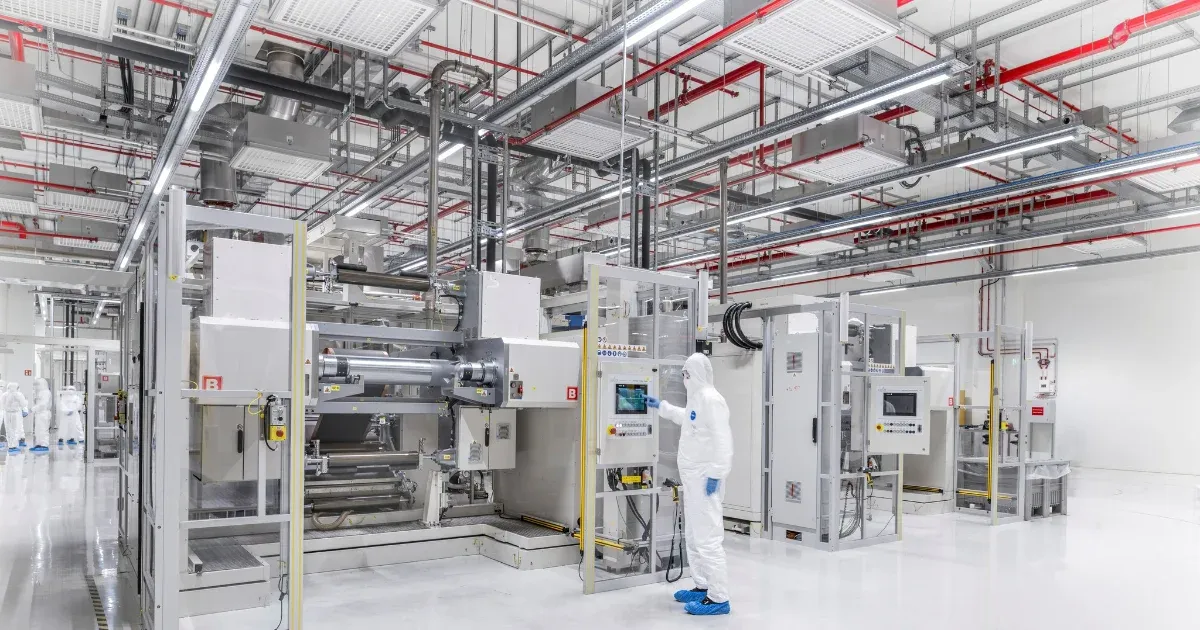
A Powerco üzemcsarnoka Salzgitterben – Fotó: Powerco / Facebook

Volkswagen is diversifying its business to include energy storage and energy trading alongside battery production for electric vehicles, according to a Bloomberg report. The German automaker’s first large-scale energy storage facility began operations on Monday in Salzgitter, where its PowerCo subsidiary has been producing battery cells since December.
- The energy is stored using batteries manufactured by the company and is capable of powering approximately 20,000 homes for two hours. The facility is directly connected to the power grid, enabling Volkswagen’s Elli subsidiary to trade electricity on the energy exchange.
This move comes as Volkswagen recalibrates its initial battery production ambitions, having scaled back from a target of 40 gigawatt-hours to 20 gigawatt-hours of annual capacity since founding PowerCo in 2022. The decision highlights the evolving landscape of the EV market and the need for diversified revenue streams.
- Despite long-term plans to reach a 200 gigawatt-hour production capacity through the Salzgitter plant, as well as planned facilities in Spain and Canada, company leadership has indicated that capacity expansion will depend on market developments.
Volkswagen initially aimed to have enough battery production capacity to support the manufacture of 3 million electric vehicles by 2030, but that goal has since been deemed overly ambitious.
- While electric vehicle sales in Europe increased by 30 percent and plug-in hybrid sales by 33 percent in 2024 compared to 2023, according to data from the European Automobile Manufacturers Association (ACEA) according to ACEA, growth has fallen short of earlier industry forecasts.
- Demand for energy storage, yet, is accelerating, driven in part by the construction of numerous, energy-intensive data centers and the increasing adoption of solar panels. BloombergNEF predicts that global energy storage capacity could grow eightfold by 2035 compared to 2025 levels.
Context: The creation of a European battery industry has been a key objective at the EU level in recent years, gaining particular momentum following the bankruptcy of Swedish firm Northvolt, a company once seen as a leading hope for the region. While Northvolt and PowerCo are prominent players, other European initiatives are too underway, with some already in production.
- In December, French firm Verkor opened its third battery plant in the “Battery Valley” of northern France, where the Automotive Cells Company (ACC), jointly owned by Stellantis, Mercedes-Benz and TotalEnergies, is scaling up production at its plant launched in 2024, as reported by France24.
- However, plans have also been revised: Bloomberg reported in February that, due to Stellantis planning to manufacture fewer electric vehicles, labor unions are negotiating reduced working hours at the French plant, and the construction of planned plants in Germany and Italy has been postponed.
