
Hollywood veteran willem Dafoe recently sat down for a candid interview in Vienna, discussing his approach to acting and his latest project, “Teh Souffleur,” which premieres February 13th. The film, uniquely set and shot within the Hotel Intercontinental Vienna, finds Dafoe portraying a hotel manager facing an uncertain future. Though currently starring in the horror film “Werwulf,” Dafoe shared insights into his preference for roles that prioritize artistic exploration over rigid storytelling.
Hollywood star Willem Dafoe recently returned from a walk as he prepared for an interview in a ninth-floor suite at the Hotel Intercontinental in Vienna. Sporting a relaxed winter sweater and a noticeable beard, Dafoe explained the look was a result of his recent work on the horror film “Werwulf” in London. But before audiences see him battling werewolves, they can catch him in “The Souffleur,” premiering February 13th, a film uniquely centered around Dafoe, Vienna, and the iconic hotel.
In “The Souffleur,” Dafoe portrays Lucius, the hotel manager grappling with a rapidly changing world – and the threat of demolition looming over his beloved hotel, with an arrogant investor (played by director Gastón Solnicki) eager to redevelop the property. The shoot itself was an adventure, utilizing a fragmented script, filming amidst the bustling activity of the Interconti, and incorporating non-professional actors. The result is a poetic, loosely structured experiment, featuring appearances from Viennese personalities like the renowned tailor Knize. During a recent conversation, Dafoe shared insights into his artistic approach.
The film opens with the idea that this hotel is like a ship. Do you see that comparison, and are you, in a sense, the captain?
“If one follows that logic, it would make me the captain of this ship, at least within the film. These lines are meant to showcase the romantic connection my character has to this place. For the hotel director I play, this isn’t just a job, it’s his life. But those aren’t my words; my task is simply to engage with them.”
Hotels often fascinate people, think of the lavish settings in Wes Anderson films. Do you share that fascination?
“As I said, I’m playing a role. Those aren’t necessarily my personal obsessions.”
Another comparison: is a hotel comparable to a film set? Both are stages.
“That’s true. Hotels, like film sets, are hubs where people come and go. They often resemble each other, then diverge in details depending on the director’s style.”
You filmed during full operation of the Hotel Intercontinental. What was that like?
“The hotel was fully operational, as it is now while we speak. Management was very generous, giving us a lot of freedom to film. That was practical because we developed some scenes on location. New situations constantly arose, and the direction wasn’t very predetermined. Simultaneously, we were working with people who aren’t actors. We were all very pragmatic, taking things as they came. I simply focused on being present in the moment.”
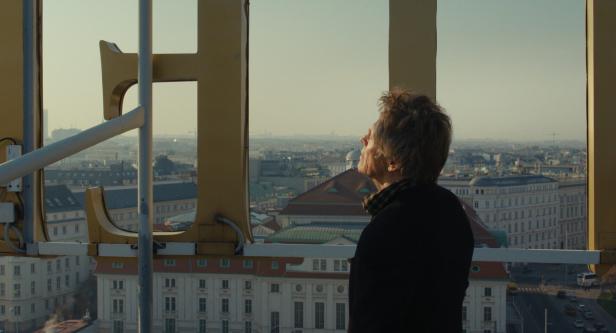
Wien with a view: Willem Dafoe on the roof of the Intercontinental in “The Souffleur”
©Little Magnet Films, Filmy Wiktora, Primo Content, KGP Filmproduktion
How do you approach a film that essentially has no script?
“I’m quite accustomed to working in that way.”
Is that not a challenge for you?
“I find that some of the best moments in the history of cinema aren’t necessarily due to how they’re told, or the script. They have to do with the place, the light, the sound – the world that’s created. So, from time to time, I seek out a project where the narrative is secondary. A good story is wonderful, but it can also obscure the truth.”
How so?
“When you follow a story and identify with it, eventually you stop thinking. Empathy takes over. Especially when the filmmakers push certain buttons. These emotions then overshadow our wonder and curiosity, and our willingness to question. Sometimes that’s nice, but our film wanted to achieve something different. The director created a simple starting point and then saw the poetry of life within it.”
Do you enjoy taking risks when choosing a film role?
“I think so. I don’t want to brag, because it’s relative what it means to take a risk. Basically, I just enjoy learning, about people, about myself. And acquiring something I wouldn’t otherwise do. It’s about having experiences – and living a life that another person has imagined.”
What’s more important to you, the artistic process or the result?
“You can’t think about the result. And you shouldn’t. Because if every step along the way has a certain integrity and commitment, the result will likely be good. If you worry too much about the outcome, it stifles the artistic impulse.”
So, no worry that you can’t bring a good film together without a plan?
“Of course, I want people to like the film. I want it to be a good film. But if you overthink it, it crushes you.”
Your filmography balances arthouse and Hollywood cinema. That’s exceptional. How important is that balance to you?
“That’s half intention and half coincidence. I like having different experiences. If you keep putting yourself in the same situation, you don’t have the same adventures as when you repeatedly throw yourself into something new. Something you don’t quite know how to approach. If you want to call that a challenge – okay, maybe it is. For me, it’s about finding a fertile ground for inspiration.”
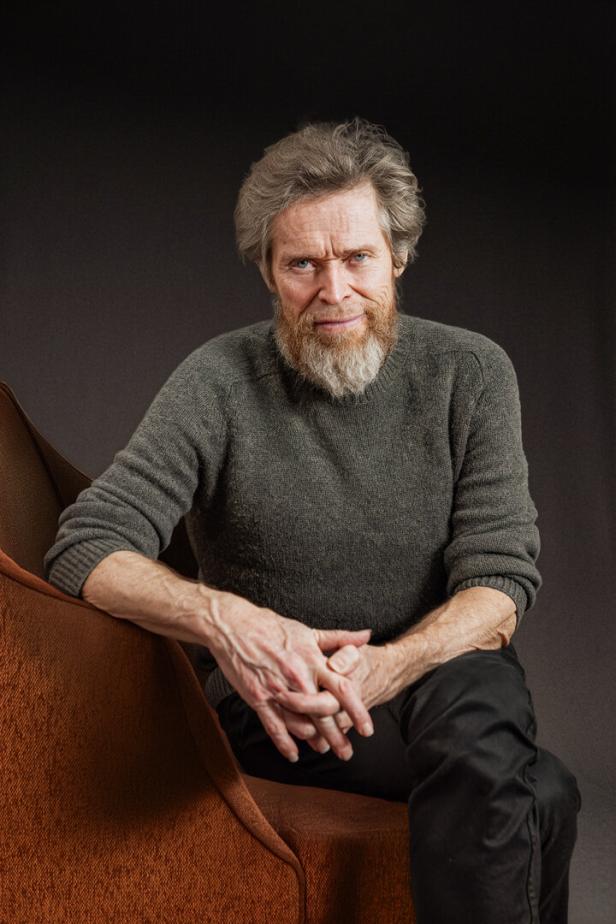
Willem Dafoe: “There are film stars and there are actors”
©kurier/BARBARA NIDETZKY
What role does the image a performer has play in all of this?
“There are film stars and there are actors. Of course, someone can be both. But usually it works like this: A film star gets a script and changes it to fit their image and the persona they’ve created. That can be fun, of course. The character someone embodies externally becomes its own kind of film language. And you can tell certain stories that way. But I prefer something else.”
What do you prefer?
“The reverse path. I prefer to be someone who adapts to the material. I try to, at least. That’s more exciting, more captivating. Also, because it throws you off balance. If you do something just for the sake of it, it blocks the art. You’re too loyal to yourself.”
Considering the image one creates publicly. What questions does that raise?
“You tell yourself, ‘Oh, I can’t do that because I’m seen as this and that.’ You have to free yourself from those thoughts. I think you achieve that by constantly changing your situation. Why not? That’s the first question you should ask when it comes to embodying someone. Sure, you might live a different life. But why shouldn’t I be able to do something else?”
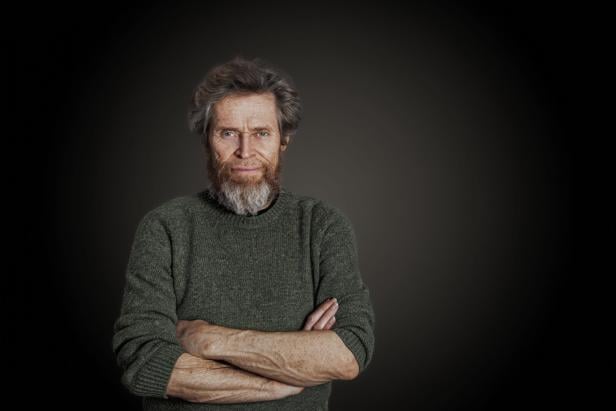
Curious to stay: “Every time you start a new project, you ask yourself: What the hell is this?!” Dafoe says.
©kurier/BARBARA NIDETZKY
Constantly challenging yourself professionally, does that keep you alive?
“I like people. And I like adventure. I enjoy working on something that challenges me, that sparks my curiosity and makes me feel truly alive.”
And you succeed at that. In every film, you’re completely different.
“Nothing is normal. Every time you start a new project, you ask yourself: What the hell is this?! I don’t know, I have to find out. Of course, you also have to feel safe and secure. But basically, you want to be thrown into the deep end, you know?”
You have to learn quickly, or you go under.
“That experience is invaluable. You fight your way up, but you feel good doing it, and the beautiful thing is: the more often you do it, the less afraid you become and the freer you feel. You look at the world, at your life, at the lives of others, with a different perspective – in a broader, more comprehensive way.”

Hollywood star Willem Dafoe during an interview with Alexander Kern at the Hotel Intercontinental in Vienna
©BARBARA NIDETZKY
What about the image a performer has?
“There are film stars and there are actors. Of course, someone can be both. But usually it works like this: A film star gets a script and changes it to fit their image and the persona they’ve created. That can be fun, of course. The character someone embodies externally becomes its own kind of film language. And you can tell certain stories that way. But I prefer something else.”
What do you prefer?
“The reverse path. I prefer to be someone who adapts to the material. I try to, at least. That’s more exciting, more captivating. Also, because it throws you off balance. If you do something just for self-purpose, it blocks the art. You’re too loyal to yourself.”
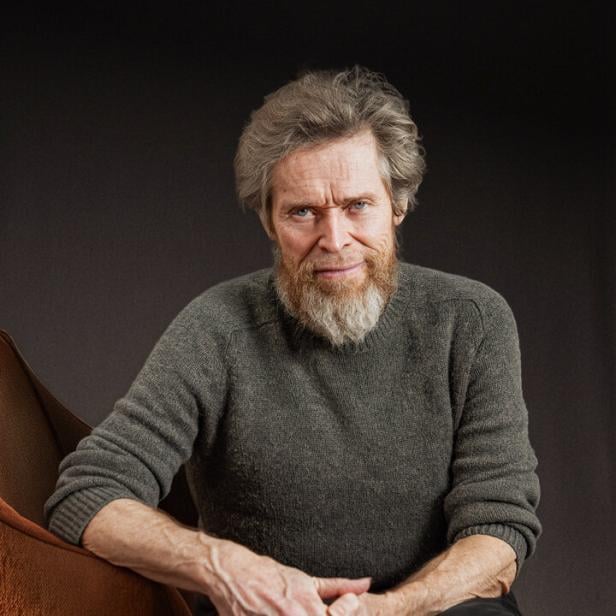
Willem Dafoe
Willem Dafoe was born in 1955 in Appleton, Wisconsin, as the second youngest of eight children. He performed on stage from a young age, later touring the world with a theater group. He has starred in films such as “Mississippi Burning,” “Wild at Heart,” “Shadow of the Vampire,” “Spider-Man,” and “Antichrist.” Married, with one son from a previous relationship.
You spend most of your time in Rome. What’s it like being an American, originally from Wisconsin, living in Europe?
“I don’t see myself as a typical American living in Italy. I like to travel, I’ve been on tour my whole life. Even before I moved to New York at 22, I was traveling with my theater group for months, in Europe, Asia, South America. I’ve continued that. I enjoy living somewhere else, even if it’s just for a short time.”
