

Misteri Monumen Bawah Laut Yonaguni di Jepang, Dibuat Manusia atau Alam?
The Yonaguni Monument: Deciphering Japan’s Underwater Enigma
A massive submerged structure off the coast of Japan continues to spark a rigorous scientific debate, challenging the boundaries between natural geological formations and ancient human architecture. Known as the Yonaguni Monument, the site remains a focal point of contention among geologists and archaeologists seeking to determine if the formation is a relic of a lost civilization or a masterpiece of nature.
The site’s discovery was entirely accidental. In 1986, Kihachiro Aratake, the director of the Yonaguni-Cho Tourism Association, was exploring the waters near Yonaguni Island—the southernmost of the Ryukyu Islands—in search of hammerhead sharks to establish new diving tourism locations. At a depth of approximately 25 to 26 meters, Aratake encountered a colossal rock formation characterized by flat surfaces and sharp, precise angles that resembled tiered terraces or stairs.
“About 35 years ago, while I was looking for a diving spot, I found it by accident,” Aratake stated in a 2022 interview with the BBC. “I was very emotional when I found it. When I realized the discovery, I knew this would be a treasure for Yonaguni Island.”
Scientific Conflict: Man-Made or Natural?
The physical characteristics of the monument—its pyramid-like shape and vertical walls—have led to diverging theories. Masaaki Kimura, a marine geologist from the University of the Ryukyus, argues that the structures are man-made stepped monoliths. However, these claims have been dismissed by other researchers as pseudoarchaeological, with many experts asserting that the formations were created through natural geological processes.
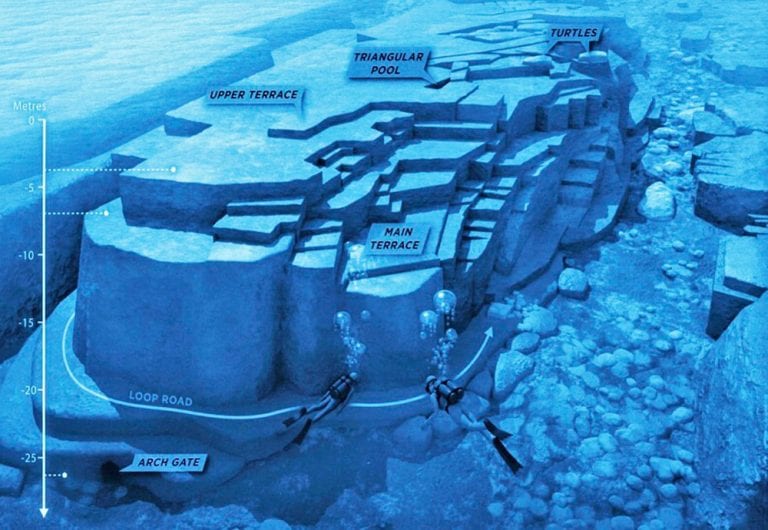
This ongoing dispute underscores the complexities of underwater archaeology, where the environment can obscure the line between natural erosion and intentional construction. Understanding such formations is critical for scientists as they attempt to map the prehistoric geography of the Pacific region.
Official Status and Tourism Impact
Despite the international fascination and the claims made by some researchers, the site lacks official recognition as a cultural landmark. Neither the government of the Okinawa Prefecture nor the Japanese Agency for Cultural Affairs recognizes the features as important cultural artifacts. Neither agency has implemented preservation efforts or conducted official research on the site.
Regardless of its origin, the Yonaguni Monument has become a significant economic driver for the region. Located approximately 100 kilometers east of Taiwan in the Philippine Sea, the site has transformed into a premier destination for divers worldwide. According to data from Japan Travel, the island is now recognized as one of the most unique and challenging diving locations globally, serving as a major tourism icon for the Okinawa Prefecture.
