
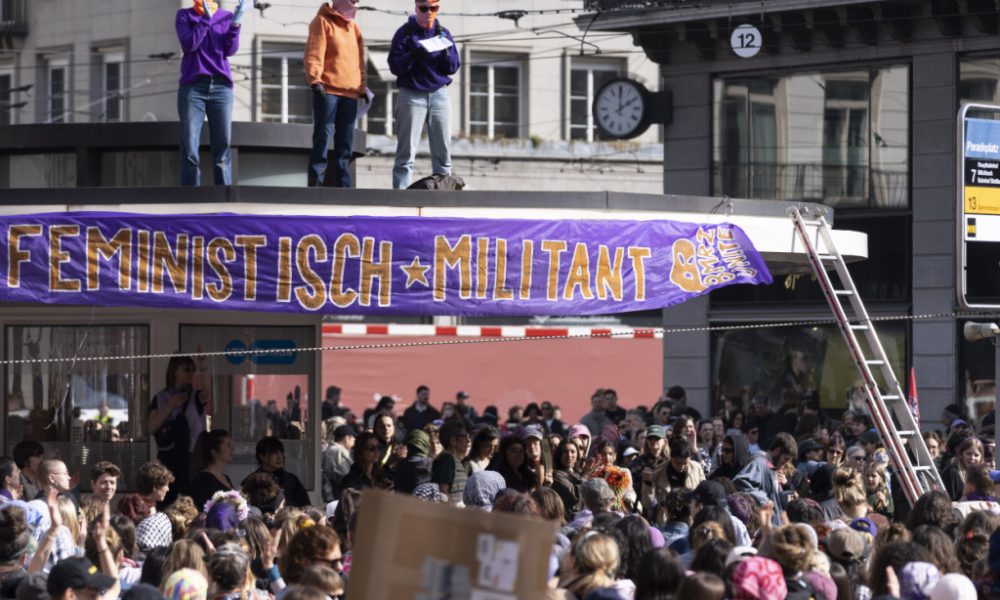
Zurich saw significant demonstrations Saturday as International Women’s Day events unfolded across Switzerland, with nearly 1,000 women participating in protests, and actions. The demonstrations highlight ongoing concerns regarding women’s rights and gender equality in the country and globally.
In Zurich, approximately 500 women blocked Helvetiaplatz, according to reports. Later, the demonstration grew to include around 1,000 participants, and resulted in some property damage.
Elsewhere in Switzerland, events took place in Lausanne, Geneva, and Neuchâtel, among other cities. In Lausanne, a gathering took place Saturday afternoon in front of the Cathedral, centered around the theme “Feminist against imperialist wars.” Organizers, the Vaud Feminist Strike Collective, called for mobilization against “austerity policies that destroy our lives and finance imperialist wars,” stating, “We refuse that public money be used to prepare for war rather than to guarantee decent lives.”
A similar rally was held in Sion, and a public action with a “just peace” theme, including a feminist flash mob, was organized in Neuchâtel.
While there was no national gathering organized by Travail.Suisse and the Swiss Trade Union Confederation, demonstrations and events were held throughout the country, including round table discussions and documentary screenings.
The events come as women’s rights advocates continue to address issues such as wage discrimination, with a coalition of 52 organizations recently denouncing a gap that “remains and is increasing,” despite efforts to analyze salaries within larger companies. According to the coalition, a woman in Switzerland loses an average of approximately 8,000 Swiss francs per year due to wage disparities.
The director of Amnesty International Switzerland shared observations on what she described as a “step backwards on women’s rights.” Demonstrators also voiced solidarity with women and gender minorities facing repression, sexual violence, or war in other countries.
In Neuchâtel, organizers aimed to highlight realities often ignored, while events across the country served as a platform to demand concrete measures to end gender-based and sexual violence.
