
Robotics Market Poised for $130 Billion Growth by 2035, Driven by Amazon, Tesla, and Nvidia
The global robotics market is on track to reach $130 billion by 2035, fueled by advancements in artificial intelligence, with three companies – Amazon, Tesla, and Nvidia – controlling the critical infrastructure powering this expansion.
Amazon currently operates over one million robots across its fulfillment network, a scale unmatched by competitors, and is seeing efficiency gains of around 10% through its DeepFleet generative AI coordinator. These robots, including models like Hercules and Proteus, are already handling billions of packages annually, streamlining e-commerce logistics. This widespread deployment demonstrates a practical application of robotics that is already impacting global supply chains.
Tesla aims to disrupt the humanoid robot market with its Optimus model, targeting a price point of $20,000 to $30,000 – significantly lower than Boston Dynamics’ Atlas, which costs around $140,000. Achieving this price target could unlock broader industrial applications for humanoids, transforming them from costly demonstrations into viable tools. For more on the potential of humanoid robots, see IEEE Spectrum’s coverage.
Underpinning both Amazon and Tesla’s efforts, as well as numerous other robotics programs, is Nvidia, which provides the AI platforms and tools – including the Isaac stack and GR00T N1 humanoid foundation model – essential for development and deployment. Nvidia’s technology is being adopted by companies like Boston Dynamics, Hyundai, and Foxconn, solidifying its position as a key enabler of the robotics revolution. This dominance in AI processing power is crucial as companies race to develop more sophisticated robotic systems; learn more about Nvidia’s robotics solutions.
Officials indicate that continued investment and innovation in these areas will be critical to realizing the full potential of robotics and addressing labor shortages across various industries.
The robotics market is heading toward $130 billion by 2035 — and these three companies control the critical infrastructure.
A robotics revolution is unfolding, thanks to the artificial intelligence (AI) explosion. Robots that physically move, lift, and assemble products are estimated to represent a $130 billion opportunity by 2035, split between $38 billion in humanoid robots and $94 billion in industrial systems.
Three companies control the essential infrastructure behind this boom. Amazon (AMZN +1.41%) operates over a million robots across its fulfillment network today. Tesla (TSLA 3.40%) aims to manufacture humanoids at prices far below existing competitors. Nvidia (NVDA +2.25%) provides the AI platforms powering both companies and virtually every serious robotics program.
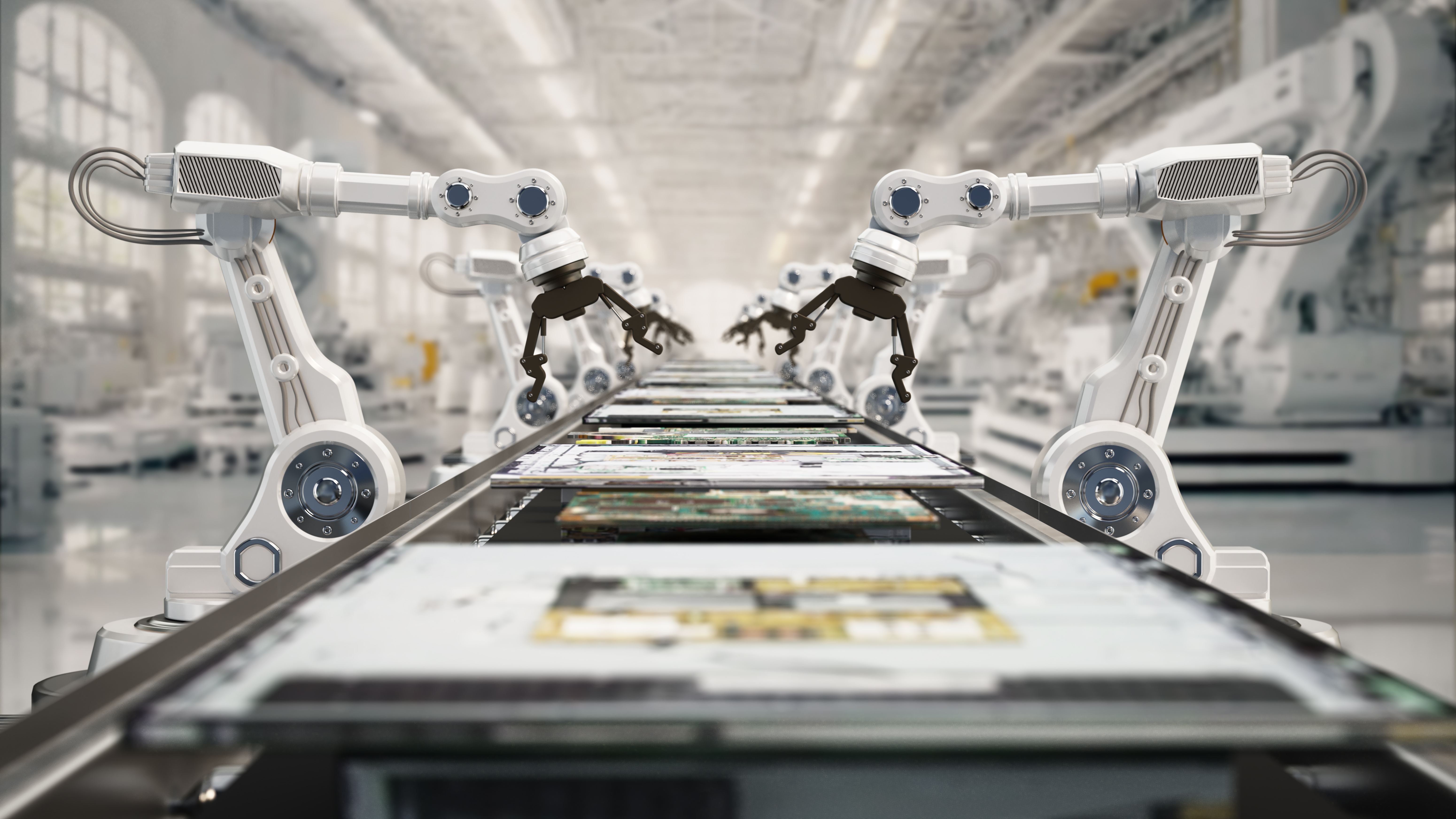
Image source: Getty Images.
Here’s why these three top robotic stocks are buys right now.
Amazon built the robot army nobody noticed
While rivals show prototypes, Amazon deploys at scale. More than 1 million robots work across more than 300 facilities, moving boxes from point A to point B. This is not future tech. It is the infrastructure that moves billions of packages each year.

Today’s Change
(1.41%) $3.12
Current Price
$224.21
Key Data Points
Market Cap
$2391B
Day’s Range
$221.90 – $225.40
52wk Range
$161.38 – $242.52
Volume
39M
Avg Vol
44M
Gross Margin
49.61%
Dividend Yield
N/A
DeepFleet, Amazon’s generative AI coordinator, drives about a 10% gain in fleet efficiency. Small gains compound when you run a seven-figure fleet. The hardware lineup includes Hercules, which lifts up to 1,250 pounds, and Proteus, which navigates safely around people.
Amazon’s robotics infrastructure handles billions of packages annually, and that throughput advantage compounds as the fleet grows. The e-commerce giant already operates robotics at a scale no competitor matches.
Why Optimus is the core thesis
Tesla’s humanoid robot, Optimus, only matters if the unit economics work. Tesla is targeting a $20,000 to $30,000 price for a general-purpose humanoid. By comparison, Boston Dynamics’ Atlas costs around $140,000.
If Tesla reaches its price target levels, competitors will need to cut prices sharply. At that level, humanoids would move from costly demos to tools that make sense for everyday industrial work.
The caveat is simple. Targets are not costs. Reliability, safety, serviceability, and lifetime maintenance are unproven at scale. The thesis depends on hitting a price that turns a humanoid from a capital-intensive toy into an operating expense with a fast payback.

Today’s Change
(-3.40%) $-15.26
Current Price
$433.72
Key Data Points
Market Cap
$1442B
Day’s Range
$430.17 – $451.68
52wk Range
$214.25 – $488.54
Volume
95M
Avg Vol
88M
Gross Margin
17.01%
Dividend Yield
N/A
If Tesla gets there, Optimus becomes the business. If it does not, Optimus is an expensive paperweight. History suggests Tesla usually crosses the finish line on big manufacturing bets, often later than promised, but at a scale that changes unit economics.
Nvidia captures the economics layer
Nvidia sells the brains and tools for robots. The Isaac stack pairs the GR00T N1 humanoid foundation model with Isaac Lab for training and Isaac Sim for digital twins. GR00T-Dreams shortens synthetic data generation to hours instead of months, which speeds up real-world deployment.
Adoption is broad across categories. Boston Dynamics and Agility build on Nvidia’s platform, Hyundai is standardizing on Omniverse and Isaac for mobility and factory use, and Foxconn has discussed humanoid deployments at its new Houston plant.

Today’s Change
(2.25%) $4.10
Current Price
$186.26
Key Data Points
Market Cap
$4526B
Day’s Range
$183.50 – $187.47
52wk Range
$86.62 – $195.62
Volume
131M
Avg Vol
173M
Gross Margin
69.85%
Dividend Yield
0.00%
In the robotics space, Nvidia benefits no matter which company takes the lion’s share of the market because the training, simulation, and edge compute layer runs through its stack.
Three paths into robotics dominance
The robotics revolution is here, and key inflection points are barreling toward humanity at light speed. Investors would thus be wise to own at least one major robotics stock. These three industry behemoths are solid picks because each company offers a distinct risk profile and value proposition.
Tesla offers massive upside if Optimus hits production and cost targets. Amazon demonstrates operational execution with a million robots already generating value and millions more in production. Nvidia owns the infrastructure layer that nearly every robotics company requires to develop advanced features. All three benefit as robots move from lab curiosities to industrial necessities.
