
Stephen King’s enduring horror classic,It,returns to the screen with Welcome to Derry,a new prequel series now streaming on HBO Max. While the 1986 miniseries and the 2017 film adaptations both found success tapping into the novel’s core fears, this latest installment-helmed by It (2017) director Andy Muschietti-struggles to recapture that magic, according to a new review. The series,set 27 years before the events of the films,explores the origins of Pennywise’s reign of terror in Derry,Maine,but falls short of delivering the compelling character growth and sustained tension that defined its predecessors.
(A kritika spoileres.)
Adapting Stephen King’s work is notoriously difficult, and even the best adaptations only scratch the surface of his vast catalog. King’s stories tap into our most primal fears while grappling with real-world issues, but it’s his richly developed characters that truly define his novels – they’re so relatable, anyone can find themselves within their pages. This is undoubtedly why the 1986 film, *It*, has remained so popular and been revisited multiple times. However, the recently concluded prequel series, *It: Welcome to Derry*, unfortunately falls among the less successful adaptations.
That’s particularly disappointing considering the series was helmed by Andy Muschietti, the director who revitalized the source material 27 years after the first *It* television movie, creating a truly chilling atmosphere with Bill Skarsgård’s portrayal of Pennywise. The 2017 *It* focused on character development alongside the classic scares, and Muschietti successfully established an instinctive connection between Skarsgård and the terrifying Pennywise character.
King’s novel interweaves the story of a dozen “losers” confronting the monstrous entity as children and then again as adults. Muschietti, however, made the decision to split the Losers’ Club story into two parts. As a result, the second installment, focusing on the adult characters, didn’t pack the same punch as the film released two years prior. The 2019 sequel suffered not only from its excessive length but also from the absence of the endearing children who brought the first film to life.
The eight-episode prequel series suffers from the same issue, despite having all the necessary ingredients for success – the setting, a seemingly ordinary small town in Maine, the underlying tension, supernatural elements, and the return of Bill Skarsgård as the child-eating clown. I had initially hoped that the script, penned by Jason Fuchs, Andy Muschietti, and his sister Barbara, would capture the essence of the novel.
The creators certainly had a promising start, and the initial episodes were genuinely intriguing, suggesting a unique approach to the source material. The story unfolds in 1962, 27 years before the events of the film, during a previous cycle of Pennywise’s resurfacing. One of the main storylines follows Major Leroy Hanlon (Jovan Adepo), who moves to Derry with his family for a mission at the local military base. Leroy quickly realizes his assignment is far from ordinary, tasked with tracking down the entity alongside his colleagues. Simultaneously, another narrative centers on teenager Lilly Bainbridge (Carla Stark) and her friends, who are plagued by disturbing visions leading to a brutal massacre at the town’s movie theater. Both threads hint at the same terrifying truth: Pennywise has awakened from decades of slumber and is killing again.
However, the creators couldn’t fully capitalize on this setup, resulting in eight episodes of characters searching for the killer clown, ultimately defeating it with the power of love – mirroring the events of the film. Despite its simplicity, the story unfolds slowly, and the characters, or when they *are* developed, are simply uninteresting, a significant misstep for the creators. Even a convincingly atmospheric Derry can’t be brought to life with hollow figures.
Marge, Ronnie and Lilly in the series (Matilda Lawler, Amanda Christine and Carla Stark) – Photo: Warner Bros. Discovery
The opening was promising, immediately establishing a sense of dread with the appearance of It in its distorted newborn form, killing a young boy named Matty. When his body wasn’t found, Lilly began to suspect something was amiss. Like Beverly Marsh in the novel, Lilly started hearing voices from the bathroom sink drain, and alerted Matty’s friends, leading them to seek answers at the town’s movie theater. Then came the twist: at the end of the episode, It slaughtered everyone in the theater, with only Lilly and Ronnie Grogan (Amanda Christine) surviving.
This set the stage for a different dynamic than expected, but the core problem remained: most of the series’ characters felt underdeveloped. The adult storylines, a common pitfall in prequel series, struggled to gain traction. The series did, however, benefit from a strong atmosphere and a return to the familiar, unsettling setting of Derry, Maine. The story begins in 1962, 27 years before the events of the film, during a previous cycle of Pennywise’s awakening. One of the central characters, Major Leroy Hanlon (Jovan Adepo), arrives in Derry with his family for a mission at the local military base, quickly discovering it’s anything but routine. Simultaneously, teenager Lilly Bainbridge (Carla Stark) and her friends are haunted by strange visions, culminating in a brutal massacre at the town’s cinema. Both storylines suggest the same terrifying truth: Pennywise has risen from decades of slumber.
But from this foundation, the creators managed to deliver only eight episodes of characters searching for the killer clown, ultimately defeating him with the power of love – a move that felt directly lifted from the film. The story, despite its simplicity, unfolds slowly, and the characters lack depth – or, when they *do* have depth, they’re simply uninteresting. This is a major failing, considering the atmospheric Derry deserves a compelling cast.
The adult characters, however, offered a welcome contrast. Korean War veteran Leroy Hanlon, for example, fears nothing, making him a more challenging prey for Pennywise. The series also explored his internal conflict between his military duty and protecting his family. Even more compelling was Dick Hallorann (Chris Chalk), a character with telepathic abilities and the ability to sense the dead, brought over from Stephen King’s *The Shining*. Chris Chalk’s scenes injected a surreal quality into the series, and his journey was far more engaging than the main plot. General Francis Shaw (James Remar) also benefited from the addition of Hallorann, tasking him with locating relics containing Pennywise within Derry’s city limits.
Shaw and his plan, however, proved to be a low point. While James Remar’s character initially led Leroy Hanlon to believe he was focused on capturing the monster, it soon became clear he had other plans. Shaw had encountered It as a child and became determined to unleash the fear-feeding entity upon America. He justified this with the bizarre claim that the United States was threatened by an internal enemy and that only fear could teach society peaceful coexistence. From this, he concluded that unleashing a creature that nearly devoured him as a child was necessary, dismissing any collateral damage. This outlandish reasoning felt ripped from any action film’s megalomaniacal villain, and Shaw’s lack of emotional range beyond a stern gaze didn’t help matters.
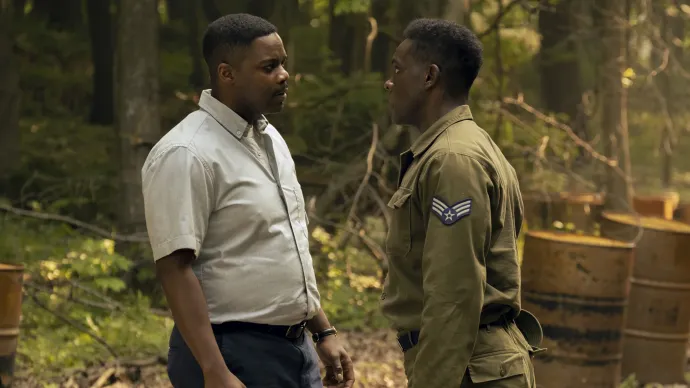
Leroy Hanlon (Jovan Adepo) and Dick Hallorann (Chris Chalk) in the series – Photo: Warner Bros. Discovery
Ingrid (Madeleine Stowe), the daughter of a previous Pennywise incarnation, was another narrative dead end. Presented as a sort of Harley Quinn figure, her assistance to It felt strangely underdeveloped. In the novel, Henry Bowers and his gang were corrupted by their own flaws, but Ingrid’s motivations in the series were simply to find her deceased father within the entity. Her storyline felt pointless, explaining only why Pennywise often appears as a clown – because her father used the guise to lure children to the circus.
Because so many of the characters in *It: Welcome to Derry* are so unengaging, the story feels adrift throughout the eight episodes. This was particularly evident with the Native American characters guarding Pennywise’s prison, whose sole function was to inform the soldiers of the relics’ locations. The military operation unfolded slowly, and when the true intentions were revealed, I wondered why the creators didn’t aim higher.
Despite my anticipation, Pennywise wasn’t allowed to unleash a massive bloodbath in the series, as a prequel can’t kill off characters who are important to the novel’s plot. And without stakes, the entire story feels hollow. Successful prequels like Better Call Saul or Andor worked because they introduced characters whose fates I was invested in, even knowing the eventual outcome. The characters in *It: Welcome to Derry* feel soulless compared to the novel’s heroes, lacking the authenticity that made me believe anyone could confront their own demons.
The series did, at least, get the atmosphere and visuals right. The tension lurking in the small town of Maine was palpable throughout. Upon arrival, the Hanlons were met with distance from the suburban residents, which grew increasingly oppressive throughout the season. It was also evident that the locals didn’t welcome them, and Ronnie’s father was immediately labeled a criminal because of his skin color. Derry’s residents were also plagued by hatred and racism, which erupted during the burning of the Black Ram. Unlike the book, however, the Black Ram wasn’t burned down by a Ku Klux Klan-like group, but by ordinary people who turned a blind eye to the horrors unfolding in their town. This suffocating atmosphere was further enhanced by the animated intro, whose music stayed with me long after the series concluded.
Pennywise’s scares were also creatively executed throughout the episodes. It appeared in a variety of forms, and Bill Skarsgård once again delivered a brilliant performance as the terrifying clown. His first appearance was chilling, convincing the children that Matty was still alive before revealing his true form in the sewer. The creators didn’t shy away from gruesome scenes either, with limbs torn and heads falling in abundance. The horror elements peaked when Pennywise nearly broke free from Derry’s confinement. The foggy town, the frozen lake, the floating children, the circus carriage, and the blood-soaked clown all set the stage for a powerful finale. It’s a shame Skarsgård wasn’t allowed to run wild until the final episodes, as his presence was sorely missed in the first half of the series.
*It: Welcome to Derry* started with promise but ultimately drowned in uninteresting subplots. Instead of dedicating more time to Dick Hallorann’s story or showcasing Pennywise, I was forced to watch the prolonged struggles of flat characters, which even a strong finale couldn’t fully compensate for. While it was good to return to the familiar small-town setting and fear its oppressive atmosphere, I realized that there are no losers left in Derry. And without them, this world just isn’t the same.
Episodes of *It: Welcome to Derry* are available to stream on HBO Max.
