

Prime Minister Mark Carney’s bold pitch to U.S. investors in New York this week—“Canada Strong will help make America great again”—marks the most aggressive diplomatic gambit yet in Ottawa’s push to reshape its relationship with Washington ahead of the July 1 deadline to renew the Canada-U.S.-Mexico trade deal (CUSMA). With tariffs still in place, formal negotiations stalled, and President Donald Trump’s administration signaling no appetite for a quick renewal, Carney’s speech at the Economic Club of New York framed Canada not as a supplicant but as a partner with leverage, offering “specific, practical proposals” to deepen cooperation in energy, critical minerals, and automotive supply chains. The message: a stronger Canada isn’t just a market for U.S. goods—it’s a solution to some of America’s biggest economic vulnerabilities.
Why Carney’s “Make America Great Again” Pivot Stings Washington
Carney’s framing—a deliberate echo of Trump’s 2016 slogan—wasn’t accidental. By positioning Canada as the antidote to global competition (especially from China), he forced U.S. officials to confront an uncomfortable truth: the two countries are economically interdependent to a degree no other allies share. As Carney put it in his speech, “Canadian exports to the United States are the energy equivalent of 10 Hoover Dams.” With U.S. demand for liquefied natural gas, aluminum, and potash surging, the subtext was clear: Why build domestic infrastructure when Canada can supply it?
Yet the optics of Carney’s pitch—delivered in New York to a room of Wall Street titans—were equally pointed. While the U.S. and Mexico hold preliminary CUSMA talks this week in Mexico City, Canada remains excluded, a snub that underscores Washington’s leverage. U.S. Trade Representative Jamieson Greer has signaled tariffs on Canadian and Mexican goods will persist post-renewal, and Trump’s administration has frozen defense talks, including the long-standing Permanent Joint Board on Defense. Against this backdrop, Carney’s speech wasn’t just a sales pitch—it was a warning: Canada is diversifying its trade partners (Europe, Asia, South America) and investing in strategic autonomy, but it’s also ready to compete.
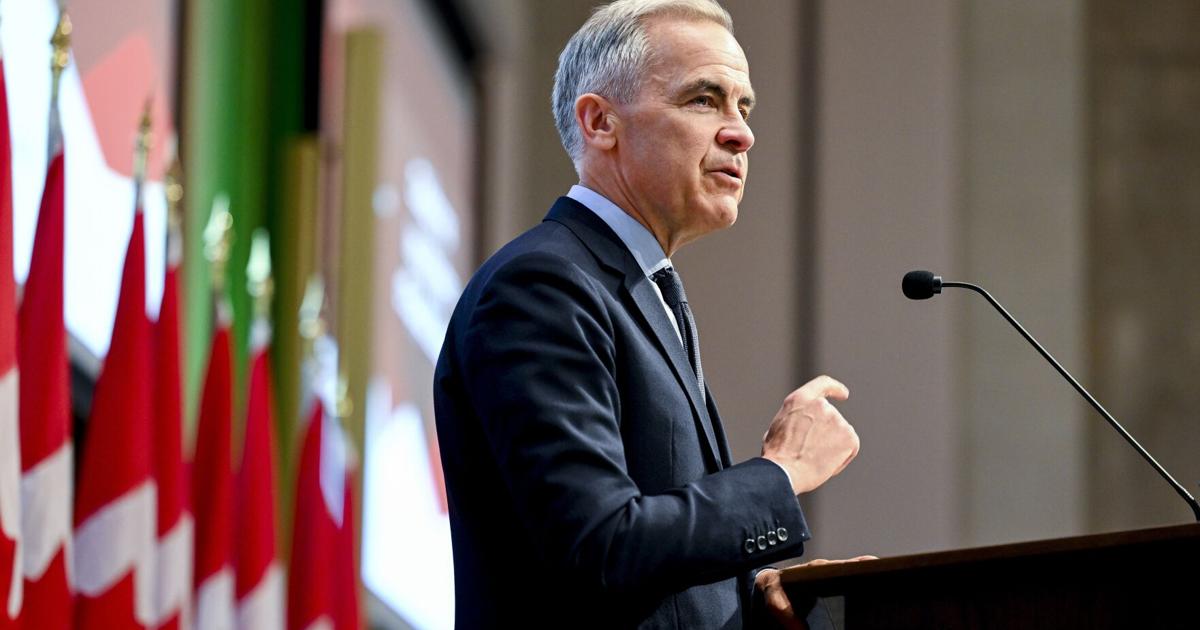
“Canada Strong will help make America great again. The examples are legion where we should work together and compete with the world together.”
—Mark Carney, Prime Minister of Canada, via CBC
Carney’s remarks were met with immediate pushback from U.S. officials, who described his approach as “unilateral framing.” A statement from the Office of the U.S. Trade Representative (USTR) emphasized that “any renewal of CUSMA must address outstanding issues on both sides,” without specifying which issues remained unresolved. Meanwhile, a senior administration official, speaking on condition of anonymity, told reporters that “Canada’s proposals have not been formally presented to the U.S. government,” suggesting that Carney’s New York speech was more of a public relations maneuver than a substantive negotiation step.
However, Canadian officials defended the approach, arguing that direct engagement with U.S. investors was necessary given the stalled diplomatic track. “We’re not waiting for Washington to invite us to the table,” said Finance Minister Chrystia Freeland in a statement released after Carney’s speech. “Our economy is too interconnected to allow politics to dictate our future.” Freeland’s remarks came as part of a broader push by Ottawa to coordinate messaging between Carney, Industry Minister Melanie Joly, and other senior officials.
The “Fortress North America” Gambit: What’s Really at Stake
Carney’s call for a “true partnership” echoes Ontario Premier Doug Ford’s Fortress North America concept—a vision of continental economic unity to counter Chinese influence. But where Ford’s proposal was vague, Carney’s was sector-specific and data-driven. His focus on energy, critical minerals, and autos isn’t just about trade; it’s about security. With U.S. supply chains under pressure from geopolitical risks, Canada’s role as a supplier of reliable resources (not just cheap ones) is a strategic asset.
Consider the numbers: Canada supplies 40% of U.S. aluminum, 70% of its potash, and is the top exporter of natural gas to America, according to data from Natural Resources Canada. Yet tariffs on Canadian steel and aluminum—imposed in 2018—remain in place. Carney’s proposal to lift these barriers isn’t just about economics; it’s about stability. As he told the Economic Club, “A country that can’t feed, fuel, or defend itself is not truly sovereign.” The subtext? Let’s stop treating each other as adversaries.

But the challenge is political. Trump’s administration has framed tariffs as a negotiating tool, not a permanent fixture. With the CUSMA review deadline looming, the question isn’t whether Canada and the U.S. will reconcile—but on whose terms. Carney’s speech suggests Ottawa is no longer willing to play by Washington’s rules. “We’re not in reaction mode anymore,” Industry Minister Joly told reporters this week. “We have a plan.”
Joly’s remarks came as part of a broader strategy outlined in a detailed briefing released by Industry Canada on May 25. The document, obtained by Reuters, highlights three priority areas for negotiation: automotive supply chain integration, critical mineral security, and agricultural trade expansion. The briefing also notes that Canada is prepared to walk away from CUSMA if the U.S. refuses to engage in “good-faith negotiations,” a stance that contrasts sharply with previous Canadian concessions.
What’s Next: Three Scenarios for July 1
- Renewal (16-year extension): Likely only if the U.S. secures concessions on automotive rules, agriculture, and tariff coordination—conditions Carney’s team has signaled they’re open to discussing. But with Trump’s administration prioritizing bilateral talks with Mexico first, Canada’s exclusion raises doubts. A leaked internal memo from the USTR, obtained by the Globe and Mail, suggests that the U.S. is seeking a 10% tariff reduction on Canadian steel and aluminum as a precondition for renewal, a demand that Canadian officials have privately dismissed as “non-starter.”
- Withdrawal: Unlikely, given the economic costs. But if negotiations collapse, Canada could trigger an annual review cycle, keeping talks alive for up to a decade—a strategy that buys time but risks prolonged uncertainty. Legal experts, including Professor Sarah Joseph of the University of Toronto’s Faculty of Law, have warned that such a move could lead to retaliatory tariffs from the U.S., further destabilizing cross-border trade.
- Neither renew nor withdraw: This would lock in the status quo, including tariffs, while forcing annual reviews—a worst-case scenario for businesses on both sides. A survey of Canadian exporters conducted by the Canadian Chamber of Commerce in May found that 62% of respondents believe this outcome would result in job losses exceeding 50,000 in the automotive sector alone.
Carney’s New York trip was part of a broader push to preempt this outcome. By courting U.S. investors and framing Canada as a solution to American challenges, he’s attempting to shift the narrative from conflict to collaboration. But with no formal talks scheduled and Greer’s warning that “tariffs will remain,” the path forward is far from clear.
In a related development, Canada’s Ambassador to the United States, David MacNaughton, met with USTR officials in Washington on May 27 to discuss “de-escalation pathways.” However, sources close to the negotiations describe the meeting as “exploratory at best”, with no concrete proposals exchanged. Meanwhile, Mexican officials have indicated they are open to acting as intermediaries between Canada and the U.S., a role they have played in past trade disputes.
The Bigger Picture: Canada’s Strategic Autonomy Play
Carney’s speech wasn’t just about trade—it was about power. His repeated references to Canada’s “strategic autonomy” and “true sovereignty” reflect a broader shift in Ottawa’s foreign policy. With China’s influence growing in Latin America and Europe, and the U.S. increasingly transactional in its alliances, Canada is hedging its bets.
Last week’s announcement of contract negotiations with Sweden’s Saab to purchase surveillance aircraft—a deal worth $1.5 billion, as confirmed by a Swedish government press release—was a case in point. By diversifying defense partnerships, Canada is signaling it won’t rely solely on the U.S. for security. Yet Carney’s New York pitch made clear: We’re not turning our back on America. We’re just refusing to be taken for granted.

This dual strategy—deepening ties with the U.S. while expanding elsewhere—is risky. But in a world where alliances are weaponized (as Carney put it), it’s also pragmatic. The question is whether Washington will meet Canada halfway. Given Trump’s history of using tariffs as leverage, the answer may hinge on whether Carney’s “specific, practical proposals” are seen as concessions or opportunities.
In a recent interview, Carney acknowledged that the U.S. has historically viewed Canada as a “soft target” in trade negotiations. “We’ve been too willing to compromise on our core interests,” he said. “That’s changing.” His remarks were echoed by Foreign Affairs Minister Mélanie Joly, who told reporters that Canada is now pursuing a “principled pragmatism” in its diplomatic approach.
What Happens If No Deal Is Reached?
The stakes are higher than most realize. A collapsed CUSMA deal wouldn’t just disrupt trade—it could accelerate Canada’s pivot to Asia and Europe. The European Union is already Canada’s second-largest trading partner, and deals with India and the UK are in advanced stages. But replacing U.S. demand won’t be easy: 75% of Canadian exports go to the U.S., according to Statistics Canada.
- Job losses in auto manufacturing (where U.S. tariffs have already cost Canada $1.6 billion in exports since 2018, per data from the Canadian Automotive Dealers Association). The sector employs over 120,000 Canadians, and industry analysts warn that prolonged tariffs could lead to plant closures in Ontario and Quebec.
- Supply chain disruptions in energy and agriculture, where U.S. buyers rely on Canadian inputs. For example, 80% of U.S. potash imports come from Canada, and disruptions could trigger fertilizer shortages in American farm states, according to the U.S. Department of Agriculture.
- Investor flight from Canada’s stock market, which has underperformed the S&P 500 by 12% year-to-date amid trade uncertainty, as reported by the Toronto Stock Exchange. Sector-specific declines have been sharpest in energy (18% drop) and automotive (15% drop).
- Accelerated diversification—but at a cost. Shifting supply chains to Europe or Asia takes years and capital. A Bank of Canada report released in May estimated that fully diversifying Canada’s trade away from the U.S. could cost $50 billion in initial investments and result in a 3% GDP contraction in the short term.
Carney’s New York gambit was a calculated move to avoid this scenario. By positioning Canada as a partner rather than a client state, he’s betting that economic logic will prevail over political brinkmanship. But with Trump’s administration showing little urgency to resolve trade irritants, the clock is ticking.
The next three weeks will be critical. If Carney’s proposals gain traction, we could see a breakthrough by July. If not, Canada may find itself forced to accelerate its strategic autonomy—with consequences for both economies.
One thing is certain: the era of Canada as America’s silent junior partner is over. Whether that’s a blessing or a curse depends on whether Washington is willing to treat it as an equal.
In the meantime, Canadian businesses are bracing for the worst. The CD Howe Institute, a Toronto-based think tank, released a report on May 27 warning that without a CUSMA renewal, Canada could face a $20 billion annual trade deficit with the U.S. by 2027. The report’s lead author, Economist Beata Caranci, described the situation as a “perfect storm of economic and political risks.”
As negotiations enter their final stretch, one thing remains clear: Canada’s approach reflects a pragmatic balance between cooperation where mutual interests align and readiness to assert its economic and security interests independently.
