
In 1964, French actress Brigitte Bardot sought refuge in Brazil, hoping to escape the intense scrutiny of paparazzi and the pressures of international stardom.The attempt at a private getaway with her then-partner, basketball player Bob Zagury, proved fleeting, as media attention followed her even to Rio de janeiro.A recent report from Paris Match details Bardot’s subsequent attempt to find solitude in the then-remote coastal village of Búzios, and the lasting impact her brief stay had on the small community, transforming it into a prominent tourist destination decades later.
In 1964, Brigitte Bardot fled to Brazil, seeking respite from the relentless pressures of fame in Paris – the constant filming, the intrusive media, and the paparazzi’s unending pursuit. Hoping to find solitude during the Northern Hemisphere’s winter, she believed she could escape the watchful eyes of photographers. Accompanying her was her then-lover, Bob Zagury, a strikingly handsome basketball player from a prominent Rio de Janeiro family. But the escape proved illusory. When their plane touched down at Rio de Janeiro’s airport in the early hours of January 7, Bardot discovered a throng of journalists and photographers already waiting on the tarmac. The idyllic getaway quickly transformed into a high-stakes chase.
A special correspondent for Paris Match described a woman relentlessly pursued, confined to an apartment in Copacabana as the building was besieged by onlookers. “Day and night, the crowd chanted her name and demanded her appearance,” the correspondent wrote. The local press fueled the frenzy, even speculating that Bardot had been dispatched by French President Charles de Gaulle as a diplomatic envoy to mend relations between Paris and Brasília, strained by the “lobster war” – a dispute over French fishermen harvesting crustaceans off the coast of northeastern Brazil.
Bardot attempted to flee once more. To evade the crowds gathered outside her apartment, the couple relied on the help of Denis Albanèse, a photographer and sailor who was a friend of Zagury’s. “He called me from Paris to tell me he was coming to Brazil with Brigitte Bardot. I thought it was a joke,” recalled the 94-year-old Albanèse, still deeply affected by the loss of his “oldest friend.” Albanèse arranged a ten-day sailing trip around Ilha Grande, on the Costa Verde. “Bob and I went spear fishing while Brigitte bought live fish from the fishermen, which she then threw back into the water behind us,” he remembered with a laugh. “I expected to meet a temperamental star, but I discovered a delightful woman. It was the beginning of a long friendship that lasted until her death.”
Brigitte Bardot, libre de vivre son idylle loin de sa famille, qui désapprouve le penchant de Bob pour le poker. Leur adventure lasted from 1963 to 1966.
© Denis Albanèse
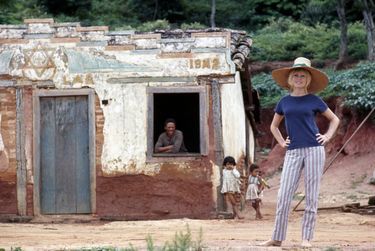
Upon their return to Rio, the journalists were still there. Albanèse decided to take the couple to his secret refuge in Búzios, before leaving them to enjoy their privacy. Located 170 kilometers northeast of Rio, the peninsula was, at the time, a simple coastal district attached to Cabo Frio. A wild paradise, bordered by turquoise waters and twenty-three beaches of fine sand – said to be so beautiful that the first Portuguese Jesuit missionaries to land in Brazil saw them as irrefutable proof of the existence of God. A far cry from the fashionable resort it would later become. When Bardot took refuge there, the year Brazil plunged into military dictatorship, it was a village of 2,500 inhabitants, with no paved roads, electricity, or running water. Its only assets were three small grocery stores, two phone booths, and schools of grouper that delighted local fishermen. Residents hauled barrels to obtain potable water for the small brick houses lining the waterfront.
While the country descended into political repression, Bardot lived a life apart, far from the world. On the cusp of her thirties, she finally ceased to be a constant public spectacle, a body on display. Under the coconut trees, she lived simply, barefoot and in a bikini, in a charming house overlooking the ocean rented from a Swiss resident. This deliberate simplicity likely reminded her of her secluded retreat in La Madrague, before it was overrun by paparazzi. In this tropical replica of her beloved Saint-Tropez, BB swam early in the morning and learned a few words of Portuguese. Local legend has it she scandalized fishermen by offering the village its first topless sunbathing display. In the evenings, music filled the air. Bardot hummed along to bossa nova tunes, like “Maria Ninguem” – “Marie No One,” a fitting title for someone dreaming of blending into anonymity – which she would record in Portuguese that same year.
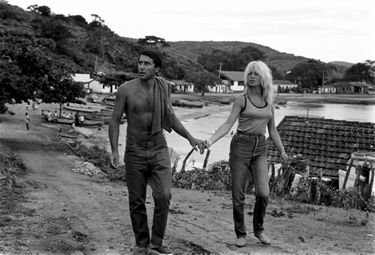
Brigitte Bardot, libre de vivre son idylle loin de sa famille, qui désapprouve le penchant de Bob pour le poker. Leur adventure lasted from 1963 to 1966.
© Denis Albanèse
“No one knew who she was. She moved with total freedom and spontaneity”
In her 1996 memoirs, the actress confided that she had found an authentic happiness in this remote corner of the world that she had long sought: “It was perhaps there, in this so very real universe, that I spent the happiest days of my life,” she wrote. This sentiment reveals a contradiction that Bardot never fully resolved. The Brazil she loved was a land of miscegenation, where the blending of cultures was celebrated as a richness: indigenous peoples, African slaves, and European colonists had produced a society where bodies, cultures, and music intertwined until they became inseparable. This experience, however, wasn’t enough to dispel her persistent fear of a France she believed was threatened by immigration.
Initially kept secret, her presence in Búzios eventually leaked. Bardot asked Denis Albanèse to take the photos requested by the Brazilian media in exchange for her peace of mind. The photographer arrived one morning in his old Volkswagen and captured a series of images of Bardot in her element among the fishermen’s children and wild pigs. “No one knew who she was. She moved with total freedom and spontaneity.” He had always refused to sell the photos in France, until now. “I then wanted to take her to an Indian tribe in the heart of the Amazon. I dreamed of photographing her naked amidst the piranhas and equally naked Indians,” he joked. “But she was afraid to board the small military plane I had chartered for the occasion. That remains a great regret…”
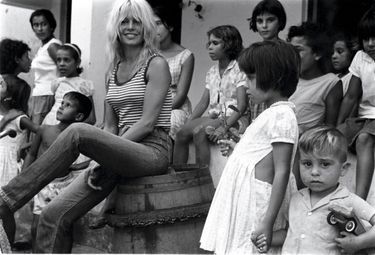
Brigitte Bardot with the children of fishermen, as fascinated by this unknown blonde as by Denis Albanèse’s camera.
© Denis Albanèse
Bardot eventually left her Brazilian paradise, but her stay of just three months was enough to transform the peaceful village into the “Saint-Tropez of the tropics.” In her wake, roads were built, hotels sprang up, and stars flocked to the area – Leonardo DiCaprio, Mick Jagger, Madonna among them. “Brigitte propelled our city onto the world stage,” said Ciro Testa, owner of the Madame Bardot restaurant, whose facade is adorned with a cat’s head in homage to the star’s love of animals. The restaurant serves a BB cocktail made with mango, pineapple, rum, and blue curaçao – the most ordered and photographed drink on the menu, according to the grateful owner, eternally thankful for both the international aura Bardot contributed to Búzios and the commercial boon the French actress continues to represent six decades later. “It’s simple,” he said, “we owe everything to her.”
“I have wonderful memories, but what Buzios has become leaves me stunned”
Bardot’s death was widely reported in the local press, occurring during the Brazilian summer break. On social media, the municipality of Búzios published an official tribute, declaring itself “in mourning.” “We have truly lost a part of our identity with her death,” lamented José Wilson Barbosa, a businessman who has lived in Búzios since 1988. For this devoted fan, “there was a before and after Brigitte. She gave us a place on the world map.” Founder and president of the Brigitte Bardot Cultural and Memorial Association, he has amassed everything he could find about the actress’s Brazilian sojourn over the years – posters, books, photos, which he dreams of one day bringing together in a museum dedicated to the memory of the woman he calls the “muse of Búzios.” “With her discreet and enchanting presence,” he said, “Brigitte lifted the veil that hid the wild beauty of Búzios from the world’s gaze, attracting curious visitors from all over the globe. BB is gone, but her name remains etched in the heart of every resident.”
This is evident in the numerous establishments bearing her name, still capitalizing on the Bardot myth, and the bronze statue depicting her gazing out to sea. The statue portrays Bardot in jeans and a striped t-shirt, not necessarily a very accurate likeness, the work of sculptor Christina Motta, installed along the “Bardot promenade,” one of the city’s most iconic tourist sites. Guides also offer tours of the house where the star stayed, romanticizing the torrid nights of love it supposedly sheltered, when the sound of the waves wasn’t yet drowned out by the rumble of tourist buses. A metamorphosis that would leave the actress with a bitter taste. “I have wonderful memories, but what Buzios has become leaves me stunned,” she declared in 2017. It was as if the place that had saved her had ultimately slipped away.
Brigitte Bardot face à la mer. At that time, she never traveled without her guitar. She had already recorded “La belle et le blues,” “La Madrague,” “Faite pour dormir…”
Gamma Rapho
/
© Ghislain Dussart
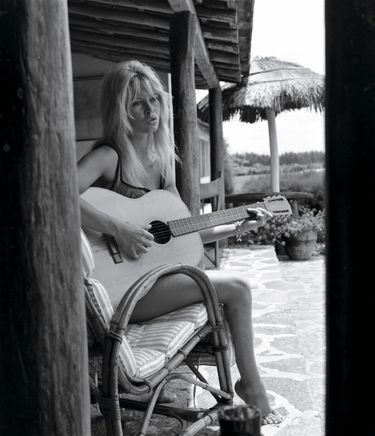
Brigitte Bardot face à la mer. At that time, she never traveled without her guitar. She had already recorded “La belle et le blues,” “La Madrague,” “Faite pour dormir…”
© Denis Albanèse
