
News•
-
Merel Stikkelorum
Domestic News Editor
-
Merel Stikkelorum
Domestic News Editor
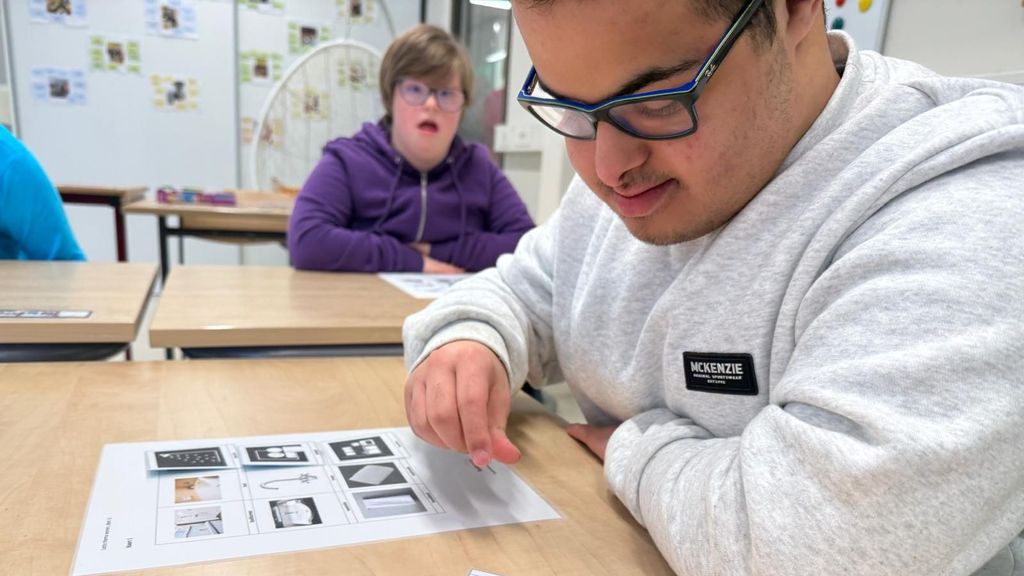
Students in specialized education programs across the country are being taught with textbooks designed for general education classrooms, leaving many struggling to maintain up. Experts say the lack of appropriate materials hinders learning and limits students’ ability to develop essential life skills.
Schools are now collaborating on a national platform to share specialized lesson materials, but funding remains uncertain and insufficient.
Ilja de Voogd, director of VSO Alphons Laudyschool in Amsterdam, a secondary school for students with special needs, said the issue was one of the first things he noticed when he took the position eight years ago. “There are no appropriate teaching methods for our students. That’s our reality.”
A Niche Market
Commercial textbook publishers have largely avoided creating materials for the nearly 110,000 students in the Netherlands with learning and behavioral challenges, physical disabilities, or intellectual limitations. “We are a niche,” De Voogd explained. “We are not financially attractive enough.”
Publishers acknowledge the issue. “The student group is so small that it quickly becomes too expensive to create something specifically for them,” said Jorien Castelein of the MEVW industry association. “Unfortunately, the availability of teaching materials for this group is not tailored enough.”
Textbooks from general education don’t meet the needs of these students, according to Herald Hofmeijer, a teacher educator specializing in special education at the University of Amsterdam. “They assume a different rate of development. For specialized education, you need to take intermediate steps and repeat more often, otherwise the children quickly fall behind.”
Physical Reactions
The mismatch also impacts students’ emotional well-being. Former Teacher of the Year Steffie van der Meijden recalled instances of disruptive behavior in her classroom as a result. “When a 16-year-old sees ‘grade 3’ prominently displayed on the cover of their language textbook, it’s incredibly frustrating. It leads to great frustration. Desks were sometimes thrown around the room.”
students rely on dedicated teachers who often spend their own time creating materials. At De Voogd’s school, teachers are given time during the workday to develop resources. “It takes a lot of time. They are busy with it every day.”
More often, teachers work on materials during their free time. “I was one of those teachers who spent every weekend and holiday creating lessons,” said Van der Meijden.
Through the sector council GO, a solution is in development: GOpen, a national digital platform where teachers can share high-quality lesson materials. The platform will launch in early March with the first fifty lessons, developed by teams including teachers and educational experts.
School director De Voogd believes this will be a significant improvement. “It’s important that there is more uniformity in the teaching materials and that expertise is pooled. My teachers will then have more time to focus on supporting the students.”
One of the schools collaborating on GOpen is the Heliomare College Alkmaar for specialized secondary education. Teacher Chantal Kuyl-Mater has seen firsthand how important good teaching materials are. Previously, many children struggled to learn to read, she noted. “Every time, it was a confirmation for them: see, I can’t do it.”
If you understand the world around you better, you can function better in it.
Parents’ dissatisfaction with reading instruction prompted the development of their own materials. “We now provide language lessons that are close to the students’ world of experience.”
With positive results. The children are not only reading better, they are thriving. “Students can read a WhatsApp message themselves, read the menu in a restaurant. It gives them independence and does something for their self-esteem. If you understand the world around you better, you can function better in it.”
Volunteer Contribution
That teaching material will also be available on GOpen. Van der Meijden’s goal is to fully meet the need for teaching materials for special education.
But, this requires substantial government funding, according to the sector council GO. Currently, teachers can only be paid a volunteer contribution from the subsidy, and schools largely bear the costs themselves.
Last week, the Ministry of Education pledged funding for the platform through 2030, but the amount remains unclear. What will happen after 2030 is uncertain.
