
The XXX edition of the Festival de Jerez concluded Saturday with a performance of Lo inédito by Compañía Flamenca La Lupi, bringing to a close two weeks celebrating flamenco dance, Spanish classical dance, and their evolution. The festival transformed the Andalusian city into a hub for the art form, and its final days showcased the deeply personal solo perform of dancers María Moreno and Leonor Leal, following a performance by Sara Calero the previous week. These three millennial dancers, all past recipients of the festival’s Revelation Prize, offered a diverse look at contemporary flamenco in conversations with EL PAÍS.
Sara Calero, 42, received the prize in 2014 for El Mirar de la Maja, one of her first solo works. Her decision to forge her own path followed an extensive career as a principal dancer with the Spanish National Ballet, among other companies. She describes the transition from performer to creator as a natural progression, calling her time with companies “particularly nourishing” and valuing the lessons learned in the creative process. However, she also admits to always feeling “a very powerful inner voice to create my own choreography.” Now, she finds preparing and directing her own shows the most exciting part of her work, and takes pride in bringing her ideas to the stage.
Calero expressed a desire to form her own company, acknowledging the current challenges: “I would like to form a company, but it is something unviable in the current conditions.” As a sort of experiment, she incorporated three dancers into her latest work, Taberna femme, which premiered at Suma Flamenca.
For her performance at the Jerez festival, Calero presented El renacer, a complement and continuation of her 2023 piece, La finitud. Both works move beyond the pursuit of formal perfection and youthful ideals— “when everything had to be perfect or beautiful”— toward a transcendence born from “an expressive urgency” that reflects her own personal and mental journey. “I’m breaking down inside, laughing, crying, getting excited…,” she explained. This emotional range resonated with the varied display of dances she performed at the Teatro Villamarta on February 25, showcasing her rich and diverse choreographic style.
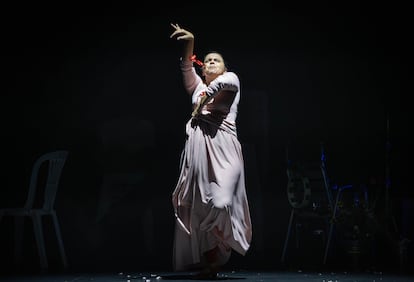
María Moreno, 39, was recognized with the Revelation Prize in Jerez in 2017 for her first work, Alas del recuerdo, and says she always knew she wanted a solo career. “I’m very restless and I’ve always seen myself dancing alone,” she said. She previously worked with companies like Eva Yerbabuena’s, but even then, she confessed to thinking about “how I would do it” whereas watching other dancers. She also collaborated with other artists, revealing her ambition to be a lead performer.
Following her second work, De la revelación (2018), which earned her the Giraldillo Revelation award at the Seville Biennial, Moreno’s career took a significant leap with More (no) More (2020). She described feeling a sense of fulfillment and authenticity with that piece, a feeling connected to her collaboration with operatic director Rafael R. Villalobos. He also directed her experimental deconstruction of the soleá dance in o../o../..o/o../o (2022) and brought his external vision to her latest work, Magnificat, which premiered at the Madrid Biennial and was presented at the Teatro Villamarta on Thursday.
The work is a celebration, conceived as such. Inspired by a painting of the Visitation—the meeting between the Virgin Mary and her cousin Saint Elizabeth announcing their pregnancies—Moreno wondered how she would celebrate her own motherhood. She explored popular festivals to capture that magnitude in dance, and turning that idea into reality became a cathartic experience during a demanding time in her life.
Describing herself as selfish, Moreno wanted to share the stage for the first time, and convinced performer Rosa Romero to join her, adding a touch of humor and irreverence. She was also accompanied by Raúl Cantizano (guitars), Miguel Lavi (cante), and Roberto Jaén (compás), all contributing to a vibrant performance where Moreno’s flamenco dance—expressive and restrained, with or without a shawl—shone brightly.
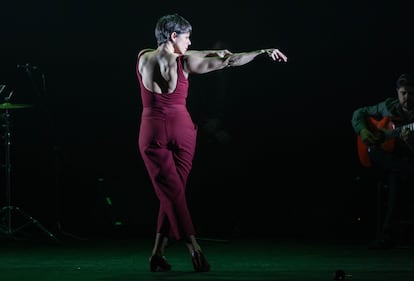
Leonor Leal, 45, a Revelation Prize winner in 2011, says she never quite fit into the world of companies after starting her professional career with Andrés Marín and the Ballet Flamenco de Andalucía. She still doesn’t feel drawn to dance ensembles, believing her vision of flamenco is individual—an expression of a personal search. “I couldn’t choreograph a piece for anyone else,” she stated firmly.
Her career, comprised of over a dozen minor productions, has been built on solo work, with one notable exception: J.R.T. Pintor y flamenco (2016), a collaboration with Úrsula and Tamara López that marked a turning point. Through that project, she connected with María Muñoz of the Malpelo dance company. “That opened my mind, because she conveyed a new perspective on the stage and taught me to speak from my own language, which is flamenco.”
She also met her husband, percussionist Antonio Moreno, during that production, and he has since collaborated on most of her work. The work premiered in Jerez, Martinicos le di a mi cuerpo (C.S. Blas Infante, March 6), was developed in collaboration with singer David Lagos, brought together for the project almost by chance. Lagos describes Leal as an open dancer who “knows tradition well, but fits the dance well when we talk about a concept.”
In this case, that concept revolves around Lorca’s theory of *duende*, each artist offering their own interpretation through their respective languages. Lagos delivers a vibrant cante centered on death, with poems by Hernández, Bergamín, and Lorca. Leal seeks the bodily expression of that *duende* with a minimalist approach. Together, with the support of Proyecto Lorca (J. Jiménez, winds and A. Moreno, percussion) and the guitar of Manuel Valencia, they pursue emotion, the stirring air of *duende*. And they succeed.
