
A recent survey indicates that whereas a majority of the French population remains supportive of vaccination, hesitancy is growing, particularly regarding specific vaccines. Understanding these attitudes is crucial for public health officials as they plan and implement vaccination campaigns.
According to a report released in December 2025 by Santé Publique France, 80.1% of respondents stated they were either “very” or “rather” favorable toward vaccination in general. This figure represents a slight decrease from 83% in 2021, but remains consistent with the 80% recorded in 2020. These numbers follow a period of fluctuating vaccine confidence following a period of confusion and disorganization surrounding the H1N1 vaccine rollout in 2009.
Vaccination Acceptance Varies by Vaccine Type
The survey, which included nearly 35,000 participants aged 18 to 79, likewise revealed that acceptance levels differ depending on the specific vaccine. Hesitancy towards certain vaccinations has increased, with 37% of French respondents expressing reservations as of 2024, a 4-point rise since 2021.
The vaccines facing the most skepticism are those for COVID-19 (25%), influenza (7%), and hepatitis B (2%). These attitudes are influenced by social class and age, with women reporting higher levels of selective hesitancy.
Acceptance of vaccination is consistent between genders. When considering age, support forms a U-shaped curve, with higher acceptance rates at both ends of the age spectrum, though the difference between groups is only 4 percentage points. Although, socioeconomic disparities are more pronounced: individuals with education levels below a high school diploma show a 15-percentage-point difference in acceptance compared to those with higher education (73.8% versus 87.2%). A 16-point gap also exists between respondents from higher social categories and those in working-class or agricultural professions (89.9% versus 73.7%).
Regional variations also play a role, with the highest acceptance rates in the Île-de-France region and the lowest in Corsica, Provence-Alpes-Côte d’Azur, and particularly in the overseas departments of Martinique and Guadeloupe. Guyane is an exception, with vaccination rates closer to the national average.
Sociological Factors and Vaccine Attitudes
Researchers are exploring the underlying factors driving these trends. Studies by Jeremy Ward and Patrick Peretti-Watel, utilizing data from the ICOVAC program, highlight the role of political affiliation in shaping attitudes toward vaccination. The ICOVAC program aims to track vaccine-related issues, particularly surrounding COVID-19, and assess the impact of the pandemic on broader vaccination attitudes.
A 2024 study published in J Health Polit Policy Law found that vaccine hesitancy and acceptance are often linked to partisan affiliations. The study examined the degree of trust in institutions involved in vaccine strategies and policies, as well as individuals’ political engagement and confidence in political institutions.
Respondents were categorized based on their level of hesitancy – non-hesitant, hesitant but not generally distrustful of vaccines, or distrustful of vaccines in general. Political affiliations were grouped into seven categories: far-left, environmentalist, left, center, right, far-right, and a large group (27% of respondents) with no political affiliation.
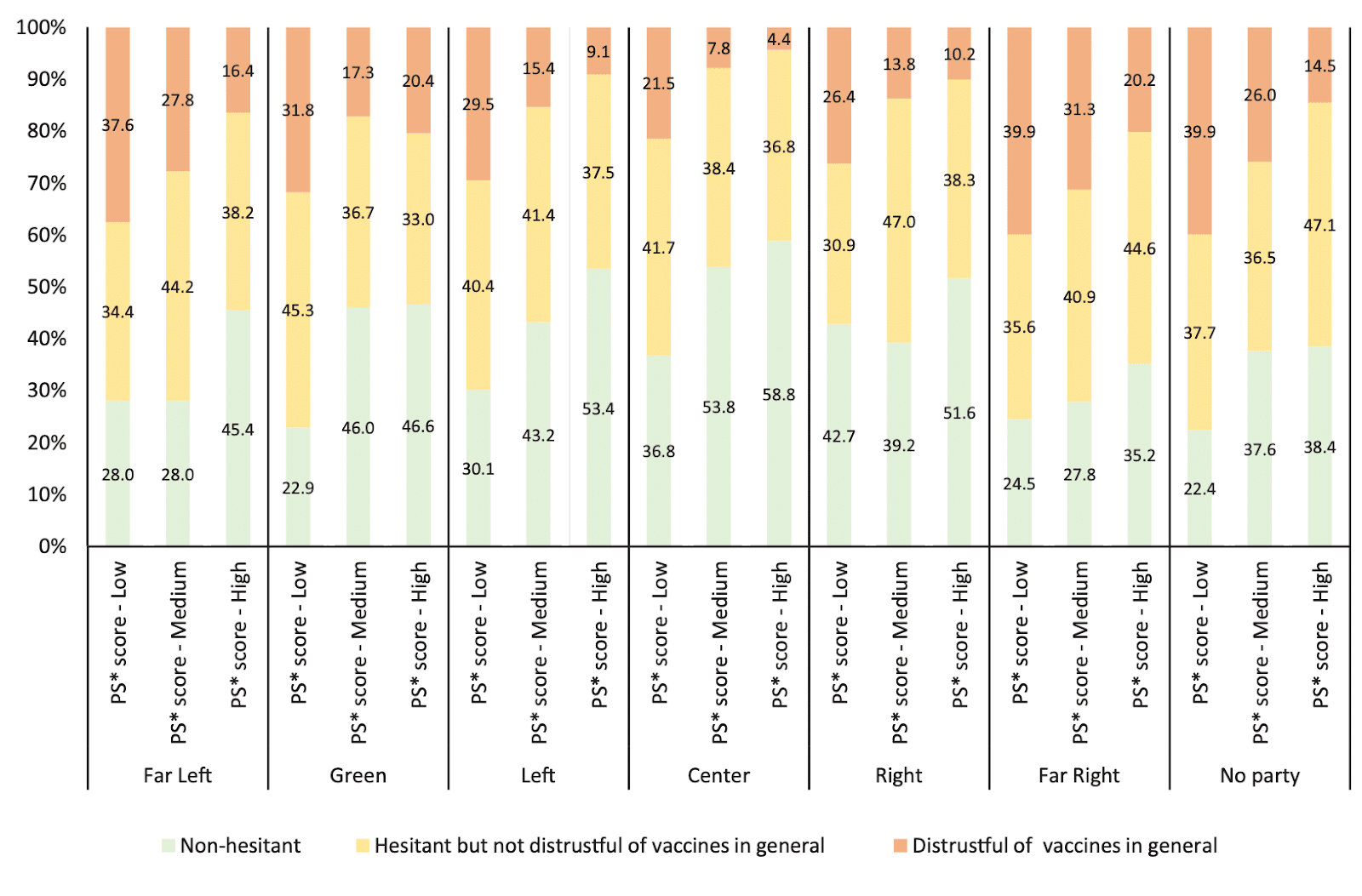
The study found that individuals at the “center” of the political spectrum exhibited the highest vaccination acceptance, with 54.5% being non-hesitant and less than 8% expressing distrust. Those with no political affiliation were found to be more distrustful of vaccination, aligning with the far-right group, with only 29% being non-hesitant and 33% expressing general distrust.
Further research, published in Vaccine in September 2025, investigated the role of trust in political institutions. This study assessed attitudes toward vaccination in general, as well as vaccines for measles, hepatitis B, HPV, influenza, and COVID-19, alongside levels of trust in 13 institutions, including the justice system, media, government, and scientific community.
The analysis revealed that trust in science is a key determinant of vaccination acceptance. Among those with complete trust in science, 92.1% were favorable toward vaccination in general, compared to 54.6% among those with no trust. This difference was also observed for other vaccines, particularly those subject to misinformation, such as HPV and measles.
The researchers found that trust in pharmaceutical companies and government health agencies also played a significant role. Interestingly, the media had a limited impact on vaccination attitudes, with low rankings in the analyses. These findings suggest that building trust in scientific institutions and addressing misinformation are crucial for promoting vaccine confidence. The study underscores the importance of experts clearly communicating the scientific basis for vaccination decisions and depoliticizing the debate surrounding science, a task that researchers acknowledge is not simple.
References
Ward JK, Cortaredona S, Touzet H, Gauna F, Peretti-Watel P. Explaining Political Differences in Attitudes to Vaccines in France: Partisan Cues, Disenchantment with Politics, and Political Sophistication. J Health Polit Policy Law. 2024 Dec 1;49(6):961-988. Doi: 10.1215/03616878-11373758.)
Ward JK, Youssef R, Peretti-Watel P. Vaccine. 2025 Sep 17;63:127668. Doi: 10.1016/jDifferent vaccines, different trust issues? Disentangling the effect of trust in various institutions using dominance analysis. Vaccine.2025.127668. Epub 2025 Aug 27. PMID: 40876136) )
