

What began far from observatories and telescopes, in fact in a casual conversation between Mexican scientists while one of them waited for a medical appointment, ended with a troubling question about the chemical composition of the oldest galaxies observed.
Recent observations from the James Webb Space Telescope showed very young galaxies, formed shortly after the Big Bang, but with surprisingly high amounts of nitrogen for their cosmic age. This discovery has implications for our understanding of early star formation and galactic evolution.
According to classical models of stellar evolution, nitrogen is produced slowly, over several generations of stars. Detecting it in large quantities in young galaxies was considered impossible!
Those galaxies hadn’t had enough time to recycle stellar material repeatedly, yet the data suggested otherwise, posing a profound dilemma about how essential elements are made in the early chapters of the cosmos.
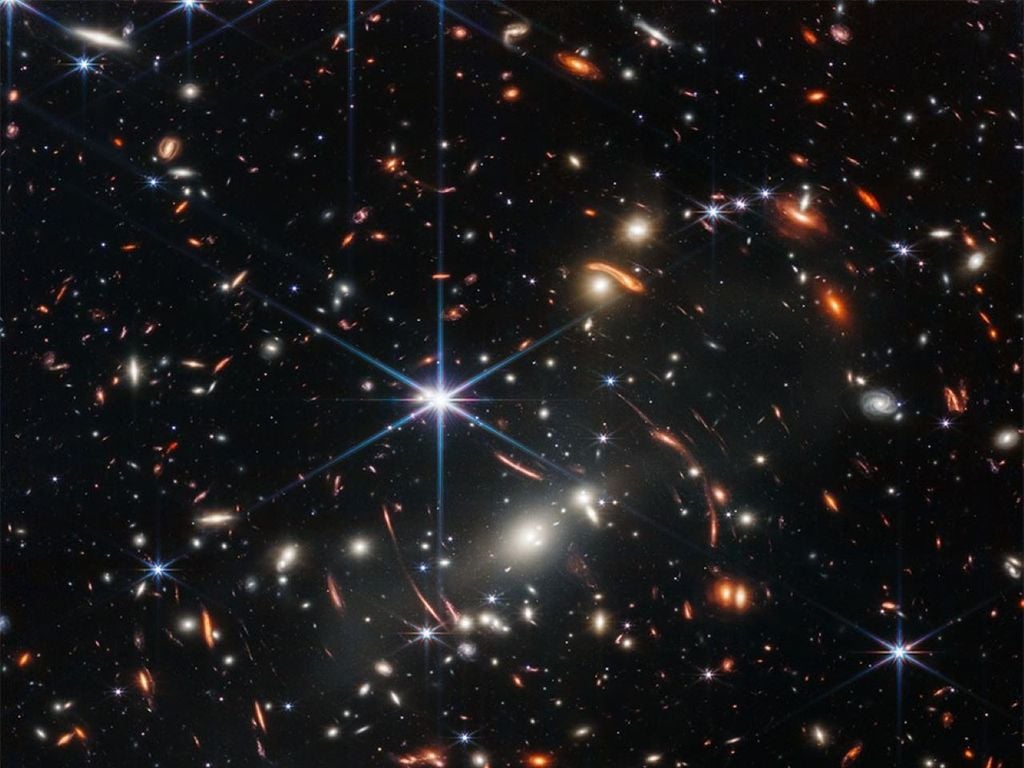
The question wasn’t just how much nitrogen there was, but whether the information was being interpreted correctly. Perhaps the universe wasn’t breaking the rules, but revealing the limitations of our tools for reading its history, as often happens.
Oxygen as a Thermometer for the Universe
To move forward, the team decided to look at the problem from another angle and instead of focusing directly on nitrogen, analyzed oxygen, which helps to more accurately measure the actual temperature of ionized gas in young galaxies.
These measurements are used as a cosmic thermometer where the relative intensity of the oxygen light spectrum changes depending on the energy of the environment, offering a direct window into the physical conditions where the earliest stars are born and die.
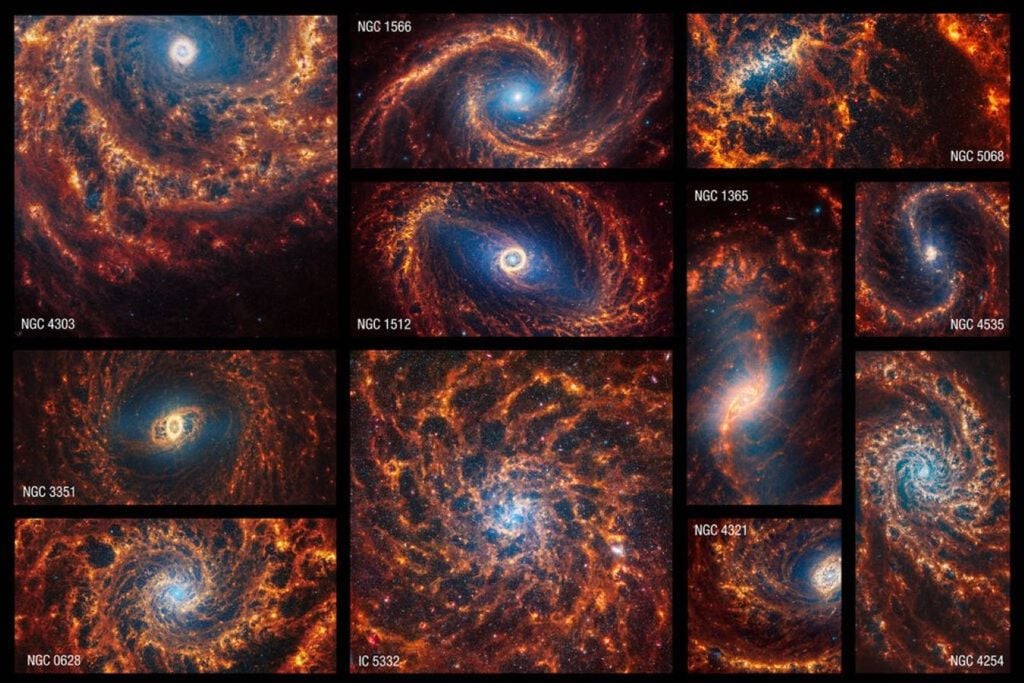
Until now, many studies assumed densities similar to those of nearby galaxies. But the early universe was much more compact, with regions where gas was compressed to extreme levels and collisions between particles were constant.
By combining observations in ultraviolet and optical light, researchers developed a more robust method and were able to calculate temperature and density simultaneously, avoiding past assumptions that distorted the chemical reading of cosmic history.
Extreme Density and Chemical Distortion
The results revealed gas densities hundreds of thousands of times greater than those typical in the local universe. In such a compressed environment, light doesn’t escape in the same way and chemical signals are deeply altered.
When the density is so high, some spectral lines fade and others are artificially reinforced. If this effect isn’t corrected, calculations inflate the amount of certain elements, such as nitrogen, even if they aren’t actually present, resulting in incorrect or unbelievable values.
Recalculating abundances using realistic densities, the excess nitrogen began to disappear. The galaxies no longer appeared chemically impossible, but consistent with rapid, but not miraculous, stellar evolution.
The mystery didn’t require new physical laws or exotic stars. It was enough to recognize and understand that early galactic gas was dense, chaotic, and extreme, and that those conditions had misled previous interpretations.
A New Narrative of Chemical Evolution
This finding requires revising many recent results on primordial galaxies. If density can alter chemical measurements so much, other supposed elemental excesses could also be artifacts of incomplete analysis.
We now know that nitrogen didn’t appear spontaneously at the dawn of the universe, but was produced by real stars, following known processes, but observed under physical conditions that amplified its apparent signal.
Understanding early chemistry isn’t just a technical detail. Oxygen, carbon, and nitrogen are the building blocks of life, and their initial distribution defines the path that led, billions of years later, to planets and stunning organisms like the one reading these words.
The James Webb Space Telescope doesn’t just allow us to witness further, but to think better. By correcting our reading of the past, the early universe ceases to appear strange and reveals itself as an extreme, but deeply coherent place.
News Reference:
K Z Arellano-Córdova, J E Méndez-Delgado, S R Flury, C Esteban, K Kreckel, J García-Rojas, F Cullen, L Carigi, C Morisset, F F Rosales-Ortega, A Peimbert, T M Stanton, D Scholte, A Self-Consistent Direct Method for Chemical Abundances in High-z Galaxies with JWST, Monthly Notices of the Royal Astronomical Society, 2026;, stag380, https://doi.org/10.1093/mnras/stag380
