

The European Space Agency’s Proba-3 mission has returned its first scientific data, confirming that the slow solar wind—streams of charged particles from the Sun—travels three to four times faster than previously modeled. Using a pair of satellites to create an artificial solar eclipse in space, the mission observed the Sun’s outer atmosphere (corona) with unprecedented clarity, challenging long-held assumptions about solar wind dynamics.
The Revolutionary Technique of Artificial Solar Eclipses in Space
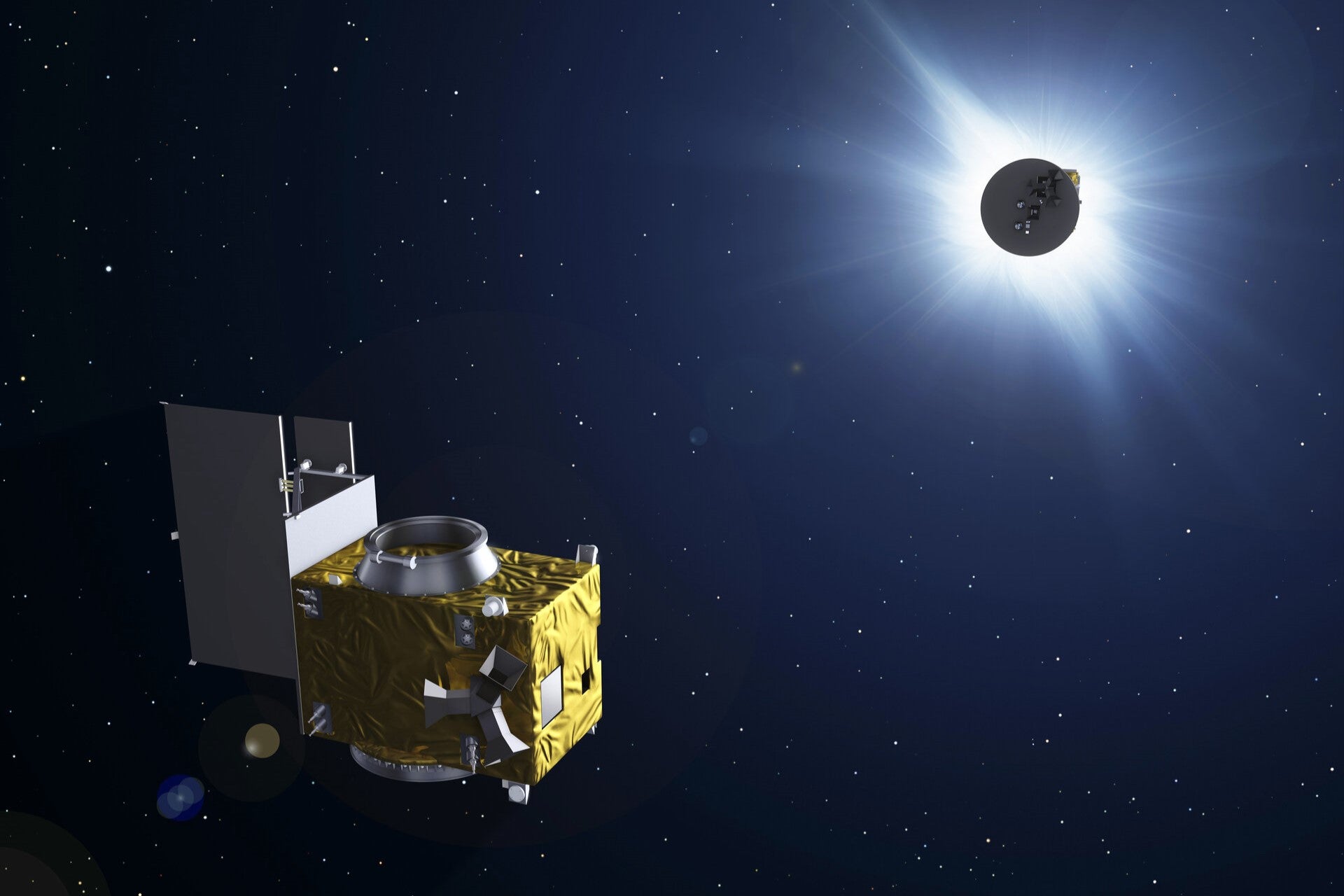
For decades, scientists relied on terrestrial solar eclipses to study the corona, the Sun’s faint outer atmosphere. But these events are rare and brief. Proba-3, launched in 2024, overcame this limitation by deploying two satellites in precise formation—one casting a shadow over the other—to simulate an eclipse continuously. This allowed instruments to measure the corona’s properties without Earth’s atmospheric interference.
The mission’s early findings, published in May 2026, reveal that the slow solar wind—once thought to move at a modest pace—accelerates far more rapidly than theoretical models suggested. According to ESA officials, the observed speeds exceed earlier estimates by a factor of 3 to 4, a discovery that could reshape understanding of space weather and its impact on satellites, power grids, and astronaut safety.
“The data from Proba-3 is revolutionary. It shows that the corona’s magnetic fields and plasma interactions are far more dynamic than we anticipated.”
Dr.
How Faster Solar Wind Speeds Could Transform Space Weather Predictions
The Sun’s solar wind drives space weather, a phenomenon that can disrupt GPS, radio communications, and even trigger geomagnetic storms capable of blacking out power grids. Current forecasting models assume slower wind speeds, meaning predictions may underestimate the severity of solar storms.

Proba-3’s observations suggest that coronal heating and acceleration mechanisms—the processes that propel solar wind particles—are more efficient than believed. If confirmed, this could lead to more accurate space weather alerts, giving operators of satellites and power infrastructure critical extra time to prepare.
The Engineering Marvel Behind Proba-3’s Formation-Flying Satellites
Proba-3’s success hinges on its formation-flying technology, a first for ESA. The two satellites—Coronagraph (the occulter) and Solar Orbiter (the observer)—maintain a separation of just 144 meters, creating a near-perfect artificial eclipse. This precision allows instruments to study the corona’s polarized light, a key indicator of magnetic field structures.

The mission also carries high-resolution spectrometers to analyze the composition of solar wind particles, providing insights into how the Sun’s outer layers evolve over time.
Unanswered Questions and the Future of Solar Wind Research
ESA has extended Proba-3’s mission through 2028, with plans to expand its formation-flying capabilities. Future updates may refine solar wind speed models further, potentially integrating data with NASA’s Parker Solar Probe and Solar Orbiter missions.
However, challenges remain. The mission’s ultra-precise satellite alignment requires constant adjustments to compensate for gravitational perturbations and solar radiation pressure. Engineers are testing autonomous navigation systems to reduce reliance on ground control.
Proba-3’s findings align with broader trends in heliophysics, where in-situ measurements (data collected in space) are increasingly challenging ground-based theories. Earlier this year, NASA’s Parker Solar Probe detected unexpected turbulence in the solar wind, further complicating models.
The discrepancy between observed and predicted solar wind speeds raises questions about the corona’s energy budget—where does the extra speed come from?
- Magnetic reconnection events near the Sun’s surface.
- Hidden plasma waves accelerating particles beyond current models.
- Interactions with the solar magnetic field that were previously overlooked.
Space weather is not just an academic concern. In 2023, a moderate geomagnetic storm caused a six-hour blackout in Quebec, while a 2024 solar flare disrupted Starlink satellite communications for days.
- Shorter warning times for severe storms, reducing economic damage.
- New shielding requirements for deep-space missions, including NASA’s Artemis program.
- Revised satellite orbit calculations to avoid radiation exposure during high-speed wind events.
While Proba-3’s data is compelling, scientists caution that more observations are needed. The mission’s current dataset covers only a few solar cycles, and the Sun’s activity varies over 11-year cycles. Future missions, including ESA’s Vigil (scheduled for 2029), may provide additional clarity.
One lingering question: Is the fast solar wind a localized phenomenon, or does it occur across the Sun’s surface? Answering this could require a constellation of satellites, a prospect under discussion at the 2026 International Space Science Institute conference.
Proba-3 has delivered its most significant discovery yet: the solar wind moves faster than we thought. This challenges decades of solar physics, with potential ripple effects across space weather forecasting, satellite design, and even our understanding of the Sun’s behavior.
As ESA’s Director of Science, Dr.
“This is not just a correction to our models—it’s a call to re-examine fundamental assumptions about how the Sun works.”
With Proba-3’s mission extending into 2028, the next two years will be critical in determining whether this finding marks a one-off anomaly or a paradigm shift in solar science. One thing is clear: the Sun’s secrets are far from fully unlocked.
