
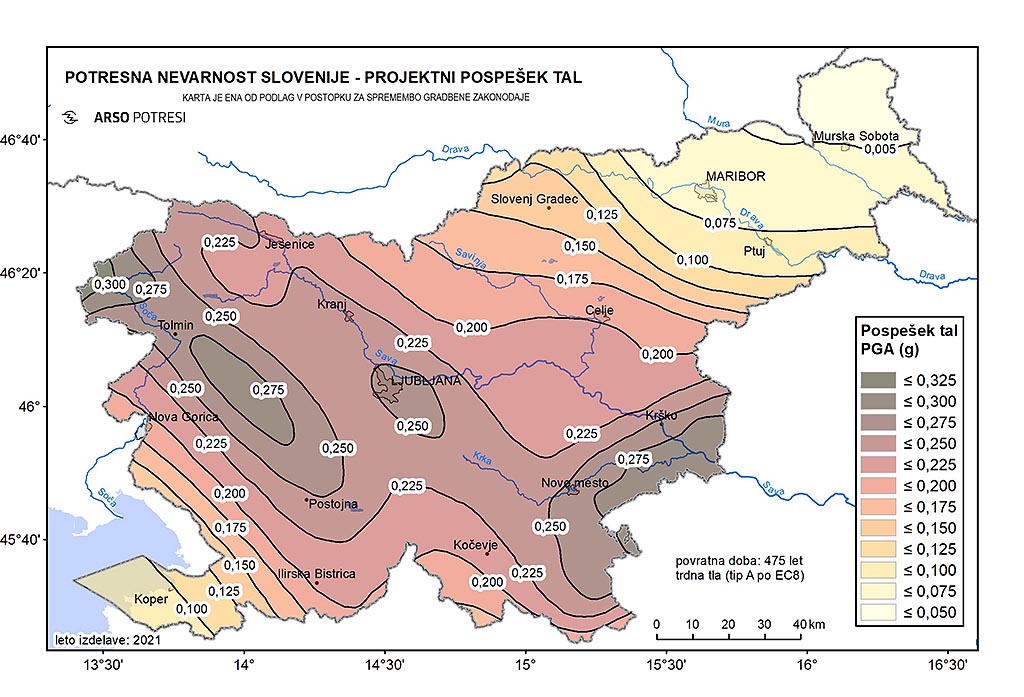
A seismic safety study published April 18 in the *Seismological Society of America* journal has reignited debate over Slovenia’s Krško Nuclear Power Plant (NPP), with geologists accusing state-owned energy firm Gen Energija of manipulating earthquake-risk maps to downplay hazards near the plant and its proposed second reactor, Krško 2.
Scientists Challenge Gen Energija’s Seismic Risk Map
Two geologists, Livio Sirovich and Kurt Decker, published a paper in late April that directly challenges a map produced by Gen Energija, Slovenia’s state energy company. The authors argue the map contains “location errors” that artificially shift the plant’s perceived seismic risk away from known fault lines. Their analysis, the most-read paper in the journal’s recent history, disputes Gen Energija’s claim that the plant’s design accounts for a maximum earthquake magnitude of 4.9—a figure the geologists say is dangerously low given historical seismic activity.
The controversy centers on the 1917 earthquake near Krško, with magnitude estimates ranging from 5.7 to 6.2 in historical records. The paper notes that Krško 2’s design documentation relies on the 4.9 benchmark, a threshold the authors call “incompatible with site suitability” under International Atomic Energy Agency (IAEA) criteria. They also question Slovenia’s gradual increase in seismic resistance parameters for the plant, which rose from 0.3 g to 0.6 g—a change they describe as insufficient given the region’s geological history.
Gen Energija has not yet publicly responded to the allegations, but the paper’s prominence in a leading journal has forced regulators and policymakers to confront the gap between the company’s assessments and independent scientific analysis.
Krško’s Seismic Risks: A Decades-Old Oversight
The Krško NPP, operational since 1983, was designed in the 1970s during Yugoslavia’s era, when seismic mapping of the region was incomplete. The plant’s original seismic safety parameters were based on limited data, a shortcoming that has become increasingly problematic as Slovenia’s energy strategy pivots toward nuclear expansion. The proposed Krško 2 reactor, planned adjacent to the existing facility, faces heightened scrutiny amid growing concerns about seismic vulnerability.
Sirovich and Decker’s paper highlights a broader European trend: nearly 150 nuclear plants across the continent are situated in areas with elevated earthquake risks. Krško, they argue, stands out due to its proximity to active faults and the discrepancy between historical seismic events and modern safety standards. The authors point to the IAEA’s guidelines, which require plants to withstand earthquakes up to a magnitude 0.2 g higher than the maximum recorded in the region—a threshold Krško currently falls short of.
Slovenia’s nuclear regulator, the *Agency for Radiation and Nuclear Safety*, has not issued a public statement on the paper, but internal reviews suggest the debate will intensify as the country prepares to finalize Krško 2’s environmental impact assessment later this year.
Gen Energija’s Map: Did Location Errors Undermine Safety?
The heart of the dispute lies in Gen Energija’s seismic risk map, which the geologists accuse of misrepresenting fault lines near Krško. According to the paper, the map’s errors “artificially reduce the perception of risk” by positioning the plant in a less hazardous zone than its actual location. The authors contend that a nearby fault, previously assessed as low-risk, could pose a greater threat than currently modeled.
While Gen Energija has not disclosed the methodology behind the map, industry sources suggest the company relied on outdated geological surveys conducted in the 1990s. The paper’s authors argue that modern satellite and ground-penetrating radar data contradict these older assessments, revealing fault lines closer to the plant than previously believed.
If the map’s inaccuracies are confirmed, they could have legal and regulatory implications. Under EU nuclear safety directives, member states must ensure plants comply with the latest seismic hazard assessments. Slovenia’s failure to update its maps in line with contemporary science could trigger an investigation by the European Commission or the IAEA.
What’s Next for Krško 2 and Slovenia’s Nuclear Future
The geologists’ paper has already prompted calls for an independent review of Krško’s seismic safety protocols. Slovenian environmental groups, including *Eko Centar*, have demanded transparency from Gen Energija and the government, arguing that the proposed Krško 2 reactor cannot proceed without a full reassessment of earthquake risks.

Regulatory hurdles remain significant. Even if the map’s errors are acknowledged, retrofitting Krško 2 to meet higher seismic standards would require billions in additional costs and could delay construction by years. Meanwhile, Slovenia’s energy ministry faces pressure to balance nuclear expansion with public safety concerns, particularly in a region where seismic activity has historically been underestimated.
For now, the debate hinges on whether Gen Energija’s map will be discredited or revised. If the company’s seismic modeling is found to be flawed, it could set a precedent for other aging nuclear plants in Europe, where similar discrepancies between old data and modern science have gone unaddressed for decades.
One certainty is that Krško’s seismic risks will remain under the microscope. With the paper’s findings gaining traction, Slovenia’s nuclear future now depends on whether regulators prioritize scientific rigor over political and economic incentives.
